Unveiled by PI – Open Source Center Autonomous Kurds in Post-Asad Syria Unlikely

UNCLASSIFIED//FOR OFFICIAL USE ONLY

This product may contain copyrighted material; authorized use is for national security purposes of the United States Government only. Any reproduction, dissemination, or use is subject to the OSC usage policy and the original copyright.

OSC Analysis: Syria — Autonomous, Federal Status for Kurds Unlikely

GMF20120820256001 SyriaOSC Analysis in English 20 Aug 12

Syria — Autonomous, Federal Status for Kurds in Post-Al-Asad Syria Unlikely

An autonomous or federal Kurdistan within Syria — similar to that which exists in Iraq — is unlikely because of intra-Kurdish conflict and the opposition of Turkey and the Syrian National Council (SNC) — the main external Syrian opposition group.

Disunity between the two main Kurdish forces in Syria, the Democratic Union Party (PYD) and the Kurdish Syrian National Council (ENKS), suggests that the main Kurdish parties themselves cannot agree on how Syrian Kurdistan should be governed.

  • In possible anticipation of events in Syrian Kurdistan, Iraqi Kurdistan Region President Mas’ud Barzani brokered a conciliation agreement on 11 July between the People’s Council of Western Kurdistan — an offshoot of the PYD believed to be affiliated with the outlawed Kurdistan People’s Congress (KGK), which was formerly known as the PKK — and the ENKS. As part of this Arbil agreement, Kurdish groups formed a higher Kurdish commission to administer Syria’s Kurdish areas after the Syrian Army withdrew, according to the Iraqi independent daily Al-Zaman (27 July).[ 1]
  • However, some media reports — possibly influenced by the ENKS — have suggested that the PYD took sole control of Syrian Kurdistan in late July, exploiting its reputed ties to the Syrian regime. ENKS figure Abd-al-Karim Bashar, for example, told independent Kurdish weekly Rudaw, that the Syrian Army had abandoned its posts to the PYD because it was the Syrian regime’s “partner” (10 August).[ 2] Defecting Syrian Army officer Fayiz Amr told Londonbased, Saudi-financed, pan-Arab daily Al-Sharq al-Awsat that Damascus had armed the PYD and intimidated other parties (28 July).[ 3]

Kurdish Entities in Syria Make Disunity Likely

The Syrian Kurdish political landscape consists of several parties — some of which have historically been heavily influenced by Damascus or Iraqi Kurdistan President Barzani.

  • The ENKS, formed in October 2011 under the auspices of Kurdistan Region President Mas’ud Barzani as an umbrella grouping of 16 parties, maintains strong ties with Barzani and has opposed the Al-Asad regime (18  August).[ 4]
  • The PYD, led by Salih Muslim, is a very influential and popular Kurdish party and believed to be the Syrian version of the KGK (Al-Sharq al-Awsat, 9 July).[ 5]

Turkey Views Kurds’ Self-Administration in Syria as Threat to National Security

Turkey’s recent military and political mobilization suggests concern that Syria Kurd’s self-administration might aggravate its conflict with the KGK/PKK.

  • Turkish statements indicate alarm over the PYD. Prime Minister Recep Tayyip Erdogan has not ruled out military incursions in pursuit of KGK/PKK forces (Today’s Zaman, 6 August).[ 6] He claimed that Turkey enjoys a right to intervene in Syria if “terrorist formations” pose a threat, according to Istanbul daily Hurriyet (26 July).[ 7]
  • Several media reports suggest that Turkey tried to persuade Barzani to discourage self-administration in Syrian Kurdistan.[a] During Turkish Foreign Minister Ahmet Davutoglu’s 31 July visit to Arbil — in which he met with KRG officials, the ENKS, the SNC, but not the PYD[ 8] — Davutoglu may have lent support to KRG claims to Kirkuk[b] in return for Barzani’s cooperation in containing Syria’s Kurds, according to independent Al-Sharqiyah Satellite TV (Hurriyet Daily, 7 August;7 August).[ 9]

Federal Status for Syrian Kurds in Post-Al-Asad Syria Unlikely

Turkey’s ostensible acceptance of Kurdish rights in Syria is possibly conditioned on the SNC’s stated opposition to Kurdish autonomy or self-administration.

  • A Turkish plan discussed with Barzani rejected any ethnic-based structure in Syria before Al-Asad’s fall but accepted the possibility of an autonomous Kurdish region in post-Al-Asad Syria, pending approval by Syria’s people within the framework of a new constitution, according to the independent Iraqi website Shafaq News (31 July).[ 10]
  • SNC President Abd-al-Basit Sida, however, categorically rejected a federal Syria, stressing that the PYD must respect Syria’s territorial integrity, according to the privately owned Kurdish newspaper Hawlati (5 August).[ 11]

[a] For more information, see the 7 August OSC Report, Turkey — Ankara Upholds Syrian Kurds’ Rights in Pluralistic New Syria (EUP20120807346001EUP20120807346001).
[b] Davutoglu visited Kirkuk following his meeting in Arbil without informing the central government in Baghdad. Al-Sharqiyah reported Baghdad’s fury over the unannounced visit.

[ 1] [Open Source (Not OSC) | Al-Zaman | | 27 July 2012 | 27 July 2012 | Syria’s Kurds Seek Unity to Secure Status in Post-Al-Asad Syria | | (U) | (U) | Baghdad Al-Zaman in Arabic — Baghdad-based independent Iraqi daily providing coverage of Iraqi, Arab, and international issues, headed by Iraqi journalist Sa’d al-Bazzaz; Internet version available at: http://www.azzaman.com%5D
[ 2] [Open Source (Not OSC) | Weekly Rudaw | | 30 July 2012 | 30 July 2012 | Interview with Abd-al-Karim Bashar, leader of the Kurdish Democratic Party | | (U) | (U) | Arbil Rudaw.net in Kurdish – Kurmanji — Website of Rudaw, weekly newspaper supportive of the Kurdish cause; URL: http://www.rudaw.net/%5D
[ 3] [Open Source (Not OSC) | Al-Sharq al-Awsat | | 28 July 2012 | 28 July 2012 | Syria’s Kurds Face New Challenges; Turkey: We Will not be Lenient With Terrorist Organizations Near our Border | | (U) | (U) | ]
[ 4] [Open Source (Not OSC) | Carnegie Endowment for International Peace | | 16 August 2012 | 16 August 2012 | The Kurdish Syrian National Council | | (U) | (U) | ]
[ 5] [Open Source (Not OSC) | Al-Sharq al-Awsat | | 9 July 2012 | 9 July 2012 | Kurdish Political Parties in Syria | | (U) | (U) | ]
[ 6] [OSC | | OSC ID: EUP20120806407005 | 6 August 2012 | | Erdogan Says Al-Asad-Backed KGK Terrorists Seeking To Infiltrate Turkey | | (U) | (U) | Istanbul Today’s Zaman Online in English — Website of English-language daily published by the Zaman media group, supportive of Fethullah Gulen community; URL: http://www.todayszaman.com%5D
[ 7] [OSC | | OSC ID: EUP20120726406008 | 26 July 2012 | | Erdogan Warns of Terrorist Formations in Syria, Says Intervention Natural Right | | (U) | (U) | Istanbul Hurriyet Daily News Online in English — Website of Hurriyet Daily News & Economic Review, pro-secular daily, with English-language versions from other Dogan Media Group dailies; URL: http://www.hurriyetdailynews.com/%5D
[ 8] [Open Source (Not OSC) | | | 7 August 2012 | 7 August 2012 | PYD Party Says Turkey Should not Interfere in Syria | | (U) | (U) | ]
[ 9] [OSC | | OSC ID: GMP20120808193001 | 7 August 2012 | | Al-Sharqiyah Roundup: Deputy PM Heads Committee To Investigate Turkish FM’s Visit | | (U) | (U) | London Al-Sharqiyah News Television in Arabic — Independent, private news channel focusing on Iraq, affiliated with Al-Sharqiyah Television, run by Sa’d al-Bazzaz, publisher of the Arabic-language daily Al-Zaman]
[ 10] [Open Source (Not OSC) | Shafaq News | | 31 July 2012 | 31 July 2012 | Turkish Sources: Davutoglu To Discuss Six Points on Syria’s Kurds in Arbil | | (U) | (U) | ]
[ 11] [Open Source (Not OSC) | Hawlati | | 5 August 2012 | 5 August 2012 | Hawlati interviews Abd-al-Basit Sida | | (U) | (U) | Al-Sulaymaniyah Hawlati in Sorani Kurdish — Privately owned newspaper published twice a week, often critical of the Kurdistan Regional Government (KRG), controlled by the Kurdistan Democratic Party (KDP) and the Patriotic Union of Kurdistan (PUK)]

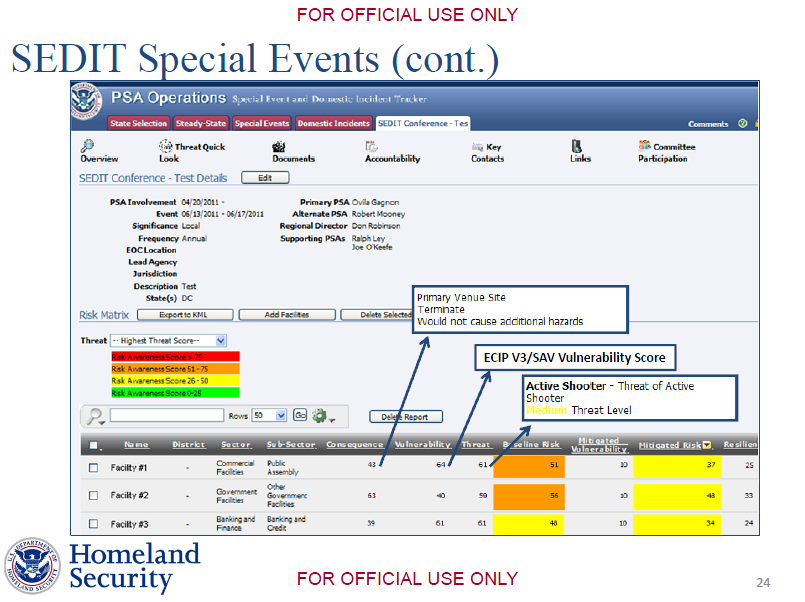
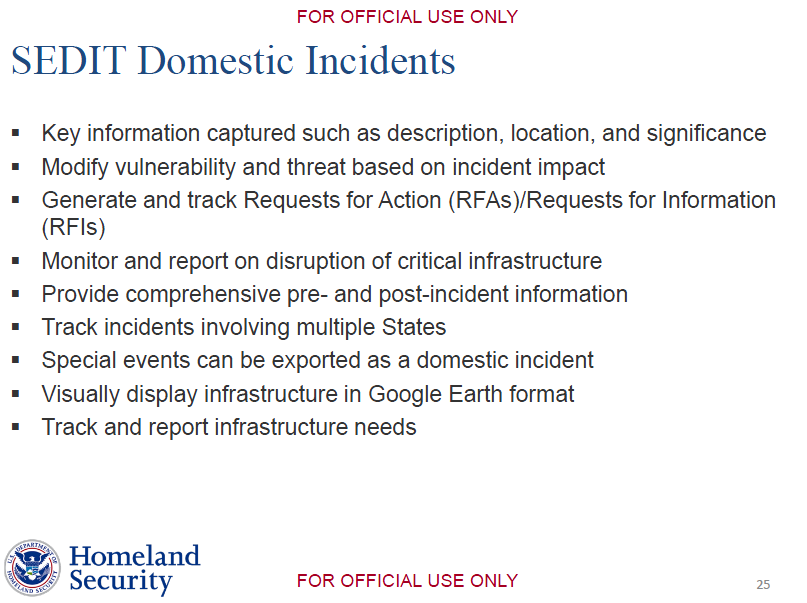
TOP-SECRET – DHS Special Event and Domestic Incident Tracker Overview Brief

The following presentation was given at the FEMA National Preparedness Symposium earlier this month in Crystal City, Viriginia.

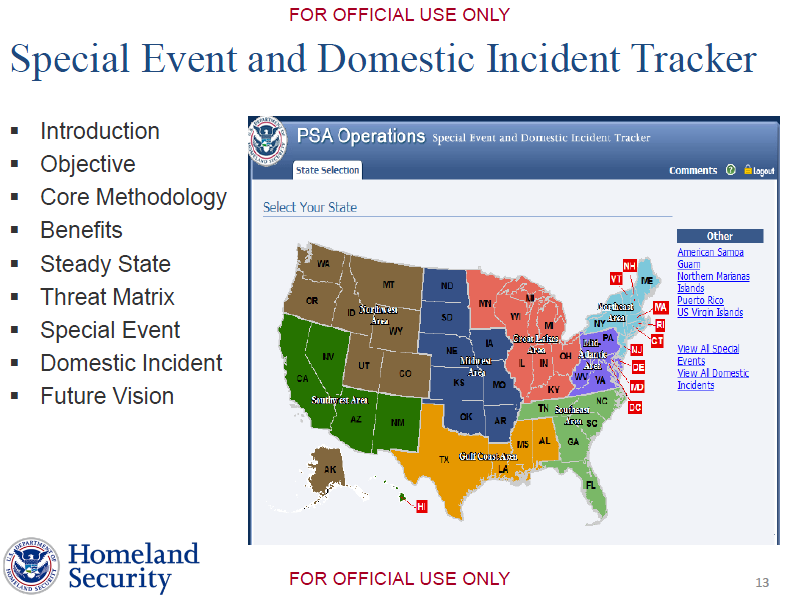
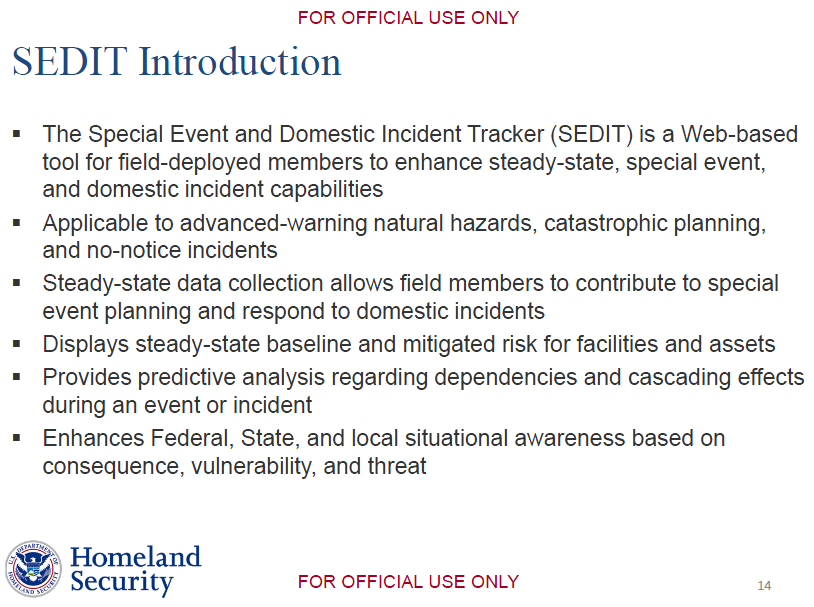
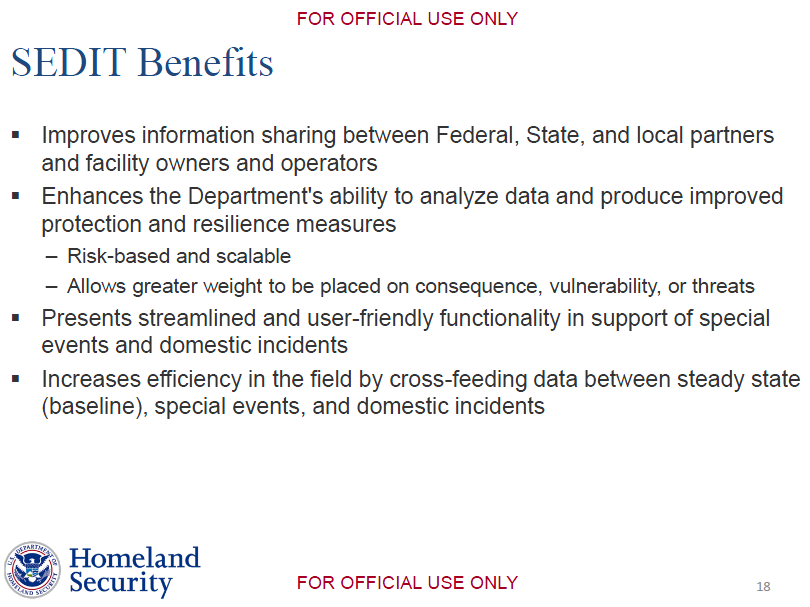
National Protection and Programs Directorate Protective Security Advisors and Special Event Domestic Incident Tracker Overview

https://publicintelligence.net/wp-content/uploads/2012/08/DHS-SEDIT-1.png


https://publicintelligence.net/wp-content/uploads/2012/08/DHS-SEDIT-2.png

https://publicintelligence.net/wp-content/uploads/2012/08/DHS-SEDIT-3.png


https://publicintelligence.net/wp-content/uploads/2012/08/DHS-SEDIT-4.png


https://publicintelligence.net/wp-content/uploads/2012/08/DHS-SEDIT-5.png


https://publicintelligence.net/wp-content/uploads/2012/08/DHS-SEDIT-6.png


DOWNLOAD THE ORIGINAL DOCUMENT HERE:

DHS-SEDIT

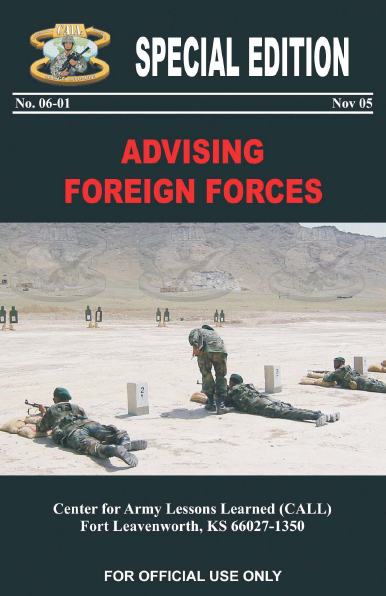
TOP-SECRET – U.S. Army Advising Foreign Forces Handbook

https://publicintelligence.net/wp-content/uploads/2012/08/CALL-AdvisingForeignForces.png


The purpose of this special edition is to provide a practical reference guide for individuals and units to use in preparation for missions as trainers and advisors to foreign military units. The publication includes tactics, techniques, and procedures successfully used by both United States Army special operations forces (SOF) and conventional forces in conducting foreign military training (FMT). The final section of the special edition is an explanation of the security assistance process and includes the organizations involved in planning and resourcing foreign training missions and their respective responsibilities.

Part I. Working with Indigenous Forces

1.1 Introduction

The following guide was prepared by Army SOF personnel as a class for incoming conventional troops assigned as trainers to foreign units. This information is based on SOF experience training foreign forces and explains the basic skill sets and factors that assist non-SOF Soldiers in becoming effective military advisors and trainers.

1.2 Bottom Line

Every Soldier in the U.S. military has experienced or conducted the type of training involved in foreign internal defense. Training and military skills used by all advisors are derived from such things as training individual fire team members or attending professional development courses at an Army school.

The initial step in assuming the role as an advisor is to dispel the mystique of training foreign soldiers. The primary obstacle is the language barrier. Language issues are easily surmountable by conducting detailed rehearsals with interpreters and conducting all training as practical, hands-on events with realistic scenarios. The U.S. Soldier assigned as an advisor may be an experienced combat veteran, but he is a trainer by profession. Confidence and professionalism are fundamentals that foreign troops understand and respect.

1.3 The Goal of Advisory Assistance

The United States provides military assistance to other nations as part of U.S. foreign policy strategy. The ultimate goal is to enhance American security. The intent of assistance programs is to develop the recipient nation’s capacity to assume responsibility for its own security. The role of the U.S. advisor is to develop a positive rapport with his counterparts and to influence the actions of the units he is working with. Personal influence is one of the primary factors determining the success of advisory operations. Even if relations with a counterpart are tenuous, some influence is inherent due to the fact of the referent power being a representative of the U.S. military.

1.4 Leveraging Influence

Influence is an intangible element built on personal relationships and other factors. An advisor can gain influence by providing the following:

• Funding and equipment
• Lethal and non-lethal effects
• Political weight (prestige to counterparts)

1.5 Expanding the Advisory Relationship

Mediocre advisors who do not understand the dynamics of establishing personal relationships are often reduced to a liaison role. Effective advisors are able to see solutions to seemingly unsolvable problems, sometimes guided only by commander’s intent. Added to the challenge of being an advisor is the requirement to work through the counterpart’s chain of command. Overly hard-charging and ambitious advisors will have a difficult time building up a new unit’s confidence while operating behind the scenes. The advisor is part diplomat, part warrior. Be aware of local power struggles and the effect on the mission.

1.6 Situational Awareness

Potential flash points between groups or organizations may exist at the lowest levels. Bureaucratic power struggles occur in the U.S. as well, but in developing
countries situations can quickly escalate out of control. Recognizing and managing these relationships is a key part of advising.

Example:

“Counterpart sources reported that two soldiers were assaulted and arrested and that the local police had threatened other soldiers. The counterpart battalion commander traveled to the provincial police station to discuss the situation. The soldiers were released and a warrant issued for the arrest of the two local police responsible for the incident. Relations between the army and police have been improving. Counterpart sources feel this incident may be due to recent counterinsurgency operations in the province. Some of the individuals detained on these operations have connections to provincial government and police personnel. Trainers will continue to monitor the situation.”

1.7 Psychological Pitfalls and Traits for Success

Negative factors hindering an advisor’s success:

• Culture shock (overwhelming rejection of the new environment)
• “Going native” and losing site of U.S. objectives (overwhelming acceptance of the new environment)
• Usurping a counterpart’s authority with his subordinates (taking charge at inappropriate times)
• Frustration with the ambiguity caused by a lack of clear guidance (no command direction)
• Frustration with a counterpart’s unwillingness to conform to U.S. doctrine, standards, tactics, techniques, and procedures (TTP) (impatience, short time horizon)
• Rolling over to please a counterpart; sacrificing credibility to build rapport (not taking charge at all)
• Being an “ugly American” (see culture shock and the comments below)

Show respect for counterparts. There are U.S. military personnel who find it difficult to interact with foreign troops or officials. Some advisors only talk to their interpreter (and not to the foreign participants) during meetings. Other advisors make insulting or degrading comments about the locals in the meeting, thinking none of them understand English. Reassign anyone that cannot overcome their reluctance to act respectfully with foreign counterparts.

Qualities of an effective advisor:

• Mature
• Professional
• Patient, yet relentless enforcers of standards
• Knowledgeable
• Confident
• Culturally aware, but not coddling
• Situationally aware

DOWNLOAD THE ORIGINAL DOCUMENT HERE:

CALL-AdvisingForeignForces


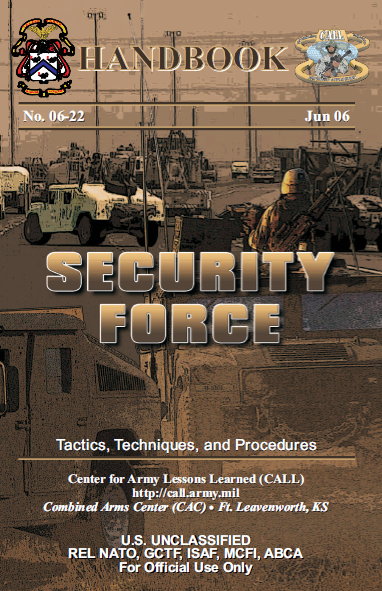
TOP- SECRET – U.S. Army Security Force Handbook

https://publicintelligence.net/wp-content/uploads/2012/08/CALL-SecurityForce.png


1. The Basic Security Force Unit

Throughout the Iraqi theater, units tailor security forces in order to meet the requirements of the mission. The equipment used is also modified depending on the operating environment. However, most security forces share common building blocks used in this handbook.

Tactics, techniques, and procedures (TTP) in this handbook are based on the model of a common base security force unit. The basic security force platform is generally the M1114, the XM1117 (armored security vehicle), the RG31 (multipurpose vehicle), or an equivalent gun truck. Designated security force companies are currently equipped with the M1114s as their main gun truck. Each platform has a minimum of three Soldiers: a truck commander, gunner, and driver.

One squad (section for artillery security force units) consisting of four platforms is the standard package for most missions. The squad conducts autonomous security force missions and is left alone at combat outposts for long stretches. Squads are the most common organization receiving the security force missions discussed in this handbook.

Modification tables of organization and equipment (MTOE) designated security force units can be task-organized to any battalion. Generally security force units are not task-organized below company/battery level; however, it is common to see platoons designated a specific mission for extended periods of time, i.e., as a police transition team (PTT), convoy security, or personal security detachment (PSD). Many company-size units (usually field artillery) are transforming into MTOE security force companies. MTOE security force companies consist of three platoons plus an additional platform for the commander. Each platoon consists of three squads, plus an additional platform for the platoon leader. This composition gives the company a total of 40 platforms plus additional vehicles for support personnel. Most battalions also have an internal security force unit primarily for PSD and occasionally for convoy security. The composition of these internal security forces depends on platform availability, type of mission, and scope of the operation. This handbook also provides these types of security forces valid TTP, as well as common before, during, and after considerations for their operations.

2. Types of Security Force Missions

a. Convoy security. Both military and civilian convoys are subject to attack from insurgents, necessitating constant security. While most military convoys will have an internal security force, civilian convoys do not have that capability. For this reason security forces are often tasked to escort convoys consisting of two or more vehicles. The size of the convoy determines the number of required security force squads. The general rule of thumb is one platform (M1114) for every five vehicles in the civilian convoy. Platoon leaders may choose to add platforms to squads or lead a mission with multiple squads. (Note: Types of convoys often escorted are listed in Annex A).

b. PSD. PSD is conducted regularly by almost every unit in Operation Iraqi Freedom. PSD may include the security of a unit commander or sergeant major, a dignitary or local leader, or even a detainee. Security forces are charged with escorting VIPs from point A to point B. Given the operating environment in Iraq, a well-trained PSD is essential for the safety of VIPs and the Soldiers conducting the missions.

c. Site security. Security forces may be required to conduct site security as part of their convoy operations. Depending on the type of mission, site security may require Soldiers to conduct dismounted security. Examples of site security where Soldiers dismount include restricting access to an area due to an improvised explosive device or providing security around a building in a populated area. Examples of site security where Soldiers do not dismount include waiting for recovery assets while the squad provides security for a downed vehicle or road security when a squad is required to secure access into an alternate supply route.

d. Other missions. While other missions are beyond the scope of this handbook, it is important to note security forces conduct numerous other types of missions. The most current (FY 2006) critical mission is training the Iraqi Police (IP). This mission requires security forces and MP units to link and develop habitual relationships with the IP. Some units man the IP basic training academies, while others monitor IP station progress and provide additional training. This mission also requires Soldiers to fully understand how Iraqis conduct business. Soldiers must be prepared to conduct a variety of classes with the assistance of an interpreter. Knowledge of basic police station administrative requirements will assist in this mission.

Another common mission is detainee operations. Most forward operations bases (FOBs) have some sort of detainee facility. The responsibility for maintaining security inside and outside the facility often falls to security forces. This responsibility includes the daily health and welfare of the inmates and their administrative and logistical requirements, as well as the movement of detainees within the FOB or to other sites. Occasionally security forces will transport detainees by air to distant FOBs.

When contact is made with the enemy, security forces must be prepared to engage and destroy the enemy. Security forces should develop basic contact battle drills aimed at maneuvering, fixing, and eliminating the enemy.


DOWNLOAD THE ORIGINAL DOCUMENT HERE:

CALL-SecurityForce

TOP-SECRET – Developing Self-Sustaining Security Force Capabilities

https://publicintelligence.net/wp-content/uploads/2012/08/CALL-Partnership.png


The Multi-National Corps–Iraq logistics staff and the Iraqi Security Forces (ISF) support operations cell, an element of the Iraqi Assistance Group, merged at the operational level to publish plans, policies, and procedures that met the strategic aims of the coalition forces, the national goals of the government of Iraq, and the joint campaign plan published by Multi-National Force–Iraq. Corps sustainment planners published operational objectives for execution at the operational and tactical levels in an effort to develop a sustainment-based system for the ISF. Based on experiences and observations over the past 18 months, the partners, advisors, and planners gathered the best practices for advising and assisting security forces at all levels of the sustainment system. This handbook presents partnering considerations in developing a fundamental base for a self-sustaining, host nation security force.

Although based largely on the experiences of units deployed in support of Operation Iraqi Freedom from 2007–2009, the sustainment development ideas and concepts presented in this book are worthy of consideration by any leader assigned the challenging task of developing host nation logistics. This publication is not just for logisticians. All leaders are charged to sustain the force, and many of the lessons learned over the past two years highlight gaps at the collective task/green-tab leader level. Many of the leaders in the Iraqi Army; Iraqi Police; National Police; Department of Border Security; Ministers of Defense, Interior, Transportation, Health, Oil; and many others, including coalition partners were themselves challenged by force sustainment and are critical elements to the solution.

Key Concepts

• Commanders must avoid providing direct support to host nation security forces—if a system exists—and instead provide recommendations supporting the development of a host nation sustainment culture.
• Host nation logistics development requires organizations to assess processes outside their level of war to determine friction points.
• Leaders must recognize the importance of moving from initial assessment and continuing the planning process and plan implementation.
• Development of a process to synchronize efforts across all headquarters to gain unity of effort without unity of command is key to developing host nation systems.
• Systematic problems should be solved rather than symptomatic problems.
• Development of sustainment capabilities for local security forces is essential to establishing a viable local security structure.

DOWNLOAD THE ORIGINAL DOCUMENT HERE:

CALL-Partnership

TOP-SECRET – Restricted U.S. Army Special Forces Tactical Facilities Manual

https://publicintelligence.net/wp-content/uploads/2012/08/USArmy-SF-TacticalFacilities.png


Field Manual (FM) 3-05.230, Special Forces Tactical Facilities, supports key United States (U.S.) Army Special Forces (SF) doctrine. An SF tactical facility (TACFAC) is defined as any secure urban or rural facility that enables Army special operations forces (ARSOF) to extend command and control (C2), provides support for operations, and allows operational elements to influence a specified area. SF TACFACs include a variety of secure locations for SF operations, including (but not limited to) firebases, camps, and team houses.

PURPOSE

As with all doctrinal manuals, FM 3-05.230 is authoritative but not directive. It serves as a guide but does not preclude SF units from developing their own standing operating procedures (SOPs) to meet their needs. This FM focuses on the establishment, improvement, operations, and security of SF TACFACs.

SCOPE

This FM presents the details of the three phases of SF TACFAC development in an order that the SF Soldier should expect to encounter them—initial, temporary, and permanent. Additionally, this FM discusses in sequence planning, design, construction, operations, sustainment, funding, and transfer of authority. The primary audiences of this FM are the commanders, staff officers, and operational personnel of Special Forces operational detachments A (SFODAs), Special Forces operational detachments B (SFODBs), and Special Forces operational detachments C (SFODCs).

The primary role of the SF TACFAC is to support special operations (SO) and function as a tactical and operational base. As such, TACFACs serve a primarily defensive function, although they may serve as bases for needed offensive operations. The secondary role of the TACFAC is to be a center that develops, nurtures, and maintains liaison with local host-nation (HN) populace and members of the HN military and civilian leadership. This role is critical in foreign internal defense (FID) and counterinsurgency (COIN) operations.

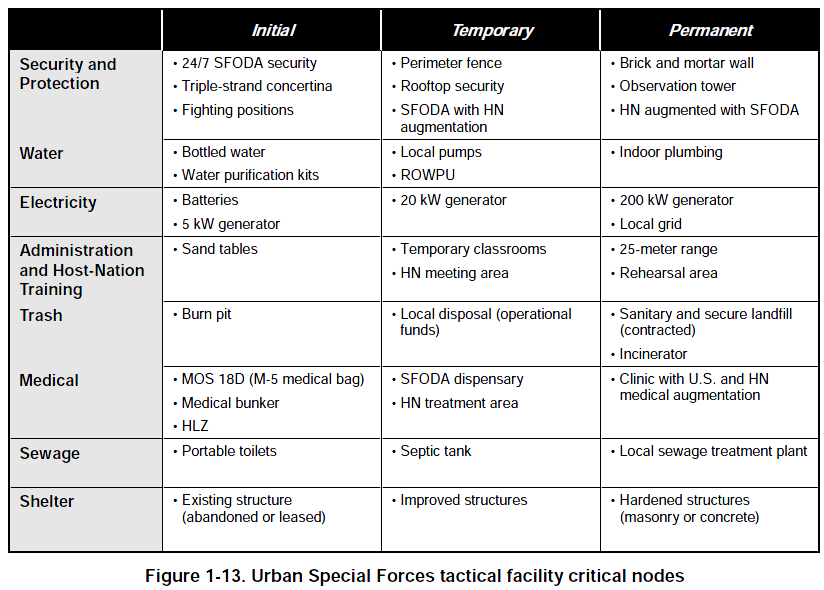
Over time, the TACFAC helps provide for establishment, restoration, and improvements of many local HN community and governmental services and systems. These essential support systems for the TACFAC and surrounding HN communities are best captured by the acronym SWEAT-MSS (security, water, electricity, administration, trash, medical, sewage, and shelter). Eventually, the SF TACFAC will be returned to the control of the HN government through a relief in place (RIP).

OVERVIEW

1-1. SF operations support the operations and goals of the geographic combatant commanders (GCCs) and their subordinate joint force commanders (JFCs). SF TACFACs primarily serve as a base to support SF operations. As such, they serve an operationally defensive role. They allow SF units and partnered HN or multinational forces to meet the tasks and purposes of the defense and aid in setting the conditions for successful offensive operations, which can be either lethal or nonlethal. FM 3-0, Operations, defines defensive operations as “combat operations conducted to defeat an enemy attack, gain time, economize forces, and develop favorable conditions for offensive or stability operations.”

1-2. Several of the purposes of defensive operations are very closely related to SF TACFAC operations. These purposes include the following:

  • Deter and defeat enemy attacks (such as insurgency operations).
  • Achieve economy of force (such as allowing the JFC to concentrate conventional forces elsewhere against an enemy main effort).
  • Retain key terrain (which includes the local populace).
  • Protect the populace, critical assets, and infrastructure.
  • Develop intelligence (particularly local intelligence).

1-3. SF TACFAC operations also can have a tremendous positive impact in support of friendly information operations (IO), as TACFACs are tangible proof of a stabilizing friendly-force presence. In order for U.S. Armed Forces—and SF in particular—to have any positive effect on the local population’s view of their government, local critical assets and infrastructure must be defended. These assets and infrastructure usually have more economic and political value than tactical military value.

1-4. Prior to selection of the TACFAC site, the Special Forces operational detachment (SFOD) must analyze the mission, enemy, terrain and weather, troops and support available, time available, and civil considerations (METT-TC). When planning and designing the TACFAC, the SFOD must take into account the factors critical to the security of the facility, including observation and fields of fire, avenues of approach, key terrain, obstacles, and cover and concealment (OAKOC). The SF TACFAC commander uses all available assets during defensive planning. These include intelligence, reconnaissance, and engineer assets to study the terrain. Optimum use of terrain, depth, and security operations allows the SFOD to minimize defensive resources.

1-5. The smallest SF unit tasked to operate and maintain an SF TACFAC is the SFODA. SFODBs and SFODCs that occupy TACFACs produce much larger tactical footprints in their areas of operation (AOs), which may be a distinct disadvantage. The larger advanced operating base (AOB) or special operations task force (SOTF) TACFAC needed to sustain a greater force requires additional logistics and protection support.

1-6. SF units must determine if there are advantages or disadvantages to breaking ground on a new facility or using an existing facility. Questions that are considered when making this decision include the following:

  • Is the AO permissive, uncertain, or hostile?
  • Are the facilities located in urban or rural settings?
  • Are the facilities logistically sustainable?
  • Are HN defense, security, and protection adequate?
  • Are there established casualty and emergency evacuation plans?
  • Are there future plans to close, convert, or abandon the facility?
  • Are the facilities part of a larger operation with a yet-unspecified strategic plan?
  • Are there Civil Affairs (CA) and Psychological Operations (PSYOP) missions in the AO?

1-7. In addition to the SFOD (or SFODs) occupying the TACFAC, the facility may also house vetted interpreters and other friendly force personnel on either a permanent or temporary basis. These friendly forces may include other U.S. or multinational force personnel (military, interagency, or contractor), HN personnel (military, constabulary, or civilian government), or irregular forces working with the SFOD. The SFOD must take into account both the size of these elements and any cultural considerations related to these various groups when developing a TACFAC.

https://publicintelligence.net/wp-content/uploads/2012/08/tacfac.png


TOP:-SECRET – Immigration and Customs Enforcement Tactical Teams

https://publicintelligence.net/wp-content/uploads/2012/08/ICE-TacticalTeams.png


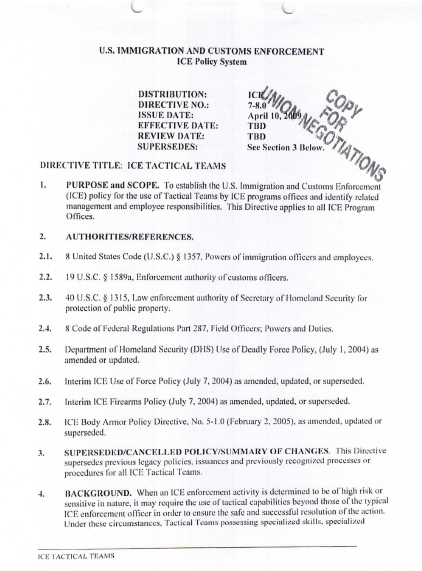
BACKGROUND. When an ICE enforcement activity is determined to be of high risk or sensitive in nature. It may require the use of tactical capabilities beyond those of the typical ICE enforcement officer in order to ensure the safe and successful resolution of the action. Under these circumstances, Tactical Teams possessing specialized skills, specialized equipment and specialized training to meet these particular challenges may be required. The deployment of these teams can be viewed as the use of an elevated level of force.  For these reasons, it is important for ICE to have processes and procedures for the establishment and operation of these teams, appropriate training and qualification standards for team members, and very specific reporting requirements through defined reporting channels, for team activities.

6. POLICY.

6.1. When an ICE enforcement activity is determined to involve high risk or to be sensitive in nature requiring tactical capabilities beyond those of the typical ICE enforcement officer. Program Office Directors may authorize the use of specialized Tactical Teams in order to ensure the safe and successful resolution of the action. It is the policy of ICE to conduct enforcement operations requiring the use of Tactical Teams as safely and professionally as possible.

6.2. Since the deployment of Tactical Teams to perform enforcement actions is considered to be the use of an elevated level of force, the use of Tactical Teams shall be limited to those circumstances where an elevated level of force and visible presence is deemed necessary to safely and effectively complete an enforcement action. The deployment of Tactical Teams shall be made in accordance with the provisions of this Directive and their use in a particular circumstance shall be justified by articulable facts.

8.12. Deployment of Tactical Teams.

1) Enforcement Actions involving High Risk Activities.

a) High Risk Activities under Normal Conditions. When requesting the deployment of Tactical Teams during enforcement actions that include high-risk activities, the following procedures shall be followed:

i) ICE agents and officers shall submit a request for the deployment of Tactical Teams through their supervisor to tl1e Tactical Supervisor. This request will include a completed Risk Analysis for Tactical Operations which shall be submitted at least 48 hours prior to any ICE enforcement operation.

ii) The Tactical Supervisor will ensure the accuracy and completeness of the Risk Analysis for Tactical Operations that will be used as a guide in determining the need to use Tactical Team resources.

iii) The requesting officer may be assisted by the Tactical Supervisor or Team Leader in preparing the Risk Analysis for Tactical Operations. The requesting officer or agent most knowledgeable of the situation will be readily accessible to provide the Tactical Supervisor with all relevant infom1ation.

iv) In circumstances where a search or arrest warrant will be executed, the requesting officer or agent will ensure the warrant’s validity and provide copies to the Tactical Supervisor, who will verify the warrant.

v) The Risk Analysis for Tactical Operations will be discussed with the requesting officer’s immediate supervisor and the supervisor of the appropriate Tactical Team. If Tactical Supervisors feel that the request justifies the deployment of the Tactical Team they will forward the request to the Field Responsible Official for their approval and authorization to activate the team.

vi) For the purposes of this Directive, examples of high-risk activities include but arc not limited to, the following situations:

A) A suspect with a history of violence or resisting arrest;

B) Fortified buildings, property, vessels, or other structures or conveyances that require the use of specialized equipment to gain access;

C) Suspects who are members of organizations that advocate violence;

D) Situations that would overwhelm the resources and capabilities of an officer or office with standard equipment and training;

E) A disturbance at an ICE detention facility that poses a risk of physical injury; and

F) Other situations where the totality of circumstances presents an above average risk of danger.


DOWNLOAD THE ORIGINAL DOCUMENT HERE:

ICE-TacticalTeams

SECRET – Afghan National Army and Coalition Forces Partnership in Khost and Paktiya

https://publicintelligence.net/wp-content/uploads/2012/08/USArmy-HTS-ANAPartnership.png

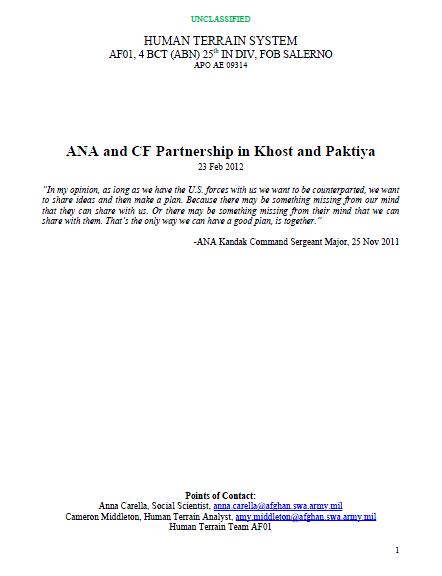
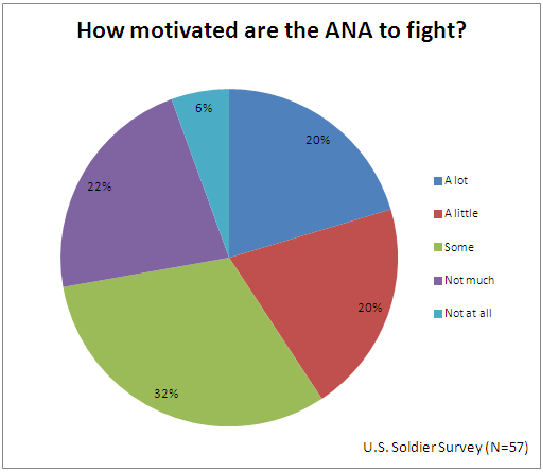
(U) Members of Human Terrain Team AF01 embedded with a U.S. cavalry squadron from November to December 2011. Our goal was to understand the dynamics that influence partnering between the Afghan National Army (ANA) and Coalition Forces (CF) and how those dynamics impacted ANA effectiveness in gaining the Afghan population’s support. We conducted 22 interviews with U.S. Army personnel, including U.S. enlisted Soldiers and officers, U.S. troop commanders, police trainers, and ANA mentors. In addition, we conducted 21 interviews with high- and low-ranking ANA enlisted Soldiers and officers and Afghan police officers. We accompanied U.S. forces on non-kinetic missions to villages throughout Khost and Paktiya to gather perceptions from the Afghan civilian population. We also distributed a survey to three U.S. Cavalry companies (N=57). These data, along with research from secondary sources, informed the findings presented in this paper.

(U) A recent study by Bordin (2011)2 has drawn attention to “green on blue” hostility. While we acknowledge that his findings are probably an accurate reflection of Soldier views, we disagree with his conclusion that CF and ANA may be “culturally incompatible.” Instead, we are very optimistic that with the right training and leadership, cultural barriers can be overcome. Partnership, if correctly executed, can combine the strengths of Afghan and CF units such that each partner benefits from, and is bolstered by, the other. Afghan National Security Force (ANSF) development can become a force multiplier, not a trade-off, in efforts to defeat the insurgency. While our study, like Bordin’s, does highlight some uncomfortable truths about partnership, we hope that as much as we have criticized current efforts, we have equally acknowledged the challenges facing Soldiers at all levels, and provided helpful solutions that begin to address how these can be overcome.

(U) Key Findings:

Three factors: Motivation, Training, and Dependence begin to explain variation in ANA performance. Closer partnership can increase CF understanding of these factors, and more. Increased understanding is needed in order to improve ANA performance and readiness for transition. The squadron with whom HTT embedded prioritized ANA development but faced at least two key obstacles that could not have been overcome without external intervention or support:

1. Due to geographic separation of headquarters, they could not benefit from regular Afghan contributions to their planning processes. This created an asymmetric relationship, with U.S. unilateral planning driving the vast majority of operations.

2. A focus on ANA deficiencies in meeting U.S. expectations, due to metric reporting that ignores Afghan knowledge of and interactions with the human terrain, led them to overlook uniquely Afghan strengths that could have improved their planning process. Existing CF measurement instruments, such as the Commander’s Unit Assessment Tool (CUAT) and the Tactical Conflict Assessment and Planning Framework (TCAPF), provide indicators of ANSF performance and effectiveness, but both lack reporting on population perceptions of the ANSF and are therefore incomplete measures of ANSF’s effectiveness in counterinsurgency. This deficiency in data collection should be addressed. Initial findings indicate that CF and Afghan perceptions do not match up when it comes to views of the ANA and the Afghan police. CF rate the police as more professional, but Afghans favor the ANA. This is a reflection of CF preferences for police tactics and frustration with ANA unwillingness to use CF warfighting tactics, such as searching homes or religious buildings for weapons caches. HTT’s assessment of COP Wilderness found that success lay in a combination of clear guidance, metrics to provide accountability, and regular assessments, along with a shared mission. At COP Wilderness, the U.S. Troop Commander recognized the benefits of partnered training, operations, and social activities.

(U) Recommendations: Collocating partnered units is the single most critical adjustment to current operations that would vastly improve opportunities for partnering. Give CF a better idea of “what right looks like” in their pre-deployment training. Create metrics to measure the quality and closeness of partnership and include them in Soldiers’ regular reporting to incentivize them to improve current efforts. Because ANSF is on the frontline of building public confidence in the Afghan government, we recommend the rapid development of better metrics to measure both partnership and ANSF effectiveness. CF should track population perceptions in order to ensure that their measures of performance and effectiveness resonate with Afghans. Better incorporate Afghan input into CF planning. By this we mean not just obtaining Afghan buy-in to a CF plan, but inserting their ideas, especially those regarding the human terrain, into the planning process. In this way, CF can leverage the ANA’s strengths—knowledge of, and legitimacy with, the Afghan population—rather than focusing on improving their weaknesses. Leverage the ANA’s knowledge of the human terrain, knowledge of the local culture, and lessons about how to shift operations to being more population-centric. CF training and joint operations with the ANSF should be tailored to address the issue of ANSF legitimacy and the population’s perception of the ANSF’s ability to improve security and stability.


DOWNLOAD THE ORIGINAL DOCUMENT HERE:

USArmy-HTS-ANAPartnership

CONFIDENTIAL – U.S. Postal Service Operation Medicine Delivery Exercise Outcomes Summary

https://publicintelligence.net/wp-content/uploads/2012/08/USPS-OMD-Summary.png


The following document summarizes outcomes and lessons learned from an exercise conducted in May 2012 by the U.S. Postal Service and the Department of Health and Human Services in conjunction with the Minnesota Department of Health called Operation Medicine Delivery.  The exercise was the first test of the National Postal Model for the Delivery of Medical Countermeasures in the event of a biological attack.  For more information on the exercise, see Carlton Purvis’ article for Security Management magazine.


On May 5-6, 2012, the Minneapolis-St. Paul area conducted a major test of the National Postal Model for distribution of medicine to the public in an emergency, using U.S. Postal Service assets to supplement mass dispensing sites and other strategies. The May exercise, known as Operation Medicine Delivery, was the culmination of planning efforts that began in February 2004, with a memorandum of agreement signed by the U.S. Secretary of Health and Human Services, the U.S. Secretary of Homeland Security and the Postmaster General. Parties to the 2004 MOA agreed to make USPS resources available for distributing emergency medicine in response to a bioterrorist attack. A subsequent presidential executive order (December 2009) called for the development of a federal capability to distribute medical countermeasures (MCM) in response to a bioterrorist attack.

In February 2010, work was completed on the Minneapolis/St. Paul (MSP) Comprehensive Postal Plan, a blueprint for implementing the Postal Model in the Twin Cities area of Minnesota. A tabletop exercise (TTX) of the MSP Comprehensive Postal Plan was conducted in January 2011. Operation Medicine Delivery was conducted as a full-scale exercise (FSE) of the plan. The MSP Comprehensive Postal Plan was the first such plan in the nation, and OMD was the first full-scale exercise of the Postal Model. The concept had previously been tested, on a limited basis, in Boston, Philadelphia and Seattle.


Exercise Objectives

Activities undertaken in connection with Operation Medicine Delivery were evaluated based on the success of exercise participants in (1) implementing key elements of the MSP Comprehensive Postal Plan, and (2) meeting six key objectives chosen to reflect critical emergency response capabilities. The six exercise objectives were developed by the exercise planning team, specifically for Operation Medicine Delivery. These objectives included:

• Demonstrating the ability to establish and maintain an effective system for communicating with the public during an incident requiring activation of the MSP Comprehensive Postal Plan.
• Demonstrating the ability to alert, activate and assemble the necessary personnel, facilities and equipment to distribute simulated preventive antibiotics to residential mailing addresses in four Twin Cities ZIP codes.
• Testing the process for assembling law enforcement personnel involved in implementation of the MSP Comprehensive Postal Plan, and coordinating their activities with those of USPS personnel.
• Assessing the ability of exercise participants to activate and secure facilities used to receive, break down, distribute and dispense simulated supplies of preventive antibiotics.
• Testing the process for recovering and handling any undelivered supplies of simulated preventive antibiotics, and demobilizing postal operations that were activated in connection with the exercise.
• Testing the ability of exercise participants to maintain appropriate command and control over exercise activities, and maintain effective internal channels of communication, as described in the MSP Comprehensive Postal Plan.

Areas for Improvement

Exercise evaluators identified the following outcomes of Operation Medicine Delivery as primary areas for improvement:

• Clearer description of command and control structure in the plan. The overall command and control structure for the MSP Comprehensive Postal Plan, including the integration of local command elements, needs to be defined more clearly.
• Authority to reallocate and demobilize delivery teams in the field. Four different command entities had responsibility for the delivery teams – the Postal Emergency Operations Center, delivery unit managers, law enforcement command centers and law enforcement sergeants in the field. Greater clarity is needed regarding who has authority to reallocate (reassign) or demobilize the delivery teams.
• Clarification of terminology used to report completion of delivery routes. Issues related to reporting terminology created uncertainty regarding the completion of routes and affected the ability to quickly redeploy delivery teams to other routes.
• Lack of a process for reallocating delivery teams following route completion. Lack of a defined process for reallocating teams after they had completed their assigned routes delayed reallocation of teams to new routes by as much as 40 minutes.

TOP-SECRET – DHS-FBI Suspicious Activity Reporting Bulletin: Aviation Flyovers

https://publicintelligence.net/wp-content/uploads/2012/08/DHS-FBI-AviationFlyovers.png


(U) Suspicious Activity Reporting (SAR): Aviation Flyovers

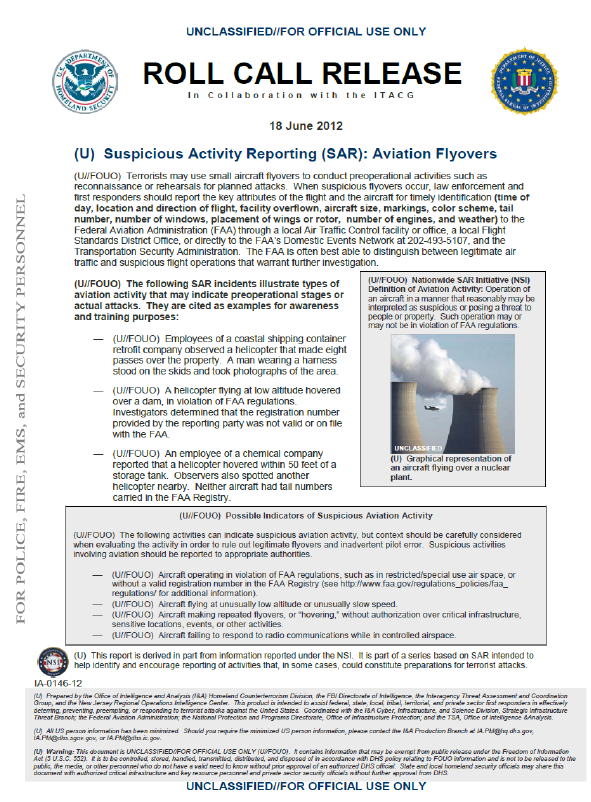
(U//FOUO) Terrorists may use small aircraft flyovers to conduct preoperational activities such as reconnaissance or rehearsals for planned attacks. When suspicious flyovers occur, law enforcement and first responders should report the key attributes of the flight and the aircraft for timely identification (time of day, location and direction of flight, facility overflown, aircraft size, markings, color scheme, tail number, number of windows, placement of wings or rotor, number of engines, and weather) to the Federal Aviation Administration (FAA) through a local Air Traffic Control facility or office, a local Flight Standards District Office, or directly to the FAA’s Domestic Events Network at 202 493 5107, and the Transportation Security Administration. The FAA is often best able to distinguish between legitimate air traffic and suspicious flight operations that warrant further investigation.

(U//FOUO) The following SAR incidents illustrate types of aviation activity that may indicate preoperational stages or actual attacks. They are cited as examples for awareness and training purposes.

— (U//FOUO) Employees of a coast shipping container retrofit company observed a helicopter that made eight passes over the property. A man wearing a harness stood on the skids and took photographs of the area.
— (U//FOUO) A helicopter, flying at low altitude hovered over a dam, in violation of FAA regulations. Investigators determined that the registration number provided by the reporting party was not valid or on file with the FAA.
— (U//FOUO) An employee of a chemical company reported that a helicopter hovered within 50 feet of a storage tank. Observers also spotted another helicopter nearby. Neither aircraft had tail numbers carried in the FAA Registry

(U//FOUO) Possible Indicators of Suspicious Aviation Activity

(U//FOUO) The following activities can indicate suspicious aviation activity, but context should be carefully considered when evaluating the activity in order to rule out legitimate flyovers and inadvertent pilot error.  Suspicious activities involving aviation should be reported to appropriate authorities.

— (U//FOUO) Aircraft operating n violation or FAA regulations, such as in restricted/special use air space, or without a valid registration number in the FAA Registry (see https://www.faa.gov/regulations_policies/faa_ regulations/ for additional information).
— (U//FOUO) Aircraft flying at unusually low altitude or unusually slow speed.
— (U//FOUO) Aircraft making repeated flyovers, or hovering, without authorization over critical infrastructure, sensitive locations, events, or other activities
— (U//FOUO) Aircraft failing to respond to radio communications while in controlled airspace.

Public Intelligence – Survey Finds U.S. Soldiers Believe the Afghan Army is Making Little to No Progress

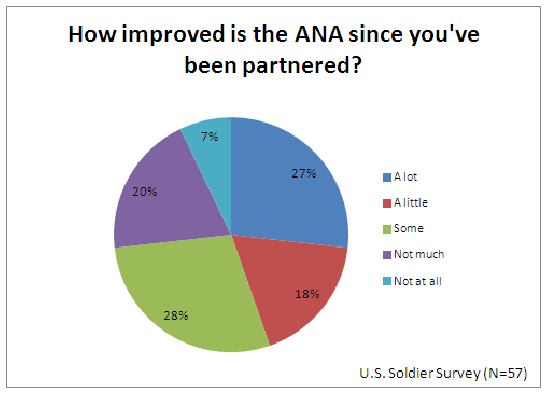
A survey conducted in late 2011 as part of the Human Terrain Team report found that 45% of the soldiers that responded believed the Afghan National Army has improved little, not much or not at all.

Public Intelligence

A research report compiled earlier this year by a group of social scientists working for the U.S. Army’s Human Terrain System found that members of the Afghan National Army (ANA) are largely seen by U.S. soldiers as unmotivated, highly dependent and making little to no progress. The report, titled “ANA and CF Partnership in Khost and Paktiya”, is based on interviews and observations made during the Human Terrain Team’s time embedded with a U.S. cavalry squadron from November to December 2011. A survey distributed to three other companies also informs much of the report’s findings, which are intended to analyze “the dynamics that influence partnering between the ANA and [coalition forces] and how they contributed to the ANA’s effectiveness in gaining the Afghan population’s support.” The soldiers’ candid responses to the survey provide a great deal of insight into perceptions of the ANA among coalition forces.

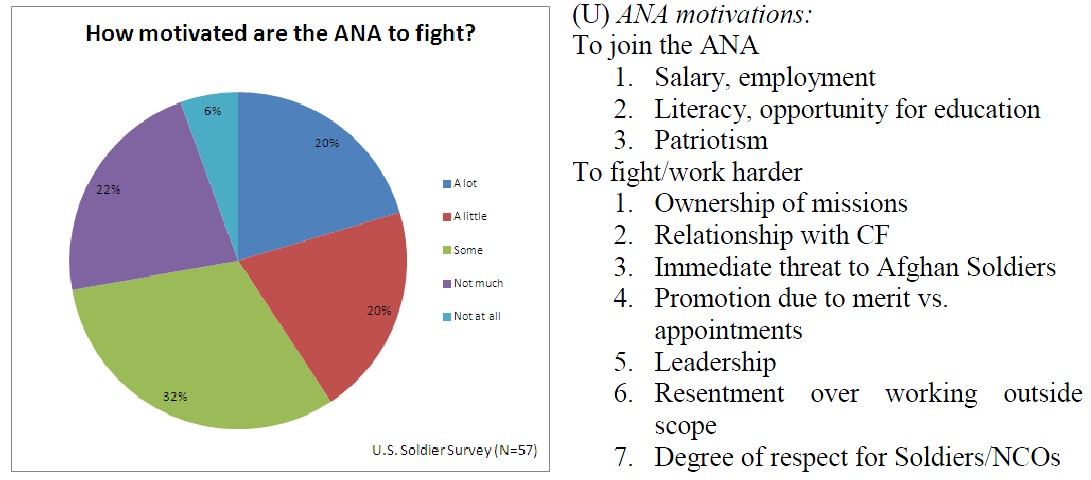
Nearly half of soldiers surveyed said the ANA has improved little, not much or not at all during their partnership. A major reason for this lack of progress is reported by U.S. soldiers to be a lack of motivation. The report lists several of the  primary reasons why Afghans join the ANA, including earning a salary and consistent employment, as well as the desire to become literate and an opportunity for education. Illiteracy among the ranks of the ANA became such a problem for coalition forces trainers that mandatory literacy programs were instituted in 2009 at the NATO Training Mission – Afghanistan (NTM-A). One trainer told the report’s authors that “I never thought when I entered Afghanistan as a senior trainer I’d be talking more about literacy training than I would about infantry training. But that is truly the case. We recognized very early on in the NTM-A time frame that we had to put a literacy program in place to compensate and mitigate the great illiteracy problem in the ranks as well as in their society.”

Soldiers responding to the survey are quoted as stating that the “ANA doesn’t care, they are lazy” and the “ANA have no motivation to do anything.” One U.S. Staff Sergeant said that the ANA are not interested in taking on more responsibility, adding that “We do the heavy lifting, they put a face on it.” Nearly half of soldiers surveyed said the ANA has little, not much or no motivation at all to fight. This lack of motivation often causes coalition forces to take the lead even on missions that are supposedly led by the ANA.  One soldier told the report’s authors:

“They won’t do a patrol unless U.S. forces are on a patrol. If you ask them ‘hey what did you guys do today,’ you will never hear ‘oh we kicked out a patrol over to Seway, 3 trucks, 15 guys went over there, trying to find out some information about blab blah blah…’ Never gonna happen. They’re just going along with us whenever we need them.”

In fact, 62% of soldiers responding to the survey said that so-called “ANA-led” missions are rarely or never actually planned and executed by Afghan forces. Another soldier reported that a recent “ANA-led” mission that he had been on required him to “spoon-feed” his Afghan counterpart the entire operations order and planning.

A particularly interesting finding in the report is that the views of the Afghan population often differ widely from those of coalition forces on the professionalism and respectability of the ANA. Focusing on data collected during a 2011 survey of residents in Paktiya and Khost provinces, the report finds that the ANA is widely viewed by the Afghan people as more honest, fair and professional than the Afghan National Police. The report recommends that coalition forces do a better job of incorporating the views of the population into their assessments of the ANA, as the perception of stability and legitimacy plays an important role in the overall campaign. If coalition forces cannot do this, then they have only “fought half the battle” and the Afghan National Security Forces “will be able to clear, but not to hold or build.”

TOP-SECRET – U.S. Army Environmental Considerations During Military Operations

https://publicintelligence.net/wp-content/uploads/2012/08/CALL-EnvironmentalConditions.png


This newsletter does not strive to make readers environmental experts. However, it does emphasize the importance of incorporating environmental considerations throughout the military decision-making process (MDMP). Through a variety of environmental lessons learned, this newsletter provides tactics, techniques, and procedures in an effort to reduce overall environmental risk.

Section II of the newsletter deals with environmental considerations at home station. Military units integrate environmental considerations throughout their daily activities and during training because environmental laws and regulations mandate it. Environmental sustainability and good environmental practices begin in garrison. By taking care of the environment, installations maintain good neighbor relationships with local communities and continue to provide Soldiers with realistic training areas for future use. Additionally, environmental stewardship promotes force health protection.

Section III presents situations from each of the combat training centers (CTCs) and provides lessons for units to understand the environmental challenges of planning and conducting training. The integration of environmental considerations into training is very similar to the integration of safety and force protection issues. Training is key to accomplishing the mission. Understanding environmental aspects of the training mission can help mitigate the risk environmental conditions pose to Soldiers and mission success.

Section IV covers environmental considerations during operational deployments. Environmental considerations have several implications for military operations that affect all levels of war. Once units leave the home station area and begin training or mobilization operations, their focus shifts to accomplishing their combat mission and, consequently, environmental awareness tends to decrease. This decline may cost the commander much needed time, personnel, and other resources. Integrating environmental considerations early in the MDMP for both training and mobilization operations will help ensure that we continue to fight as we train.

ISSUE:

Aerial Bombardment of Industrial Complex Releases Toxic Cloud (Gulf War)

DISCUSSION:

During the first Gulf War, a U.S. unit came under fire from an Iraqi mechanized unit that took up a defensive position in a refinery/processing plant. The U.S. unit responded with artillery fire. The 155mm rounds hit and silenced the Iraqi unit; however, the resulting collateral damage caused the unintentional release of a toxic cloud of hydrochloric and sulfuric acids.

The cloud blew over a herd of camels and other livestock, causing their deaths. A post-operations investigation determined that the consequences would have been disastrous if friendly forces or non-combatants were downwind of the refinery. While chemical protective gear will protect soldiers from biological and chemical agents, they offer no protection against many toxic industrial chemicals (TICs)/toxic industrial materials (TIMs).

Depending on the type and quantity of TICs/TIMs, a deliberate release could present either a short- or long-term hazard at the release site and for those within the downwind chemical plume. They would disperse similarly as chemical warfare agents. The vapors tend to remain concentrated downwind from a release point and in natural low-lying areas such as valleys, ravines, or manmade underground structures.

TECHNIQUES AND PROCEDURES:

1. The commander and staff must conduct an intelligence preparation of the battlefield (IPB) during the mission analysis phase of the military decision-making process (MDMP). (The IPB defines the battlefield environment and considers all risks.)

2. Fire support officers must address the hazards associated with TICs/TIMs during their targeting procedures.

3. Units must address the hazards associated with TICs/TIMs in unit SOPs and operations orders.

ISSUE:

Lack of Contract Oversight Results in Improper Dumping of Hazardous Waste (GWOT)

DISCUSSION:

During operations in support of the war on terrorism, the United States hired a local national contractor to haul waste oil from U.S. forces’ positions. The contractor dumped the oil in a local landfill and sold the barrels. Lack of direct oversight of the contractor resulted in a claim by the host nation for clean-up compensation of $1.25M.

The U.S. Government should have hired a reputable contractor to dispose of the waste oil IAW applicable disposal standards, usually host nation or U.S. standards.

Contracting representatives and contracting officers in theater must ensure contractors are supervised for compliance of the contract terms.

Units must remain aware of contractor personnel working in their area. If they see contractors performing illegal, improper, or unethical actions, they should inform their command and the local contracting agency.

TECHNIQUES AND PROCEDURES:

1. The contracting officer should include the proper procedures for waste removal into the contract statement of work.

2. The contracting officer’s representatives, occasionally the unit receiving the services, must ensure proper execution of the contract statement of work.

3. Unit leaders must remain cognizant of contractors working in their area and report all incidents that create potential safety, health, or environmental risk.

DOWNLOAD THE ORIGINAL DOCUMENT HERE:

CALL-EnvironmentalConditions

CONFIDENTIAL – DoD Science and Technology for Communication and Persuasion Abroad Analysis

https://publicintelligence.net/wp-content/uploads/2012/07/DoD-ST-CommunicationPersuasion.png

Over the last 10 years, the U.S. government has made significant investments in science and technology in order to enhance its ability to understand and shape public opinion and behavior abroad—a domain of activity referred to in this report as “shaping,” “influencing,” or “communication and persuasion.” Because this effort is taking place across a vast government bureaucracy, the policy-makers and practitioners engaged in communication and persuasion do not always know what tools are at their disposal and what tools need to be invented.

To address this problem, the Department of Defense’s Rapid Reaction Technology Office (RRTO) issued a “Strategic Communication Science and Technology Plan” in 2009 that surveyed the government’s programs in this area and their gaps. To keep abreast of the latest technological developments, RRTO commissioned CNA to update this report for FY 2012. The updated report discusses domains for future investment in research and development (R&D); identifies gaps and proposes new science and technology (S&T) initiatives; and surveys current S&T programs.

There has not been adequate investment in the technological gaps identified by RRTO in 2009. Furthermore, the U.S. government has made limited R&D investments in using social interaction technology, persuasive technology, and immersive virtual environments and simulation games for communication and persuasion—areas of R&D not discussed at length in RRTO’s 2009 report. CNA reached this conclusion after surveying current U.S. government programs, reviewing recent academic literature on technology for communication and persuasion, and consulting with experts inside and outside the U.S. government. Based on an analysis of these gaps, we have identified the following areas for investment:

• Survey and validation of theories and techniques for influence in the digital realm
• Target audience analysis, trend monitoring, and source criticism
• Online measures of effectiveness
• Training in techniques of communication and persuasion in the digital realm
• Immersive virtual environments and simulation games for non-military purposes
• Persuasive technology on mobile devices for encouraging positive behavior
• Crowdsourcing for problem solving and accountability
• Studying adversary use of social media
• Technology for promoting freedom under repressive regimes
• Expanding investment in emerging technologies

Although these development, research, and training gaps have been listed separately, they are interdependent, as are the three technologies highlighted below: social interaction technology, persuasive technology, and immersive virtual environments and simulation games. Indeed, as the technologies converge on one another, it will become more difficult to speak of different domains of technological research and development for communication and persuasion.

As communication becomes more digital (i.e., mediated by computers), more interactive (enhancing an individual’s influence), and more mobile, those who understand the new communication environment and know how to use it effectively will have more influence than those who do not. Audience analysis is not enough. Therefore, this report recommends conducting research on effective techniques for cultivating relationships and influencing people in the digital realm, as well as investing in new technologies to deploy them.

Despite the focus of this report on technology for communication and persuasion, such technology will only succeed in advancing U.S. interests if it serves well-informed policies; if the senior makers of those policies use and understand the technologies themselves; and if the practitioners carrying out those policies remember that putting a human face on an institution’s words and actions and establishing positive relationships—on and offline—with people working toward shared goals matter more than the substance of any particular message.

Expanding investment in emerging technologies

Through institutions like In-Q-Tel and in-house innovation offices like DARPA and IARPA, the U.S. government is already investing in new technologies for communication and persuasion. For example, IARPA’s “Babel Program” (see Appendix) is developing speech recognition technology to improve speech transcription for languages other than English, making it easier to search. The government might consider expanding the remit of these institutions to invest in research and development for communication and persuasion technology. To ensure that these technologies are understood and used by its employees, the U.S. government might also encourage collaboration between its communicators and the technologists at its in-house innovation offices, who can help each other identify technological gaps and use off-the-shelf technologies to meet U.S. objectives abroad.

DOWNLOAD THE ORIGINAL DOCUMENT HERE:

DoD-ST-CommunicationPersuasion

Public Intelligence – CONFIDENTIAL – DoD Science and Technology Strategic Communication/Social Media Programs

The following lists contain basic information on current, ongoing, and planned Department of Defense Science and Technology Strategic Communication (SC) programs.  The list from 2009 was taken from the 2009 Strategic Communication Science and Technology Plan compiled by the Defense Research and Engineering Rapid Reaction Technology Office.  The 2012 list was taken from the Science and Technology for Communication and Persuasion Abroad Gap Analysis and Survey compiled by Will McCants of the Center for Naval Analyses.

Program Categories

 I Infrastructure Enabling and facilitating access to information from news to markets to vocational
 S Social Media Knowledge Management, Social Media, and Virtual Worlds
 D Discourse Analysis of radical and counter‐radical messages and ideas
 M Modeling and Forecasting Gaming and anticipating adversarial messages and ideas activities and our counters and pre‐emptives
 C Collaboration Increasing collaboration and training across and beyond Government
 F First Three Feet Empowering, Equipping, Educating, and Encouraging media and others to exist and freely report on events for what they really are
 U Understanding Develop country, culture, and regional expertise, including polling
 P Psych Defense Planning and capacity building for dealing with critical strains on society in peacetime and wartime

Projects as of March 2012


Project Name Description Execution Agent
C Return on Investment Analytic Framework for COCOM VOICE Operations The contractor shall develop one or more Return on Investment Analytic Frameworks for the COCOM Voice Operations. These frameworks shall provide measurements of performance, measurements of effectiveness, and methods of determining overall return on investment of program dollars. Deliverables include: 1) an analysis plan; 2) development of a semistructured instrument to assist in Stakeholder interviews; 3) a summary report with a literature review; a final report / final analysis frameworks/scorecards; and 4) development of a training manual and slide presentation detailing the application of its ROI framework(s). ASD(SO/LIC)-
CTTSO
C Population Research and Analysis Planning Support to Military Information Support Operations The contractor shall design and execute a graduated research training course for the Department of Defense designed to be taught in an incremental fashion, over an extended period of time. As many as six courses of training are desired to teach advanced, senior, and (as an option) master approaches to the methodological design and interpretation of public opinion polling, focus groups, in-depth interviews, media analysis and general analytical concepts associated with evaluation. Additionally, the courses shall highlight examples of the types of situations where each approach is most useful. ASD(SO/LIC)-
CTTSO
C Tanzania Terror Conference Four day conference to bring African Partners to discuss and cross-talk about CVEI initiatives and problems USAFRICOM
C Embassy Dhaka Countering Violent Extremism Conference The conference’s objective is to discuss and identify Countering Violent Extremism strategic communication objectives for counter-radicalization. Mission Dhaka requests action posts to nominate host nation participants for the conference. Each delegation will present a case study on the counterradicalization methods, policies and programs used in their respective country. The United States’ Combating Terrorism Fellowship Program (CTFP) is fully sponsoring seventy-five participants from Bangladesh, India, Maldives, Nepal, Sri Lanka, and Thailand to participate in this conference. AMEMB Dhaka OASD-SOLIC CTFP
C Multi-lateral Planners Conference VII This conference is co-sponsored by JS J5 and the Australian Defense Force. The conference will contain a series of four break-out sessions, focused on CVE, Addressing Resources Scarcity, Examining the Role of Multi-national Institutions, and Addressing the New Global Commons. Joint Staff J5, Australian Defense Force
D RED BEARD Translation and exploitation of AQA internal correspondence for use by US and foreign nation CT forces; Counter AQA propaganda USSOCOM
D Metaphor Program The Metaphor Program will exploit the fact that metaphors are pervasive in everyday talk and reveal the underlying beliefs and worldviews of members of a culture. In the first phase of the two-phase program, performers will develop automated tools and techniques for recognizing, defining and categorizing linguistic metaphors associated with target concepts and found in large amounts of native language text. The resulting conceptual metaphors will be validated using empirical social science methods. In the second phase, the program will characterize differing cultural perspectives associated with case studies of the types of interest to the Intelligence Community. Performers will apply the methodology established in the first phase and will identify the conceptual metaphors used by the various protagonists, organizing and structuring them to reveal the contrastive stances. IARPA
F Leaders of Influence – Maldives This is a counter-radicalization series of seminars, workshops, and discussions facilitated by the Asia Foundation, incorporating religious and secular leaders in the Maldives to advocate moderate religious messages tolerance of dissenting views and non-violent expressions of faith. The series will also serve to discredit violent extremist ideology. Additionally, the series will establish a network of new key communicators and contacts for future programs. USSOCOM
I Operation PALISADES Op Palisades Cell Towers to ensure 24×7 availability USCENTCOM of cellular service to Afghans, commencing in RCSOUTH USCENTCOM
I Public Command Message Translation Website The USPACOM website and public pages to include selected third party media content translated, culturally optimized, and updated daily in the languages of Japanese, Chinese (Mandarin), Indonesian (Bahasa), Korean, Indian (Hindu), Vietnamese, Mongolian and Thai. This capability provides blogging and interactive, public communication capabilities utilizing existing social media and network sites like Facebook, Flickr, and Twitter or other regional web applications. USPACOM
I Regional Magazine Initiative (RMI) – Multiple / Worldwide USSOCOM develops a centrallymanaged magazine architecture within which participating COCOM magazines tailored to foreign audiences can operate in order to amplify their transregional impact, achieve cost efficiencies and enhance quality. USSOCOM
I Trans Regional Web Initiative (TRWI) – Multiple / Worldwide USSOCOM develops a centrallymanaged website architecture within which participating COCOM websites tailored to foreign audiences can operate in order to amplify their transregional impact, achieve cost efficiencies and enhance quality. USSOCOM
I Center for Strategie Counterterrorism Communications (CSCC) An Executive Order established the CSCC in FY 11. The goal of the interagency center is synchronizing the USG’s CT and CVE communications. DOS
I Real-Time Contextual Mapping and Visualization Dashboard for Muslim Social
Movements
A web portal that provides access to a broad range of information. This will include a database that tracks both radical and counter-radical networks of ideas and actors. The web portal’s dashboard will graphically map the diffusion and influence, geographically and diachronically, of these ideas and actors. The dashboard will feature the ability to search and return results which include descriptive information about and classification of the search terms and constructs; a visual representation of where along multiple spectrums any particular group lies at a defined period of time based on the project’s analysis of multi-faceted crossregional and cross-disciplinary data using theoretically driven non-binary models which capture the complexity of the material; the ability to track peaking religious, political, socioeconomic markers driving Muslim social movements, their target demographics, and locations. ASD(R&E)-
Minerva
I Babel Program The Babel Program will develop agile and robust speech recognition technology that can be rapidly applied to any human language in order to provide effective search capability for analysts to efficiently process massive amounts of real-world recorded speech. Today’s transcription systems are built on technology that was originally developed for English, with markedly lower performance on non-English languages. These systems have often taken years to develop and cover only a small subset of the languages of the world. Babel intends to demonstrate the ability to generate a speech transcription system for any new language within one week to support keyword search performance for effective triage of massive amounts of speech recorded in challenging realworld situations. IARPA
M Influencing Violent Extremist Organizations Update The objective of the I-VEO project was to gain a holistic understanding of intended and unintended effects of Influencing Violent Extremist Organizations (IVEO) that can be transferred to a usable analytic framework that informed decisionmakers and planners. The resulting holistic analyses derived analytic confidence from the examination of sound theoretical knowledge, conceptual modeling, and testing in historical cases. The results of this study aided the Joint Staff and COCOMs at strategic and operational levels by providing a conceptual framework grounded in scientifically-sound theoretical concepts and analyses. ASD(R&E)-Strategic Multilayer
Assessment
M Early Warning, Analysis and Targeting for Hotspot Identification, Tracking and Intervention Sandia National Laboratories will pilot the use of its suite of graph, text, and web analytics to identify locations, websites, groups and individuals where social mobilization and flare ups are most likely to occur. Primarily using open-source information from the web, Sandia will identify and map relevant social and information networks, determine their virulence and effectiveness, map current influence flows and effects, and identify opportunities and candidate means for positive change. ASD(R&E)-Rapid Reaction
Technology Office, USPACOM, SOCPAC
M Sirius Program The goal of the Sirius Program is to create experimental Serious Games to train participants and measure their proficiency in recognizing and mitigating the cognitive biases that commonly affect all types of intelligence analysis. The research objective is to experimentally manipulate variables in Serious Games and to determine whether and how such variables might enable playerparticipant recognition and persistent mitigation of cognitive biases. The Program will provide a basis for experimental repeatability and independent validation of effects, and identify critical elements of design for effective analytic training in Serious Games. The cognitive biases of interest that will be examined include: (1) Confirmation Bias, (2) Fundamental Attribution Error, (3) Bias Blind Spot, (4) Anchoring Bias, (5) Representativeness Bias, and (6) Projection Bias. IARPA
P IO Subject Matter Expert Exchange – Mexico IO subject matter expert Exchange requested by SEDENA and SEMAR (Mexican Military) to provide information about Information Operations in general and certain IO capabilities within stated Mexican military capabilities in September 2011 USSOUTHCOM
S Knowledge Management Cell Provides timely and relevant cultural advisement to USCENTCOM on-going planning efforts and current events. Maintains a Common Operating Picture with database for IO related operations, actions, and activities USCENTCOM
S Social Media in Strategic Communication The general goal of the Social Media in Strategic Communication (SMISC) program is to develop a new science of social networks built on an emerging technology base. In particular, SMISC will develop automated and semiautomated operator support tools and techniques for the systematic and methodical use of social media at data scale and in a timely fashion to accomplish four specific program goals:
1. Detect, classify, measure and track the (a) formation, development and spread of ideas and concepts (memes), and (b) purposeful or deceptive messaging and misinformation. 2. Recognize persuasion campaign structures and influence operations across social media sites and communities. 3. Identify participants and intent, and measure effects of persuasion campaigns. 4. Counter messaging of detected adversary influence operations.
DARPA
U Global Assessment Program (GAP) The Global Assessment Program (GAP) supports Military Information Support Operations (MISO) products for USSOCOM and the Geographic Combatant Commands in Overseas Contingency Operations. The program:
* Plans, develops, organizes, coordinates and analyzes relevant qualitative research, statistically reliable and valid quantitative research, and testing and polling activities at the local, provincial, national, and regional levels based upon USSOCOM designated objectives.
* Annually, collects geo-located data, both qualitative and quantitative, that relates to the performance and effects of existing influence activities in each country specified by the Government. Sample sizes shall be sufficiently large enough to enable the Government to use the province as the smallest unit of analysis.
* Applies current research and sociocultural explanations of radicalization and violent extremism to understand the effectiveness of human influence, media communications and engagement operations and activities in achieving United States Government and Department of Defense (DoD) objectives.
* Determines the population’s sympathy/antipathy for al-Qaida (AQ) and its allies’ methods and rationales for radicalization, recruitment and propensity for violence at the provincial level (or country equivalent); as well as, assesses and defines the reasons for their sympathy/antipathy and their valid human factors influence requirements.
* Uses time-series analyses, predictive modeling, and statistical matching techniques (e.g., propensity scoring) and geospatial analysis to discern the impact of military information support operations program initiatives.
* Assesses the efficacy of influence programs delivered using a variety of media including printed materials, webbased content, television and radio.
* Using a combination of qualitative and quantitative methodologies, assesses the effectiveness and synchronization of content across transregional products covering each Geographic Combatant Command’s area of responsibility.
* Assesses the effectiveness of regionally and trans-regionally oriented web-based influence programs. Assessments of content synchronization and effectiveness shall be conducted annually for each website and/or webbased initiative.
USSOCOM
U Internet Service Translation of local and satellite news to analyze USCENTCOM Iraq area of operations events, and provided advice to the J33 IO USCENTCOM
U Focus Group and Polling Polling is conducted for long term trends and analysis of the environment. Focus Groups are conducted to pretest brand products, significant changes in the environment, and other cultural or topical issues. USCENTCOM
U Baseline Assessment of MISO Effects in Mexico Develop initial Mexico information environment baseline. Identify influence control factors to apply MISO effects. Understand threat actors in area of operations, C-Trans-National Crime Organization and counterterrorism. Understand the use of social media and monitor influence and effects on threat, government, population, and green forces. USSOUTHCOM
U OPERATION Reliant Voice Assessment Manage Operation RELIANT VOICE (ORV) influence assessment effort. Intent is to synchronize all ORV assessment processes; augmented with assessment subject matter experts to deliver an integrated, efficient and effective report detailing execution and impact of all ORV operations, activities, and actions. USPACOM
U Research and Analysis of Nepal Security Environment Determine factors in Nepal that contribute to a fragile security environment and how SOCPAC can influence those factors in future operations USPACOM
U Vulnerable Population Study (VPS) A series of targeted/random assessments to identify USSOCOM (VPS) population groups vulnerable to religious radicalization, extremist recruitment and illicit activities (smuggling, piracy, trafficking) in order to develop information on potential target audiences for future MIST-BG programs, and gauge changes in perception over time. USSOCOM
U Gather Information – Thailand The MIST will employ independent contractors, through the Open Source Center, for the collection of information on past and current MISO programs, violent extremist ideology messaging, and atmospherics of the operating environment. USSOCOM
U Designing a Qualitative Data Collection Strategy for Africa The Institute for Defense Analyses will survey the qualitative data requirements among USG designers and users of computational models relating to Africa. In addition to interviews with individual stakeholders, IDA will convene a workshop of the USG modeling and simulation community to identify existing tools, models, and simulations currently being used to inform analyses of the African continent; data categories, fields, and other types of data currently collected; sources of existing qualitative data; sampling methodologies; gaps in qualitative data; and evaluate the quality of data currently collected and gauge interest/need to validate data. IDA will then work closely with the sponsor, other USG stakeholders, and key regional participants and partner institutions to develop a qualitative data collection strategy. ASD(R&E)-Rapid
Reaction
Technology
Office
U Open Source
Indicators
Many significant societal events are preceded and/or followed by population-level changes in communication, consumption, and movement. Some of these changes may be indirectly observable from publicly available data, such as web search queries, blogs, micro-blogs, internet traffic, financial markets, traffic webcams, Wikipedia edits, and many others. Published research has found that some of these data sources are individually useful in the early detection of events such as disease outbreaks. But few methods have been developed for anticipating or detecting unexpected events by fusing publicly available data of multiple types from multiple sources. IARPA’s Open Source Indicators (OSI) Program aims to fill this gap by developing methods for continuous, automated analysis of publicly available data in order to anticipate and/or detect significant societal events, such as political crises, humanitarian crises, mass violence, riots, mass migrations, disease outbreaks, economic instability, resource shortages, and responses to natural disasters. Performers will be evaluated on the basis of warnings that they deliver about real-world events. IARPA


Projects as of April 2009


Project Name Description Execution Agent
C Deployable Interagency Planning Augmentation Cell (DIPAC) The short-term objective of DIPAC is to develop regional interagency strategic communication campaign plans that support Chief of Mission Priorities and more effectively coordinate DOD, COCOM and Embassy planning, programming and resourcing. The long-term objective is to lay the foundation for regional resourcing for strategic communication, based on regionalization of the Long War and coordinated through the Department of State/Counterterrorism’s (S/CT) Regional Strategic Initiatives (RSI). The DIPAC will provide a common strategic communication planning construct, compare cost-benefit of diverse programs and leverage USG resources more effectively to gain unity of effort. Department of State/Counter- Terrorism
C VOICEBOX Operational analysis and capability design of future state SC enterprise for US Government SO/LIC Irregular Warfare Support (IWS) Office/Booz- Allen
C SC Training Providing COCOM planners and DoD representatives to U.S. country teams with appropriate training in SC, public affairs, information operations, and defense support to PD OSD/Policy/ Office of
Partnership Strategy
D Islamic rhetoric and ideological framework to
counter adversary
IO capability
Develop analytical tools and models to monitor, counter, anticipate and assess the effectiveness of adversary information operations
D Adversarial
Information Flow
(Proof of Concept)
Measures how adversary information moves from one network to another Joint Staff
J-39
D Finding Allies in the
War of Words: Mapping the Diffusion and
Influence of Counter-Radical Muslim Discourse
An on-going Policy effort to better coordinate DoD institutionalization of social science that aims to improve our understanding of foreign area populations. Minerva (DDR&E/OSD/ Policy) Arizona State University
D Emotion and Intergroup Relations An on-going Policy effort to better coordinate DoD institutionalization of social science that aims to improve our understanding of foreign area populations. Minerva (DDR&E/OSD/ Policy) San Francisco State University
D ECHOES: Identifying and Enabling Circulation of Constructive Media for Countering Violent Extremism ECHOES identifies and circulates indigenous media that offer alternative ideas to extremists propaganda but is not
well circulated. ECHOES builds a repository of constructive media
predominantly, but not exclusively, by Muslims, providing a shared tools to counter violent extremist influence for use
by USG, foreign partners, and private sector. Enabling the circulation of constructive media in key foreign audiences
undermines support for, and conversion to, violent extremism, fosters positive alternatives, and builds a market for Muslim CVE media. ECHOES will be comprised of three major projects, detailed below.
OSD/Policy/ Support to Public
Diplomacy (SPD)
D Echoes Children’s
Arabic Media
This project focuses on understanding and finding resources for prevention of radicalization among Arab children. The researchers, specialists in children’s education and Arabic, will identify the key criteria appropriate for children in prevention of radicalization, find Arabic media for children which meet these criteria, and provide copies of the media to the DoD funded counter-radicalization media repository at the University of Maryland (UMDD). The researchers will include this information in an unclassified database of the UMD repository. OSD/Policy SPD
D Echoes Repository at University of Maryland This will fund library cataloging of counter- radicalization media to support growth of the counter-radicalization media repository under development by the University of Maryland (UMDD) National Consortium for the Study of Terrorism and Responses to Terrorism (START). Build a multi-language, multi-cultural, publicly accessible clearing house of counter-radicalization media. OSD/Policy SPD
D Echoes in DoD Educational Institutions OSD/OUSD(P)/Support to Public Diplomacy (SPD) will provide to DoD PME 8 books (non-fiction and fiction) and 4 films by Muslims which counter ideological support terrorism (CIST) for use in CIST education, along with Introductory Guides for the 8 books and 4 films. International Media Ventures will handle translation and development of teaching guides, and SOCOM J239 will deliver items to US military educational institutions and
socialize the materials. Make insightful, informative Arabic and Urdu media by Muslims which undermine support for
violent extremism available to US military in English. Improve our US military capacity for CIST and cultural understanding.
OSD/Policy SPD
D CM Youth
Technology Corps
Develop new media strategies for use against online extremist propaganda SO/LIC IWS/Harvard
Berkman Center
D CM English
Language Gaming
Develop mobile phone and downloadable games using English language to promote deradicalization SO/LIC IWS/USC and
Electronic Arts
D RAND Alternative
Strategies
To facilitate the networking of women activists in Iraq and Afghanistan – at different stages of development as key lever(s) to combat extremism and sectarian strife in these two conflict zones RAND
D Brand Switching for Counter-Marketing Operations The purpose of this task is to conduct an operational analysis of the capability to rapidly and dynamically channel “message resonators” that will mitigate, eviscerate and mute the perspective of Islamist radical and insurgent thought by providing broader enveloping logic and creative interpretations that are supported by legitimate alternative intellectual resources. This analysis will result in a capability design that will build upon “brand switching” methodologies identified in the analysis and create a perpetual capability to perform counter-marketing operations across the spectrum of adversary influence. Phase 2 of the project includes a pilot program to implement the approved methodology. SO/LIC/CTTSO/ IWS
D RAND Provision of
Social Services
Study how radical Islamic organizations use social services to develop popular support RAND
D Kefaya Study Study democratic grass roots movement in
MENA and document lessons learned
RAND
D MCIA Cultural Red
Cell
Develop red team of al-Anbaris to develop vignettes for USMC UCI
D JIEDDO S&T: Attack the network Develop of counter-narrative information operations in Afghanistan. Identify insurgent discourse on IEDs. JIEDDO
F Victims of al-Qaeda
Documentary
Production of film documentary of 9/11 victims’ families reaching out to families of al-Qaeda victims in MENA countries SO/LIC/CTTSO/ IWS and
State Department
I Navy Expeditionary Transmission System IP based video and data transmission hub for Dept of Navy Office of Information. Hub or “Head-end” infrastructure will support fleet public affairs efforts to move large amounts of video data for further dissemination internally and externally. Hub will provide the capability for Navy to conduct live transmissions from around the globe 24-7, afloat and ashore. Navy CHINFO
I Digital Photo Lab Electronic imaging capability aboard Navy CVNs with still and motion imagery processing and editing software coupled with ship’s communication suite to transmit Public Affairs and other visual communication products from ship to shore. Current system is configure with one still imagery work station and one motion media work station, one small format color printer and one large format color printer. Navy CHINFO
I VOCUS Provides detailed media review and analysis, news media contact management and video clip distribution. Navy CHINFO
I Navy Public Affairs
Calendar
A software solution to maintain global awareness of significant events, leadership engagement, significant fleet activities, public outreach events, media engagement and other key events in order to align and maximize return on investment for the Navy’s communication efforts. Navy CHINFO
I Media Lighthouse Digital Asset Management System System provides a centrally managed collection of still photography, video, breaking news features, and topic specific categories to assist print, broadcast, and web based outlets requiring 24/7 access to current events throughout the U.S. Navy. Navy CHINFO
I TVEyes™ Broadcast Monitoring Service On-line search, edit, and retrieval of broadcast media programming form 140 national and international media outlets. Navy CHINFO
I Network exploitation and analysis Identify and exploit means to counter or intercept insurgent use of modern communications technologies
I Afghan Virtual
Science Library
The pilot Afghanistan Virtual Science Library at Kabul University will offer scientists and engineers access to international scientific, engineering, and technical journals and professional resources. Based on this pilot, CRDF will develop a plan and proposal to extend capacity to other universities and to Afghan government ministries. State/CRDF
M Naval Postgraduate School Information Operations Threat This project will support special operations units currently deployed in Afghanistan (OEF) by delivering fully developed IO plans, assisting units to implement these plans, and measuring the effectiveness of the plans and recommend appropriate adjustments Naval Postgraduate School
(NPS)
M Interagency Gaming
Exercise
In cooperation with DDRE/RRTO, JFCOM and the FBI, a series of inter-agency gaming exercises will be conducted to test the collaborative environment in using data from a variety of sources, among which are models produced from the social sciences. Part of the gaming exercises will include actual data, based on perceptions of local conditions and factors contributing to radicalism.

The Gallup GLASS and POLRAD models can be used as a valuable addition to the simulations, in order to help guide decision making based on actual data. When necessary, simulated data sets will also be created to fit specific scenarios, but as much as possible, the data will be based on actual survey results from the World Poll or other sources. Gallup will also participate in development of the exercises and provide reach back support.

OSD/AT&L/ DDR&E/Rapid Reaction Technology Office (RRTO)/ Strategic Multi-layer Assessment (SMA) and Gallup
M Cooperative
Security Pilot
As Secretary Gates suggests, the best way to combat the current threat environment is through a combination of soft and hard power. CSP will provide the Operational Commander an increased capability to 1) understand the root causes of conflict through a broad-based assessment tool, 2) develop integrated, cogent, foundational plans that are based on best practices garnered through experience, and 3) measure the effect of interagency, and international, stability and reconstruction efforts in support of strategic objectives – efforts aimed at reducing the drivers of conflict and strengthening institutional performance of the target state or region. The capability, including associated methodologies, data integration and analysis, will be demonstrated in-theater (such as Afghanistan, Kosovo, Philippines (PI) and/or a venue in Southcom’s AOR) with COCOM guidance and the products enable the comprehensive synchronization and monitoring of Joint, Interagency, and Multinational efforts that accommodates the needs of the Diplomacy, Defense and Development communities. US Army Corps of Engineers
(USACE)
M Initial Steps to Operationalize Analysis of Discourse Accent and Discursive Practices for Indications & Warnings (I&W) The objective of this effort is to identify a set
of leading cues/indicators of adversary action based on analysis of discourse accent and discursive practices, develop a methodology to detect/extract/exploit these cues/indicators and identify existing or modified tools to operationalize the methodology. This effort will employ a multi-disciplinary approach (including anthropology, linguistics, computational modeling), supported by government and industry analysts and technical experts with advanced degrees in both the physical and social sciences and augmented by selective groups of academic consultants. The end customer is envisioned to be the NASIC and other members of the analyst community. The payoff is the operationalization of a (“indirect sensing”) method to detect leading indicators of an action/event, and ultimately of increasing radicalization, far in advance of methods that rely on direct sensing.
M Technology Initiatives for Improving Non- Kinetic Capabilities for Irregular Warfare Emerging threats have created the need for an expanded “toolkit” of non-kinetic capabilities that will enable the warfighter to tailor an approach for any given set of conditions. This effort will identify needed non-kinetic capabilities and directions for technology initiatives that could support them. Non-kinetic capabilities evaluated include: Influencing the Population; Unity of Effort in Civil-Military Actions; Countering Corruption in Host Nation Police Forces; and Vehicle Identification and Tracking. OSD/AT&L/ DDR&E/RRTO/ Institute for Defense Analyses (IDA)
M Development of SENSE Capability for Inter-
Agency/International
Collaboration
The United States Institute of Peace (USIP) will facilitate the development of training environments for Inter-Agency/International collaboration based upon SENSE technology. The objectives of this project are: (1) to train individuals (both civilians and uniformed military/host-nation and international) in SENSE to enable them to collaborate and cooperate more successfully in conflict prevention, humanitarian assistance/disaster relief, stability, and post-conflict reconstruction operations; and (2) to expand the base of institutions which can help develop and deliver simulations. The payoff is a multiplier effect: there will be an increased number of individuals trained to more effectively operate in these operations and the simulation events will provide the opportunity to develop a new simulation based upon the SENSE architecture OSD/AT&L/ DDR&E/RRTO/ IDA and US Institute for Peace (USIP)
P Domestic
Communications
Methodologies Post- Catastrophe
Responds to a domestic catastrophic event such as a major hurricane or the detonation of a WMD OASD (HD&ASA)
P Low tech mass
communications capability — NORTHCOM’s Civil Support Information Support Element (CAISE).
CAISE produces and disseminates critical emergency information during a humanitarian crisis OASD (HD&ASA)
S Support to Common Operating Picture (SCOPe) Knowledge Management of unclassified information to counter ideological support to terrorism and violent extremism. SCOPe is a DoD-funded initiative, currently being led by NCTC/ DSOP, to identify, connect, and maintain a COP of all USG CVE programs. It is comprised of two efforts: LENS (Linking Essentials in National Security) and MAP (Mission Awareness Program). National Counter Terrorism Center (NCTC), as well as OSD/Policy Support to Public Diplomacy, HTT, and National Media Exploitation Center (NMEC)
S Comprehensive
Voice Series
Provides a cross-GCC Data Sharing Warehouse of Human and Social Network Nodal and Audience Data for influence operations Joint Staff
J-39
S Afghan COIN Web
Portal
To expand and develop ongoing research and dissemination of socio-cultural / human terrain information on Afghanistan via an open-source web portal: http://www.nps.edu/programs/ccs. Provide comprehensive assessments of tribal and clan networks in coordination with ongoing COIN operations and needs. Supply deployed forces with accurate information in a timely manner via our web portal and Requests for Information (RFI). Naval Postgraduate School
(NPS)
S Regional Engagement Plan/Counter-Motivation CMB1 includes several unfunded requirements from State Department’s Policy Planning Staff. These UFRs address core public diplomacy problems in countering ideological support to terrorism, youth engagement, and radicalization prevention. The execution of this program will deploy several independent programs into conflict regions using the latest advances in social media and networking technology. Youth Technology Core: Teams of IT-savvy Harvard students recruited to develop and promulgate code for a variety of social networking sites. Deliverables will span from simple applications for existing networks (Facebook) to all-new platforms with associated code. English Language Gaming: Tailorable and marketable games that teach the user English language, customs and culture. One game will be produced for deployment on the $100 Laptop project and another will be produced exclusively for mobile device usage (cell phones, smart phones, etc.). SO/LIC/CTTSO/ IWS
S Ontology-Based
Deductive Database for the Institute for
the Study of Violent
Groups (ISVG)
Provides a database access for warfighters to information on violent groups and criminal activity. OSD/AT&L/DDR&E/RRTO/ OntologyWorks
S Self-organizing
Groups Study
Research and analysis of the phenomenology of self-organizing systems in virtual media OSD/The Rendon Group
S Reaching Foreign Audiences through Non-Traditional Media Improving volume and penetration of DoD messages to domestic and foreign audiences through the non-traditional means such as: streaming web, podcast, blogs, cell phones, digital broadcast, emerging technologies, etc. OSD/Policy/ Building
Partnership (BP)
U Foreign Analysis The objective of this project is to provide strategic decision makers critical information about a foreign country and how it affects United States policy in the Middle East. The payoff will be detailed reporting on foreign and regional elites’ opinions on that country’s policies; additionally, the project will provide a detailed assessment of foreign elites’ reactions to U.S. actions and policies within the region. Finally, the project will provide additional tools for better understanding the foreign country. Jt. Staff
U Foreign Audience
Perceptions
COCOMs will incorporate understanding of foreign audiences and simulation of BP activities and effects into wargames and exercises OSD/Policy/BP
D Credible Muslim
Voices
The Joint Information Operations Warfare Command (JIOWC) in coordination with Special Operations Command, CIA, National Counter Terrorism Center, Joint Staff, and the Office of the Secretary of Defense is working to identify, catalogue, characterize, and reach out to Credible Muslim Voices. Joint Information Operations Warfare Command (JIOWC) with SOCOM, CIA, NCTC, Jt.Staff, OSD
F Foreign Media
Analysis
The JIOWC via USSTRATCOM has a foreign media analysis contract that acts as target audience analysis as well as an indicator and warning function. JIOWC/ USSTRATCOM
M Effectiveness of Psychological Influence Calculator (EPIC) The Effectiveness of Psychological Influence Calculator (EPIC) provides an analytical tool for predicting the effectiveness of PSYOP strategies. EPIC is based on the initial analytical framework provided by the Psychological Operations (PSYOP) Joint Munitions Effectiveness Manual (JMEM) Functional Area Working Group of the Joint Technical Group for Munitions Effectiveness (JTCG/ME). EPIC evaluates PSYOP products with four primary factors; distribution, dissemination, reception, and accessibility. Further, EPIC provides a logic mechanism to aggregate the effects of numerous products supporting a Series, the strength of the argument or line of persuasion presented through the products, and the effectiveness of the Target Audience to accomplish a Supporting PSYOP Objective (SPO). USSOCOM/J39 and
USSTRATCOM
D Data Mining and Semantic Analysis for on-line Media Preliminary research and a proof of concept has been conducted by DoD’s Information Operations Task Force on the use of semantic analysis programming to detect trends and the frequency of appearance of specific themes in on-line media. The capability can provide a broad representation of country and region attitudes and trends on issues of DoD and USG interest. USD(I)
C Joint Socio-Cultural Operational Understanding of the Terrain (J- SCOUT) Developed a concept with JS/J-3/DDGO for a cross cutting, multidisciplinary approach to Joint and Interagency Operations in Socio-Cultural terrain. It addresses the issues and hurdles in transitioning socio- cultural capabilities to COCOMs. The technical and the enabling information infrastructure requirements are identified. OSD/AT&L/ DDR&E/RRTO/ SMA/ Joint Staff
M Measuring Progress in Conflict Environments (MPICE) The MPICE system was developed to provide a basic metrics analysis capability suitable for broad interagency use applicable to any stabilization and reconstruction environment of interest. The system was developed in part through case study application in Afghanistan and Sudan, and is being employed in support of the U.S. State Department Haiti Stabilization Initiative (HSI). The system can be used both as an organizing guide for policy makers and planners, as well as a comprehensive means to analyze progress across sectors over time. The tool allows users to develop a visual story with flexibility to adapt to their particular needs. OSD/AT&L/DDR&E/RRTO/US Army Corps of Engineers/
U.S. State Department
C Transitional Law
Enforcement (TLE)
The TLE project will advance current thinking on the nature of, and need for, law enforcement capability across DoD, the Services and the interagency to support complex warfighting, conflict resolution, stabilization and reconstruction. The project will first define deployable law enforcement capabilities in terms of the full spectrum of organizational and conceptual changes required to be relevant, practical and realistic for the US military and interagency. The project will establish the relationships, operational and organizational models and the body of knowledge about past operations/practices that will be a prerequisite to developing a functioning capability in the future. The body of knowledge will cover strategic and operational level issues as well as analysis of the use of the various technologies required to best implement this capability. OSD/AT&L/DDR&E/RRTO/ Emerging Capabilities
C STARTIDES Civil and military public private partnership acting as a network organization to better respond to humanitarian assistance and disaster relief, stability operations, and finding sustainable solutions for stressed populations. Major components are social networking; capturing knowledge of cheap, sustainable emergency response gadgets; reshaping policy in stabilization and reconstruction; and coordinating, collaborating better interagency efforts in an efficient and self-organizing manner. National Defense University, Center of Technology and National Security Policy


Revealed – Open Source Center Master Narratives Country Report: Syria

https://publicintelligence.net/wp-content/uploads/2012/07/OSC-SyriaMasterNarratives.png


Understanding master narratives can be the difference between analytic anticipation and unwanted surprise, as well as the difference between communications successes and messaging gaffes. Master narratives are the historically grounded stories that reflect a community’s identity and experiences, or explain its hopes, aspirations, and concerns. These narratives help groups understand who they are and where they come from, and how to make sense of unfolding developments around them. As they do in all countries, effective communicators in Syria invoke master narratives in order to move audiences in a preferred direction. Syrian influencers rely on their native familiarity with these master narratives to use them effectively. This task is considerably more challenging for US communicators and analysts because they must place themselves in the mindset of foreign audiences who believe stories that — from an American vantage point — may appear surprising, conspiratorial, or even outlandish.

This report serves as a resource for addressing this challenge in two ways. First, it identifies a set of eight master narratives carefully selected based on their potency in the Syrian context and relevance to US strategic interests. Second, this report follows a consistent structure for articulating these narratives and explicitly identifies initial implications for US communicators and analysts. The set outlined here is not exhaustive: these eight master narratives represent a first step that communicators and analysts can efficiently apply to the specific messaging need or analytic question at hand. For seasoned Syria experts, these narratives will already be familiar — the content contained in this report can be used to help check assumptions, surface tacit knowledge, and aid customer communications. For newcomers to Syria accounts, these narratives offer deep insights into the stories and perceptions that shape the Syrian political context that may otherwise take years to accumulate.

Some master narratives cut across broad stretches of the Syrian populace, while others are held only by particular audience segments. This study divides Syria into six audience segments that demonstrate how different master narratives resonate with different sections of the populace. Each of the six master narratives aligns with one or more of the following segments: Regime Insiders, Wealthy Urbanites, Rural Sunnis, Urban Working Classes, Alawites, and Kurds (See the Appendix for a detailed description of these audience segments.)

DOWNLOAD THE ORIGINAL DOCUMENT HERE:

OSC-SyriaMasterNarratives

TOP-SECRET – Restricted U.S. Military Multi-Service Air Operations

https://publicintelligence.net/wp-content/uploads/2012/07/MTTP-AOMSW.png

his publication provides multi-Service TTP for the seamless integration of air assets during the conduct of maritime surface warfare. The maritime domain is defined as the oceans, seas, bays, estuaries, islands, coastal areas, and the airspace above these, including the littorals. AOMSW is intended to support the joint force commander’s (JFC’s) objectives by providing capabilities/forces in support of joint maritime operations. The end state of this publication is a streamlined support process for maritime surface warfare within the joint force maritime component commander’s (JFMCC’s) area of operations (AO).

3. Surface Warfare Considerations

a. When the find, fix, track, target, engage, and assess (F2T2EA) steps of the joint targeting process are applied to the maritime domain operations are complicated by factors such as adverse weather; mobility; threats; intelligence, surveillance, and reconnaissance (ISR) capability; and weapons’ capability. To overcome limitations involved in completing the targeting process on maritime surface targets, this MTTP publication identifies tactical C2 factors, planning considerations, and execution processes in order to augment traditional naval roles such as:

(1) Protecting sea lines of communication

(2) Denying the enemy commercial and military use of the seas

(3) Establishing maritime power projection

(4) Protecting naval logistic support to forward deployed battle forces

b. While there are many similarities between air operations over land and sea, important differences exist:

(1) Lack of visual/terrain references at sea. The lack of visual references adversely affects not only the ability to navigate but also the ability to quickly orient an aircrew to the tactical picture for safety and targeting. The lack of terrain eliminates the capability of low altitude aviation assets to employ terrain masking for threat avoidance. Therefore, these assets will often be within range of a surface ship’s weapon systems when attack criteria are achieved.

(2) Target identification (ID). Similarities in ship design, appearance, and density of surface traffic require aircrew threat training tailored to the maritime environment.

(3) Naval vessel mobility. Surface vessel mobility negates the effectiveness of coordinate seeking weapons. A vessel’s mobility coupled with poor weather conditions can increase difficulties in performing visual identification and complicate targeting.

(4) Friendlies/Neutrals/Noncombatants. The vast majority of maritime vessels are commercial shipping representing every major nation in the world. Their presence in the midst of an emerging tactical picture has fratricide and collateral damage implications.

(5) Maritime rules of engagement (ROE). The maritime environment encompasses historical laws of the sea which impact ROE (e.g., territorial waters versus high seas).

(6) Maritime airspace control. Nearly every combatant has a powerful radar sensor/weapons system; as a result, maritime airspace control tends to be more positive vice procedural. This emphasis on positive control involves more controlling agencies within the maritime domain. (e.g., REDCROWN [RC], GREENCROWN [GC], STRIKE control)

(7) Tactical C2. While the maritime environment contains common tactical C2 such as a forward air controller (airborne) (FAC[A]) and a strike coordination and reconnaissance coordinator (SCARC), it also employs tactical C2 unique to the maritime environment such as a maritime air controller (MAC) and an aircraft control unit (ACU).

(8) Composite warfare commander (CWC) nomenclature. Maritime forces are scalable in size and capabilities; therefore, a unique naming convention has evolved to accommodate this scalability within the CWC command structure. See chapter II for additional details.

(9) Naval flight operations. The very nature of naval flight operations is that they are mobile; the large deck aircraft carriers and smaller combatant vessels possess aviation detachments. The location of high-density flight operations is ever changing, requiring constant coordination for safe deconfliction.

(10) Sub-surface operations. Deconfliction of surface warfare and subsurface operations will be coordinated at the CWC level. Aircrew should immediately report the location of all submarines, when spotted, to the CWC.

DOWNLOAD THE ORIGINAL DOCUMENT HERE:

MTTP-AOMSW-1

Confidential – RIAA Presentation: Copyright Alert System and Voluntary Initiatives to Combat Piracy

https://publicintelligence.net/wp-content/uploads/2012/07/RIAA-CopyrightAlertSystem.png


https://publicintelligence.net/wp-content/uploads/2012/07/copyright-alert-system-1.png


https://publicintelligence.net/wp-content/uploads/2012/07/copyright-alert-system-2.png


https://publicintelligence.net/wp-content/uploads/2012/07/copyright-alert-system-3.png


https://publicintelligence.net/wp-content/uploads/2012/07/copyright-alert-system-4.png


https://publicintelligence.net/wp-content/uploads/2012/07/copyright-alert-system-5.png


https://publicintelligence.net/wp-content/uploads/2012/07/copyright-alert-system-6.png


DOWNLOAD THE ORIGINAL DOCUMENT HERE

RIAA-CopyrightAlertSystem

TOP-SECRET – Fukushima Nuclear Accident Independent Investigation Commission Official Report

https://publicintelligence.net/wp-content/uploads/2012/07/FukushimaAccidentReport.png

A “manmade” disaster

The TEPCO Fukushima Nuclear Power Plant accident was the result of collusion between the government, the regulators and TEPCO, and the lack of governance by said parties. They effectively betrayed the nation’s right to be safe from nuclear accidents. Therefore, we conclude that the accident was clearly “manmade.” We believe that the root causes were the organizational and regulatory systems that supported faulty rationales for decisions and actions, rather than issues relating to the competency of any specific individual. (see Recommendation 1)

The direct causes of the accident were all foreseeable prior to March 11, 2011. But the Fukushima Daiichi Nuclear Power Plant was incapable of withstanding the earthquake and tsunami that hit on that day. The operator (TEPCO), the regulatory bodies (NISA and NSC) and the government body promoting the nuclear power industry (METI), all failed to correctly develop the most basic safety requirements—such as assessing the probability of damage, preparing for containing collateral damage from such a disaster, and developing evacuation plans for the public in the case of a serious radiation release.

TEPCO and the Nuclear and Industrial Safety Agency (NISA) were aware of the need for structural reinforcement in order to conform to new guidelines, but rather than demanding their implementation, NISA stated that action should be taken autonomously by the operator. The Commission has discovered that no part of the required reinforcements had been implemented on Units 1 through 3 by the time of the accident. This was the result of tacit consent by NISA for a significant delay by the operators in completing the reinforcement. In addition, although NISA and the operators were aware of the risk of core damage from tsunami, no regulations were created, nor did TEPCO take any protective steps against such an occurrence.

Since 2006, the regulators and TEPCO were aware of the risk that a total outage of electricity at the Fukushima Daiichi plant might occur if a tsunami were to reach the level of the site. They were also aware of the risk of reactor core damage from the loss of seawater pumps in the case of a tsunami larger than assumed in the Japan Society of Civil Engineers estimation. NISA knew that TEPCO had not prepared any measures to lessen or eliminate the risk, but failed to provide specific instructions to remedy the situation.

We found evidence that the regulatory agencies would explicitly ask about the operators’ intentions whenever a new regulation was to be implemented. For example, NSC informed the operators that they did not need to consider a possible station blackout (SBO) because the probability was small and other measures were in place. It then asked the operators to write a report that would give the appropriate rationale for why this consideration was unnecessary. It then asked the operators to write a report that would give the appropriate rationale for why this consideration was unnecessary.

The regulators also had a negative attitude toward the importation of new advances in knowledge and technology from overseas. If NISA had passed on to TEPCO measures that were included in the B.5.b subsection of the U.S. security order that followed the 9/11 terrorist action, and if TEPCO had put the measures in place, the accident may have been preventable.

There were many opportunities for taking preventive measures prior to March 11. The accident occurred because TEPCO did not take these measures, and NISA and the Nuclear Safety Commission (NSC) went along. They either intentionally postponed putting safety measures in place, or made decisions based on their organization’s self interest, and not in the interest of public safety.

From TEPCO’s perspective, new regulations would have interfered with plant operations and weakened their stance in potential lawsuits. That was enough motivation for TEPCO to aggressively oppose new safety regulations and draw out negotiations with regulators via the Federation of Electric Power Companies (FEPC). The regulators should have taken a strong position on behalf of the public, but failed to do so. As they had firmly committed themselves to the idea that nuclear power plants were safe, they were reluctant to actively create new regulations. Further exacerbating the problem was the fact that NISA was created as part of the Ministry of Economy, Trade & Industry (METI), an organization that has been actively promoting nuclear power.

DOWNLOAD THE ORIGINAL DOCUMENT HERE

FukushimaAccidentReport

CONFIDENTIAL – California Fusion Center Tests an Inspire Magazine Ember Bomb

https://publicintelligence.net/wp-content/uploads/2012/07/STAC-EmberBombTest.png


(U//FOUO) On May 9, 2012 the California Department of Forestry and Fire Protection (CAL FIRE) conducted a practical evaluation of the Ember Bomb incendiary device as described in the ninth issue of lnspre, a magazine published by al-Qa’ida in the Arabian Peninsula (AQAP).

(U) Background

(U//FOUO) The eighth and ninth issues of Inspire, published on May 2, 2012, are the first issues of the magazine published since the deaths of Anwar al-Awlaki and Samir Khan in September 2o11. Al-Awlaki will likely be best remembered for his role In actively promoting the targeting of western assets via AQAP propaganda, to include Inspire magazine and video interviews. Similarly, Samir Khan will have a legacy as the Inspire editor who implemented production values on par with many commercial publications.

(U//FOUO) Each issue of inspire features the ongoing series “Open Source Jihad.” The series, which be8an with the first issue in 2010, includes articles describing the practical application of terrorist tactics, techniques, and procedures. One of the first articles, entitled “Make a bomb in the kitchen of your Mom,’ provided step-by-step instructions for constructing a pipe bomb. Other topics have included the proper methods or employing an AK-47 type weapon, operational planning consideration, and how to establish secure electronic communications.

(U//FOUO) The latest article in the series is entitled “It is of your freedom to ignite a firebomb,’ which provides a selected history of wildland fires, planning considerations for setting wildland fires, detailed instructions for building a device to initiate a wildland fire, and some of the anticipated societal consequences to a wildland fire.


https://publicintelligence.net/wp-content/uploads/2012/07/ember-bomb-1.png


https://publicintelligence.net/wp-content/uploads/2012/07/ember-bomb-2.png


DOWNLOAD THE ORIGINAL DOCUMENT HERE

STAC-EmberBombTest

Public Intelligence – U.S. Army Military Police School Enemy Prisoner of War and Civilian Internee Policy and Operations Courses

https://publicintelligence.net/wp-content/uploads/2012/07/USAMPS-EPW-CI-Ops.png

The following self-learning courses from the U.S. Army Military Police School at Fort McClellan describe procedures for military police involvement in internment operations related to enemy prisoners of war and civilian internees.

DOWNLOAD THE ORIGINAL DOCUMENTS HERE

USAMPS-EPW-CI-Ops

USAMPS-EPW-CI-Policy

CONFIDENTIAL – U.S. Army Military Police School Civil Disturbance Operations Course

https://publicintelligence.net/wp-content/uploads/2012/07/USAMPS-CivilDisturbanceOps.png


This lesson is designed to describe the nature and causes of disaffection and social unrest; define the potential for social unrest in the United States; identify the types of confrontations; define crowd behavioral and psychological influences; identify patterns of disorder.

2. Application of Force.

a. General.

(1) Civil disturbance operations by federal forces will not be authorized until the President is advised by the highest officials of the state that the situation cannot be controlled with nonfederal resources available. The mission of the control force is to help restore law and order and to help maintain it until such time as state and local forces can control the situation without federal help. In performing this mission, the control force may have to actively participate, not only in subduing the disturbance, but also in helping to detain those responsible for it. Control force commanders are authorized and directed to provide such active participation, subject to restraints on the use of force.

(2) Prior to committing any federal forces in the quailing of civil disturbance whether in CONUS or OCONUS commanders should train and continually brief the control force on the rule of engagement (ROE). The commander is responsible for drafting, interpreting, disseminating, and training the control force on the ROE. The staff Judge Advocate (SJA) should be included in the ROE development to ensure that it will not improperly constrain actions, but still will remain consistent with domestic and international laws, polices, and orders of the chain of command.

(3) If non lethal weapon and munitions are to be utilized, they should be addressed within the ROE and disseminated to the lowest level, preferable to platoon and squad levels. This requires that all personnel have a clear understanding of the ROE and the commander’s intent.

(4) While serving with a multinational operation under the preview of the United Nations (UN) charter or customary international law the UN will may mandate certain restrictions on the use of force. By the use of overwhelming force during a civil disturbance under the UN may compromise diplomatic efforts to reach a peaceful solution. Commanders must beware that any confrontation of the ROE made by soldiers can have strategic political implications on current and future operations.

(5) The primary rule which governs the actions of federal forces in helping state and local authorities to restore law and order is that the control force use only the minimum force required fulfilling the mission. This chief principle should control both the selection of appropriate operational techniques and the choice of options for arming the control force. In carrying out this principle, the use of deadly force is authorized only under extreme circumstances where certain specific standards are met. To emphasize limitations on use of firepower and to restrict automatic fire, rifles with only a safe or semiautomatic selection capability or modified to such a capability will be used as a basic weapon for Soldiers in a civil disturbance area.

b. Use of Deadly and Non-deadly Force.

(1) Commanders are authorized to use non-deadly force to control the disturbance, to prevent crimes, and to detain persons who have committed crimes; but the degree of force used must be not greater than that reasonably necessary under the circumstances. The use of deadly force, in effect, invokes the power of summary execution and can, therefore, be justified only by extreme circumstances. Accordingly, its use is not authorized for the purpose of preventing activities which do not pose a significant risk of death or serious bodily harm. If a mission cannot be accomplished without the use of deadly force, but deadly force is not permitted under the guidelines authorizing its use, accomplishment of the mission must be delayed until sufficient non-deadly force can be brought to bear. All the requirements of paragraph (b), below, must be met in every case in which deadly force is employed.

(2) The use of deadly force is authorized only under conditions of extreme necessity and as a last resort when all lesser means have failed or cannot be reasonably be employed. Deadly force is justified under one or more of the following circumstances:

(a) Self- defense and defense of others. When deadly force reasonably appears to be necessary to protect law enforcement or security personnel who reasonably believe themselves or others to be in imminent danger of death or serious bodily harm.

(b) Assets involving national security. When deadly force reasonably appears necessary to prevent the actual theft or sabotage of assets vital to national security. DoD assets shall be specifically designated as “vital to national security” only when their loss, damage, or compromise would seriously jeopardize the fulfillment of a national defense mission. Examples include nuclear weapons; nuclear command, control, and communications facilities; and designated restricted area as containing strategic operational assets, sensitive codes, or special access programs.

(c) Assets no involving national security but inherently dangerous to others. When deadly force reasonably appears to be necessary to prevent the actual theft or sabotage of resources, such as operable weapons or ammunition, that are inherently dangerous to others; i.e., assets that, in the hands of an unauthorized individual, present a substantial potential danger of death or serious bodily harm to others. Examples include high risk portable and lethal missiles, rockets, arms, ammunition, explosives, chemical agents, and special nuclear material.

(d) Serious offenses against persons. When deadly force reasonably appears necessary to prevent the commission of a serious offense involving violence and threatening death or serious bodily harm. Examples include murder, armed robbery, and aggravated assault.

(e) Arrest or apprehension. When deadly force reasonably appears to be necessary to arrest, apprehend, or prevent the escape of a person who, there is probably cause to believe, has committed an offense of the nature in (2) through (4) above.

(f) Escapes. When deadly force has been specifically authorized by the Heads of the DoD Components and reasonable appears to be necessary to prevent the escape of a prisoner, provided law enforcement or security personnel have probable cause to believe that the escaping prisoner poses a threat of serious bodily harm either to security personnel or others.

(3) Every Soldier has the right under the law to use reasonably necessary force to defend himself against violent and dangerous personal attack. The limitations of this paragraph are not intended to infringe on this right, but to prevent the unauthorized or random use of other types of deadly force.

(4) In addition, the following policies regarding the use of deadly force will be observed:

(a) Give an order to halt.

(b) Warning shot will not be fired.

(c) When a firearm is discharged it will be fired with the intent of rendering the person(s) at whom it is discharged incapable of continuing that activity or course of behavior prompting the individual to shoot.

(d) Shot will be fired only with due regard for the safety of innocent bystanders.

(e) In the case of holstered weapons, a weapon should not be removed from the holster unless there is reasonable expectation that use of the weapon may be necessary.

(5) Even when its use is authorized, deadly force must be used only with great selectivity and precision against the particular threat which justifies its use. For example, the receipt of sniper fire, however deadly, from an unknown location can never justify “returning the fire” against any or all persons who may be visible on the street or in nearby buildings. Such random response is far too likely to result in accidents among innocent bystanders or fellow law enforcement personnel; the appropriate response is to take cover and try to locate the source of the fire so that the threat can be neutralized.

f. Army Detention Facilities.

(1) The Army will not operate facilities for confinement, custody, or detention of civilian personnel apprehended for violation of local or state laws as long as civil confinement facilities, operated by the Department of Justice, state, or local agencies are sufficient to accommodate the number of persons apprehended.

(2) When it appears that available local facilities are insufficient, due to the large number of persons apprehended or detained, and this fact can be verified by the person or agency responsible for the facilities, temporary confinement/detention facilities may be operated with prior approval from DA, specifically, the Chief of Staff, U.S. Army. These facilities will be operated only until custody of the persons detained can be transferred to and assumed by civil authorities. They will not be used for the confinement of persons charged or convicted under civil jurisdiction.

(3) Temporary confinement/detention facilities can be developed from local federal facilities provided they are adaptable to the requirements of custody and control. Such facilities should be established, if possible, within the affected area; this will conserve time, transportation, and escort personnel. However, if no suitable federal property is available within the affected area, they can be located elsewhere on any property under federal control as long as the persons to be detained are apprehended in the affected area. Whenever such temporary facilities are established during civil disturbance control operations, the Army is responsible for providing those personnel, facilities, and supplies necessary for the custody, control, health, comfort, and sustenance of persons detained.

(4) Officers and key NCOs specifically trained and experienced in confinement operations are required to operate such facilities. Guards and support function personnel operating under the direct control of such officers and NCOs need not be specifically trained or experienced in confinement operations as long as they are under close and continuing supervision of trained responsible personnel. Whenever females are detained, they must be held in physically separate detention facilities and under the control of selected female guards operating under the supervision of trained and experienced confinement personnel.

(5) Temporary detention facilities should be constructed and arranged to provide for adequate custody, control, and safety of detainees. It is advisable to use existing permanent-type buildings. Where sufficient permanent structures are not available, only that amount of new construction required for temporary custody, control, and administration of prisoners should be accomplished. Temporary fieldtype facilities provide compartments to assure effective control.

(6) The same operational procedures that apply to the operation of installation confinement facilities and treatment of detainees apply to these temporary facilities except that those policies and procedures establishing training, employment, mail and correspondence, and administrative discipline requirements will not apply. Detailed guidance in procedures for confinement of detainees is contained in EPW Operations, FM 3-19.40.


DOWNLOAD THE ORGINAL DOCUMENT HERE

USAMPS-CivilDisturbanceOps

TOP-SECRET – DARPA Fog Computing Leak Prevention Software Design Report

https://publicintelligence.net/wp-content/uploads/2012/07/DARPA-ADAMS.png


This is the design documents for the Allure Defender system. This document is a high level design and API of the components that make up the Allure Defender system. We outline all the high-level pieces and then the individual components, their behaviors, expected input/outputs, and relationships. We will discuss specific implementation and design choices and languages and libraries that will be used. In addition we will cover specific user cases and illustrate some running examples. Last we refer to a running system which implements many of the components we cover in the document.

The goal of the document is for a designer to create a working system and or verify a working system conforms to the specifications outlined in the document.

The document generation component will create documents (henceforth referred to as Decoy Documents, or DD for short) in various formats (e.g., Word, Excel, PDF, Powerpoint, email messages, Instant Messaging logs, … ) that contain one of several features :

• a “mark” allowing Allure Defender to determine whether a file is a DD, and possibly allow legitimate users to avoid accessing/triggering the DD;
• one or more “beacons”, which will cause the application processing the DD to emit some sort of discernible signal;
• Enticing Information (henceforth referred to as EI) which, if acted upon by the adversary, will allow detection. Such information includes URLs (for various protocols), account information (e.g., username/password), and others that may be developed in the future; and
• Enticing Content (henceforth referred to as EC) that will attract t he adversary to the DD (e.g., if they are using a search function) without raising suspicion, will support the presence of the EI in the document, and will allow the DDs to “fit in” with the rest of the environment on which t hey have been deployed.

DDs may be deployed on servers, databases, user desktops and laptop, mobile devices, honeypots, or other locations. It is desirable t hat all of these seeding techniques be supported.

The EC may be generated based on templates, synthesized from private sources (e.g., by mining existing documents at the directory /account/system/server to be seeded), synthesized from public sources (e.g., documents acquired through search engines) based on high-level templates, or synthesized from public sources using information mined from existing documents at the directory/account/system/server to be seeded. Any combination of these techniques may be used to generate DDs, and a specific DD may be t he result of several such techniques being used simultaneously.

The misbehavior detection component consists of a variety of subcomponents, some of which are specific to the beacon techniques used:

• honeypot servers, pointed to by URLs and similar information;
• intrusion detection systems combined with legitimate servers/services, when the lat ter can be used for detection purposes without compromising primary functionality (e.g., invalid username password login attempts, specific directories in a filesystem or web server hierarchy, DNS server queries, and so on) ;
• Data Leakage Prevention (DLP) subsystems, which may operate at various points in the system, e.g. , network, filesystem, memory, and others. The DLP may be a priori aware of the identity and location of the DDs, or it may be able to identify them on the fly via the “mark “.

The design of the architecture (see Figure 1) attempts to cleanly divide the functionality of the different subsystems into self-managing components allowing maximum flexibility of the system to adopt to changes while allowing all the components to seamlessly work together. The design reflects the facts that (a) documents may be requested via different interfaces (e.g., webserver front-end, client-side logic interacting over the network, client-side application with generation library, and possibly others); (b) the documents may contain a combination of enticing information, marks and beacons, based on the desired configuration, (c) the corresponding detection capabilities can vary (and should be extensible so that we can add further capabilities as future research directs), and (d) the documents, and specifically the enticing content, may be generated through a variety of means.


https://publicintelligence.net/wp-content/uploads/2012/07/darpa-adams-1.png


https://publicintelligence.net/wp-content/uploads/2012/07/darpa-adams-2.png

PUBLIC INTELLIGENCE – TOP-SECRET – Joint and Coalition Operational Analysis (JCOA) Decade of War

https://publicintelligence.net/wp-content/uploads/2012/06/JCOA-Decade-of-War.png

The year 2001 began with the inauguration of a United States (US) president deliberately aiming to shift the use of the military away from the numerous humanitarian and peacekeeping interventions of the 1990s toward responding to and defeating conventional threats from nation states. The mood was optimistic, with the new US national security strategy citing widespread financial prosperity and no sense of an imminent threat to the homeland. But this situation proved to be fragile: the events of a single day, September 11, altered the trajectory of the US and the way it used its military over the next decade. A national strategy that had focused on countering regional aggressors and sophisticated attacks using weapons of mass destruction (WMD) was now confronted by an enemy that attacked the homeland with low technology in asymmetric and unexpected ways—individuals armed with box-cutters using hijacked civilian aircraft.

In the decade following 9/11, it became evident that the Cold War model that had guided foreign policy for the previous 50 years no longer fit the emerging global environment. Key changes included:

  • A shift from US hegemony toward national pluralism
  • The erosion of sovereignty and the impact of weak states
  • The empowerment of small groups or individuals
  • An increasing need to fight and win in the information domain

In the midst of these changes, the US employed its military in a wide range of operations to address perceived threats from both nation-state and terrorist groups; to strengthen partner nation militaries; to conduct humanitarian assistance operations; and to provide defense support of civil authorities in catastrophic incidents such as Hurricane Katrina. This wide range of operations aimed to promote and protect national interests in the changing global environment.

In general, operations during the first half of the decade were often marked by numerous missteps and challenges as the US government and military applied a strategy and force suited for a different threat and environment. Operations in the second half of the decade often featured successful adaptation to overcome these challenges. From its study of these operations, JCOA identified overarching, enduring lessons for the joint force that present opportunities for the US to learn and improve, best practices that the US can sustain, and emerging risk factors that the US should address. These lessons were derived from JCOA’s 46 studies during this past decade and vetted through the Joint Staff J7-sponsored Decade of War working group in May 2012; input from working group members was consolidated into this report. This initial effort is envisioned to be the first volume in a sustained, multi-phased effort to identify critical, high-level lessons for the joint force.

The Volume I report of the Decade of War study discusses the eleven strategic themes that arose from the study of the enduring lessons and challenges of the last decade:

  • Understanding the Environment: A failure to recognize, acknowledge, and accurately define the operational environment led to a mismatch between forces, capabilities, missions, and goals.
  • Conventional Warfare Paradigm: Conventional warfare approaches often were ineffective when applied to operations other than major combat, forcing leaders to realign the ways and means of achieving effects.
  • Battle for the Narrative: The US was slow to recognize the importance of information and the battle for the narrative in achieving objectives at all levels; it was often ineffective in applying and aligning the narrative to goals and desired end states.
  • Transitions: Failure to adequately plan and resource strategic and operational transitions endangered accomplishment of the overall mission.
  • Adaptation: Department of Defense (DOD) policies, doctrine, training and equipment were often poorly suited to operations other than major combat, forcing widespread and costly adaptation.
  • Special Operations Forces (SOF) – General Purpose Forces (GPF) Integration: Multiple, simultaneous, large-scale operations executed in dynamic environments required the integration of general purpose and special operations forces, creating a force-multiplying effect for both.
  • Interagency Coordination: Interagency coordination was uneven due to inconsistent participation in planning, training, and operations; policy gaps; resources; and differences in organizational culture.
  • Coalition Operations: Establishing and sustaining coalition unity of effort was a challenge due to competing national interests, cultures, resources, and policies.
  • Host-Nation Partnering: Partnering was a key enabler and force multiplier, and aided in host-nation capacity building. However, it was not always approached effectively nor adequately prioritized and resourced.
  • State Use of Surrogates and Proxies: States sponsored and exploited surrogates and proxies to generate asymmetric challenges.
  • Super-Empowered Threats: Individuals and small groups exploited globalized technology and information to expand influence and approach state-like disruptive capacity.

In this report, we briefly summarize each of these strategic themes and provide recommendations for the joint force.

DOWNLOAD THE ORIGINAL REPORT HERE

JCOA-Decade-of-War

TOP-SECRET – Central Florida Intelligence Exchange Online Jihadist Calls for Arson Attacks

https://publicintelligence.net/wp-content/uploads/2012/06/CFIX-ArsonJihad.png


Past statements from al‐Qa’ida Central, as well as their franchise groups, highlight the importance of targeting the U.S. economy as part of their strategy of confronting the West. Most recently, militant propagandists, such as Adam Gadahn, American mouthpiece for Al‐Qa’ida in Pakistan, have made statements advising Muslims in the West to “…undermine the West’s already struggling economies with…targeted attacks on symbols of capitalism which will shake consumer confidence and stifle spending”. Additionally, in November 2010, al‐Qa’ida in the Arabian Peninsula introduced the “strategy of a thousand cuts”, where they encouraged their mujahideen brothers to “attack the enemy with smaller, but more frequent operations…the aim is to bleed the enemy to death”.

In December 2010, Abu Suleiman al‐Nasser, a prominent member of the Shumukh al‐Islam [Arabic] forum, advised that the U.S. economy is at its weakest and he called on the “Mujahideen Brigades” to attack the “soft underbelly of the enemies”. On 30 May 2011, Abu Suleiman posted another article urging Muslims to carry out arson attacks on buildings, farms and forests. He also advised them not to forget to target gas stations, storage tanks and gas lines as well.

Abu Suleiman goes on to say that setting fires is a simple action and with the summer months coming up the fires will spread easily. He also stated that in order to fight these fires, huge sums of money would have to be spent from the West’s already collapsed economies. He concludes his article by providing simple instructions for manufacturing Molotov cocktails to use in facilitating the arson attacks and he signed the article “Abu Suleiman Al‐Nasser, Support of Global Jihad”.

Arsons have the potential to become an appealing tactic for extremists groups and individuals seeking to carry out attacks that would have a major impact on the economy, as well as, furthering their global agenda and long‐term strategic objectives. This type of attack is simple to perform, has relatively no cost and is a very low security risk, but at the same time yields large scale destruction and frequently draws media attention.

The general motivation mentioned by the online jihadists for utilizing arson attacks is to achieve the following objectives:

• Heavy financial impact on the West’s weakened economy
• Potential for human losses
• Creating fear and panic amongst the general population
• Exhausting the resources of first responders and military personnel

As “would be” jihadists, online and in the real world, continue to share potential methods of attack and “lessons learned” with other like‐minded individuals, it will likely become increasingly more difficult for law enforcement and members of the intelligence community to identify those individuals who are who may be in the pre‐operational phase of an attack. Because of the perceived randomness and simplicity of carrying out this type of attack, it could be appealing to those who are inspired by al‐Qa’ida’s ideologies and desire to fulfill their obligation of “individual jihad”.

TOP-SECRET – U.S. Army Rules of Engagement Vignettes Handbook

https://publicintelligence.net/wp-content/uploads/2012/06/USArmy-ROE-Vignettes.png


Vignettes put the rules of engagement (ROE) into context. Rules can be memorized, but without context, those rules have little meaning or value. There is not a repository of vignettes readily accessible to Soldiers. This handbook addresses that shortcoming for units heading to Afghanistan. Soldiers can use this handbook individually, but its value is greatly increased through group discussion and interaction with leaders and judge advocates.

Key Lessons

•• Soldiers must understand the basic definitions of hostile act, hostile intent, and what constitutes positive identification. Soldiers must be able to apply — not just know — those definitions in a dynamic, confusing, and dangerous environment.

•• Determining what is a threat is dependent upon what you know about your situation. Your knowledge needs to extend beyond your sector of fire to the culture, the patterns of life, and the second- and third-order effects of your actions.

•• The ROE are generally permissive. It is a Soldier’s responsibility to know the ROE and the environment to make the ROE an integral part of accomplishing the mission.

Introduction for Soldiers

The usual instructor for a ROE or escalation of force (EOF) class is the local unit judge advocate or your company commander. These individuals generally have expertise and a solid understanding of the legal and policy underpinnings of the ROE. However, you are a Soldier preparing to deploy and you want the Soldier’s perspective on how these rules apply in the field, in combat. The ability to recite the legal definition of hostile act may be an indication that you understand the concept, but knowing the definition is not the same as being able to apply a measured and proportional response in a dynamic, confusing, and dangerous situation. What you need is street smarts when it comes to applying the ROE. Helping you gain instinctive understanding within the context of the theater of operations is the intent behind this compilation of vignettes.

The vignettes come from the streets. They come from the experiences of Soldiers deployed to combat theaters — primarily Afghanistan. The ROE that are applied here are those for Soldiers operating under the International Security Assistance Force (ISAF) rules of engagement. If you previously deployed, you may notice some differences under the ISAF rules. If you see those differences in these vignettes, point them out during the discussions.

Highlighting the differences can help others internalize the ISAF rules. Always remember that regardless of subtle differences in terminology or definitions, your right to self-defense remains unchanged. Even if you have a previous deployment as part of ISAF, you may not have heard of the Tactical Directive, the Tactical Driving Directive, or the Commander’s Counterinsurgency (COIN) Guidance. These documents contain additional rules, but for the most part, they re-emphasize the importance of protecting the civilian population. Along those lines, you will see many of the discussions turning away from what would be allowed under the ROE to what you really think you should do under a particular set of facts. This is the “can I?/should I?” analysis that should be at the forefront of your discussions.

These vignettes do not work alone. They are intended to be used in group environments and as the spark to ignite further discussions at the fire team and squad levels. In many cases, you will find that a vignette asks a distinct question and gives an exact “right/wrong, yes/no” answer. In other cases, you will find the discussions less concrete. That is the reality of the complexity of the battlefield. Challenge the scenarios as you work through them, but keep the basic concepts of the ROE and COIN doctrine intact. There may be policy or legal constructs with which you disagree, but your goal should be to prepare yourself and your battle buddies to operate in the current legal and policy environment.

This is not a compilation that should necessarily be read cover to cover. It is an interactive compilation. Take your time on each vignette — the value of the training will be directly related to the effort you put forward as an individual and as a member of a fire team or squad. There are no additional resources required, no time limits, and no grades. The real test will come in a combat theater, and success will be measured in human life.

Introduction for Leaders

These vignettes are designed for you. Whether you, your commander, or your unit’s judge advocate initially presents your Soldiers the rules — the law of armed conflict (LOAC), ROE, EOF standing operating procedures (SOP), detainee operations SOP, et al. — you are uniquely situated to incorporate the rules into your unit’s mindset as you develop its discipline and warrior ethos. These vignettes are a tool you can use to help you do just that.

As an artisan can make a tool do far more work than a beginner could, you can make these vignettes more effective as you craft their use. Most of your Soldiers can read them and understand most of the ideas presented. If you read your Soldiers the question and answer and do nothing more, you have added command emphasis and perhaps clarified some ambiguities. But you can maximize the effectiveness of this tool if you use these vignettes as a stepping-off point to further discussion.

How can you best use this tool? Hypothetically, place your tactical unit in the position each vignette describes. Discuss the tactical situation and strategic ramifications of following or violating the rules in the scenario. Ask your Soldiers questions like, “Could you have placed yourself in a better situation?” “How can you best resolve the situation tactically and legally?” “What is likely to follow?” Inject alternative scenarios, such as “What if the man was carrying an AK-47 instead of a rocket-propelled grenade (RPG) or standing in front of a home instead of an empty field?” After you answer the question “Can you? (do something legally),” ask the question “Should you?”

Walk your Soldiers through the legal analysis. When they get the right answer, ensure they can articulate why — well-reasoned but in their own words. This should sharpen their reaction time as they develop confidence in their responses. Additionally, this training should help them provide more detailed reports and statements during your tour when called upon to do so. Changes to the rules and an evolving area of operations may tweak the best response on one or more of these vignettes. When in doubt as to the correct answer for today, consult your commander or your unit judge advocate. The COIN environment in which we operate today in Afghanistan is complex. Day-to-day success is measured less by mission accomplishment and more by whether our actions have moved the population closer to the Afghan government or closer to the insurgents. How your Soldiers react will shape your area of operations and can contribute significantly to our ultimate success. The rules will help your Soldiers focus on the mission by freeing them from destructive urges and encouraging actions that advance our goal of separating insurgents from the population. These vignettes can help you hone your Soldiers to operate successfully within the rules on today’s complicated battlefield.

Consequently, the success of these vignettes rests upon you, for their success and yours will be measured by how well your Soldiers perform in the heat of battle when unexpected situations arise and they are called upon to decide in an instant how to apply their tactical training and the rules.

Introduction for the Judge Advocate

From a teaching standpoint, bullet comment slides are likely not the preferred method for educating an Army at war on the frustrating complexities of restraining the use of force. Rote memorization of the definitions of hostile act and hostile intent will have little value for a Soldier faced with split-second, life and death decisions. The COIN Soldier needs an in-depth understanding of the political, tactical, strategic, and cultural environments in which he will operate. Situational awareness coupled with an understanding of the ROE requires more than a quarterly 50-minute block of instruction. Accordingly, this collection of vignettes is intended to  pick up where the judge advocate class ends. The key to success is support from the tactical leaders to dedicate time and energy to working through the scenarios. However, continued engagement with the judge advocate is essential to quality control and building a Soldier’s confidence in his ability to implement the ROE on the battlefield.

These vignettes were compiled and the discussions prepared by judge advocates. Where possible, the discussions and answers provide concrete answers to black letter legal issues. In other scenarios, the discussion is meant to go beyond the ROE and LOAC. These may prove to be the most valuable discussions. The ROE are generally permissive. The strategic implications of a single Soldier’s actions require very junior personnel to go beyond the ROE analysis of whether the use of force is authorized. The judge advocate needs to take that additional step as well. These vignettes provide the judge advocate the opportunity to assist Soldiers in problem solving rather than simply giving an answer.

In creating this compilation, the concept was to develop a resource for junior leaders to train their Soldiers wherever and whenever the opportunity arises. Thus, the product is created as a tool for squad-level “hip-pocket” training. Do not let this format prevent you from utilizing the vignettes in other ways. Judge advocate ROE training can often be frustrating for both the Soldier and the instructor. Judge advocates tend to think of the ROE in academic terms — definitions and rules. Soldiers tend to operationalize the materials (i.e., put the rules in terms of something that has happened or a set of facts they can visualize). In other terms, the judge advocate tends to think about the ROE in paragraphs. The Soldier wants to see it in high-definition color. These scenarios can work to bridge that gap for the judge advocate. The discussions and answers are based upon the legal opinions of the authors applying the ISAF ROE, U.S. Standing ROE, and the LOAC as of the publication of this edition. The judgment of the authors should not be substituted for that of another judge advocate. The passage of time will also affect the law and policy upon which the discussions and answers are based. That being said, these scenarios have been carefully researched and compiled. They should be an asset for Soldiers, leaders, and judge advocates.

SECRET – CSIS Canadian National Counterterrorism Intelligence Requirements (NCTIR)

https://publicintelligence.net/wp-content/uploads/2012/06/CA-NCTIR.png


In 2004, the Government of Canada issued its first National Security Policy (NSP), Securing an Open Society, to ensure that Canada would be prepared for and could respond to future threats. Recognizing that threats to national security are beyond the capacity of individuals, communities or provinces to address alone, the NSP envisaged greater integration and more strategic co-ordination of key security functions, particularly those related to intelligence collection, threat assessments and emergency preparedness through the implementation of a strategic framework and an action plan. To make substantive improvements in integration and co-ordination with regard to terrorist threats, the Canadian Security Intelligence Service (CSIS) and the Royal Canadian Mounted Police (RCMP), in co-operation with the Canadian Association of Chiefs of Police (CACP), are developing National Counter-Terrorism Intelligence Requirements (NCTIR). The NCTIR is envisaged as an integral component of a broader national strategy involving training, information-sharing and a co-ordinated response to terrorist threats involving the whole of government.

Basis of the Initiative

The working assumptions underlying this initiative are the following:

• It is crucial to develop a common understanding of the elements of terrorist threats and what information may play an important role in piecing together the puzzle of a developing threat.
• Leveraging the skills, knowledge and resources of the law enforcement and security community, as part of a national strategy to develop intelligence on terrorist threats in Canada, is now a high priority for all levels of government.
• The reach and access of front-line enforcement personnel can be critical to the early detection of terrorist activity.
• Terrorist groups, regardless of affiliation, at some point must operate at street level to plan or advance an attack.
• The role of CSIS is to collect information on threats to national security and advise the Government of Canada. Where criminal activity is identified, CSIS is authorized to inform law enforcement.
• The RCMP, through the operation of several statutes, has the primary responsibility of performing the duties assigned to peace officers, such as arrests, detentions or prosecutions of individuals involved in activities that constitute a threat to the security of Canada.
• CSIS, in co-operation with the RCMP and the CACP, has developed NCTIR.
• The purpose of NCTIR is to inform and sensitize, not task, the law enforcement community as to the valuable information they may incidentally encounter during the performance of their duties.
• NCTIR allows for a more effective two-way dialogue between CSIS and law enforcement on terrorist threats.
• NCTIR will be updated periodically and integrated into a broader training and information program led by the RCMP.

Background: National Security Policy

The NSP articulated three core national security interests: protecting Canada and Canadians at home and abroad, ensuring Canada does not become a base for threats to our allies and contributing to international security. The NSP describes the four types of terrorism affecting Canada: religious extremism, violent secessionist movements, state-sponsored terrorism and domestic extremism which result in violence and threaten Canadians.

The leading threats to Canadians – terrorism and certain types of organized crime – are beyond the capacity of individuals, communities or provinces to address alone. The NSP recognizes that the complexity of threats facing Canada requires a co-ordinated and integrated national security framework enabling this country to respond to existing threats and quickly adapt to new ones. The Canadian system needs to be fully connected to key partners at all levels: provinces, territories, communities, first-line responders, the private sector and Canadians together.

Intelligence is recognized as the foundation enabling effective measures to be enacted for the security of Canada and Canadians. To effectively manage risk, design programs and allocate resources requires a sound understanding of the environment, along with the best possible information about the threats, intentions and capabilities of those who would do us harm.

The nature of intelligence is such that there is rarely, if ever, a complete picture. Rather, intelligence reporting and assessments are based on fragmented and sometimes contradictory information. It is, therefore, essential to bring together information on threats to Canada from all available sources and properly assess it, in order to provide as accurate and complete a picture as possible. It is critical that the resulting product be conveyed in a timely, accurate and usable manner to those whose actions or decisions depend on it.

NATIONAL COUNTER-TERRORISM INTELLIGENCE REQUIREMENTS (NCTIR)

1. To identify the capabilities, intentions and inter-relationships, including recruitment, membership, radicalization, training, means of communication, the role of the Internet, the means and methods of fundraising and the deployment of individuals, either in Canada or abroad, who support:

• Global Jihad (GJ) and Islamist Extremism (IE).
• Hizballah.
• Secessionist movements, including but not limited to the Tamil Tigers (LTTE), Babbar Khalsa International (BKI), and the International Sikh Youth Foundation (ISYF).
• The use of serious violence directed at Canadian interests, including the Canadian military, diplomats, foreign aid workers or other official personnel abroad.
• The procurement, development or possible use of chemical, biological, radiological, nuclear or explosive material for use in violent activities related to any NCTIR.
• The involvement of criminal activity including fraud, theft, extortion, document forgery, illegal migration or immigrant smuggling suspected to be in support of an NCTIR.

COLLECTION CRITERIA IN SUPPORT OF NCTIR

1. Foreign Travel:

Individuals linked to an NCTIR travelling to and from ‘hot zones’, including but not limited to Afghanistan and environs, Bosnia, Chechnya, Iran, Iraq, the Palestinian territories, Pakistan, Yemen, Somalia, Sudan, Syria and Tunisia.

2. Inciting Violence:

Individuals advocating or glorifying violence through the importation, production or distribution of videos or other media, and the physical or electronic circulation of video images of terrorist or insurgent attacks in ‘hot zones’, for the purpose of propaganda, recruitment or training, or sponsorship, operation or use of Web sites, chat rooms or blogs significantly linked to an NCTIR.

3. Extremist Proselytizing:

Individuals proselytizing or invoking an extreme, jihadist interpretation of Islam for the purpose of recruiting fighters, glorifying jihadist violence or inciting hatred against an identifiable group, particularly citizens or the military of Canada, the US, the UK or any other ally.

4. Facilities:

Facilities, including religious, academic, public, private or commercial buildings and structures, used permanently or temporarily for the purpose of:

• Recruiting fighters, advocating or glorifying violence, inciting hatred or supporting such activities.
• Training or indoctrinating those linked to an NCTIR, directly or indirectly, such as paramilitary activities, paint-ball, martial arts or other self-defence training, survival skills or extreme sports and training in the use of electronic devices or communications equipment.
• Supporting or facilitating activities directly or indirectly, as referenced above, such as storage facilities, cache sites, guest houses, safe houses or venues of convenience.
• Bomb-making, including facilities with indications of inordinately high electrical power consumption, reports of unusual chemical smells, blacked out windows or damaged pipe systems, any of which may indicate the possibility of bomb-making activities.

5. Fundraising / Financing:

Sources and means of funding NCTIR activities including fraud, extortion, theft, drugs, stolen property, money transfers, loans, credit cards, personal income or investments, couriers, financial institutions, hawala banking systems, grants, gifts or aid from any source, including foreign governments. Organizations or other entities, including registered charities, which are used with consent or unwittingly to collect, receive, funnel, channel or otherwise facilitate NCTIR financing.

6. Documentation:

Individuals or groups, including public officials, involved in, and methods related to:

• The acquisition or fabrication of false documents, including passports, other travel documents, primary documents such as birth or death certificates, driver’s licences and citizenship documents. This includes equipment related to the illicit fabrication or altering of documents such as photocopiers, commercial grade flatbed scanners, printing or laminating equipment.
• The acquisition or provision of legitimate documents through false declarations or deceit, which are knowingly provided by the true owner or facilitated by a guarantor with possible or direct knowledge of the intended use. This will include reviewing the passports or travel documents of individuals of interest, wherever possible, to verify travel and to ensure the information contained therein is valid and consistent with applications for same.

7. Networks:

Definable networks associated to any of the aforementioned requirements. This includes familial, kin, clan, tribe, school or village ties.

8. Veterans:

Individuals who have fought in or met while fighting jihad or other violent movements abroad or in foreign wars.

9. Procurement:

Individuals or groups linked to NCTIR who are involved in the procurement of:

• Non-restricted items which could be used in support of NCTIR operations, including training, attacks or reconnaissance for pre-attack planning, such as registered firearms, mock/substitute firearms, video cameras, night-vision equipment, electronic devices, communications equipment, camouflage or protective clothing, vehicles, backpacks, tents or camping equipment.
• Computers or related equipment, flash memory cards or sticks, CD / DVD burners, Internet/ISP accounts, Internet kiosks, taking computer or related training, seeking employment in or starting computer-related businesses.
• Cell phones, pagers, cordless or other phones, long-distance phone cards, Blackberry or similar devices, Bluetooth technology or related equipment.
• Restricted or suspicious items which could be used in support of NCTIR operations, including illegal firearms or weapons, explosives or components thereof, detonators, remote control devices, chemicals, containers possibly used to house bombs, metal potentially used as shrapnel such as nails, diesel fuel, acetone, acids, hexamine tablets (solid campfire fuel/fire starters), hydrogen peroxide, large quantities of fertilizers, coffee, sugar, sawdust or grinding equipment.

10. Counter-surveillance:

Individuals using counter-surveillance techniques, including confrontational accusations of informing, frequent use of pay phones or Internet kiosks, especially when inconvenient, frequent changing of cell phones, sudden travel, compartmentalization of information or selective lying.

11. Reconnaissance:

Individuals engaging in possible attack planning, reconnaissance or targeting activities, including videotaping possible targets or attack routes, unusual visits to possible target sites which may be security or reconnaissance probes, the surveillance of security measures or the surveillance of individuals who may be possible targets.

12. Crime:

Individuals engaging in criminal activity related to an NCTIR, including illegal migration, petty theft or criminal assaults.

Reporting

Information related to the NCTIR should be reported through the intelligence function of the various entities directly to CSIS regional offices and to the Integrated National Security Enforcement Teams (INSET).


DOWNLOAD THE ORGINAL DOCUMENT HERE

CA-NCTIR

Public Intelligence – Ohio Fusion Center Report: Bath Salts and Officer Safety

https://publicintelligence.net/wp-content/uploads/2012/06/OHSP-BathSalts.png

(U//FOUO) The Ohio State Highway Patrol Criminal Intelligence Unit recently partnered with the Ohio Strategic Analysis and Information Center (SAIC) and gathered information regarding bath salts via a survey. The objective of the study was to assist Law Enforcement by creating an officer safety awareness product relating to the dangers of encountering people on bath salts.

(U//FOUO) A survey was distributed to law enforcement and 5 agencies responded back with pertinent information regarding the use and possession of bath salts. The agencies which contributed to this analysis are as follows:

Barberton Police Department, OH; Ohio State Highway Patrol; Powell Police Department, OH; Reynoldsburg Division of Police; and West Virginia State Police – Wheeling Division (Parcel Interdiction).

(U//FOUO) Information was obtained on 161 incidents involving bath salts.

(U//FOUO) OVERVIEW AND ANALYSIS OF RESULTS:

  • Out of the 161 incidents reported, officers made 77 arrests involving bath salt use/possession. Many of the incidents occurred before legislation was passed; therefore mere possession was not criminal at the time of many of these reports.
  • There were 27 use of force reports involving bath salts.
  • There were 3 incidents that involved fleeing of suspects.
  • 7 suspects were taken to hospital associated with bath salt use.
  • 7 offenders were pinked slipped and taken to mental health facilities.
  • There were 4 reports of deaths associated with bath salt use (Note: cause of death results did NOT find that bath salts use was the sole contributor in any of these deaths).
  • There was 1 report of suicide; 2 suicide attempts; and 1 suicide threat involving bath salt use.
  • Suspects reported paying approximately $20-$25 for bath salts.
  • The offenders reported multiple ways of using bath salts including: snorting, injection with a needle syringe, and drinking the bath salts by mixing it with fluid.
  • Many offenders admitted to combining bath salts with other drugs.
  • When reported, most people said they got the bath salts from independently owned convenient stores and drive-thrus, gas stations or markets. A WV State Police (parcel narcotics interdiction) Officer reported that a prominent internet company is: Southern Burn LLC from South Carolina.

(U//FOUO) OFFICER SAFETY CONCERNS

  • Use of force incidents included: use of Taser (3 incidents), hands on, escorts, restrained by medical professionals, and bean bag use.
  • One “officer in trouble” call was reported, involving an officer fighting with a person on bath salts.
  • Both officers in a Reynoldsburg Police case were surprised after a Taser was used on a suspect. They explained that the Taser was shot and the probes penetrated in the torso of the suspect, however it had minimal effects; the suspect fought through the electric current and rose to his feet.
  • Injuries sustained to suspects included: bruises, cuts, Taser punctures, and minimal injuries from bean bag rounds.
  • Officers sustained injuries including: injury to knee, injury to back, injury to groin, ankles, scrapes and bruises, and multiple injuries from strikes to the face.
  • 2 officers and 7 offenders were taken to the hospital resulting from physical force.
  • One incident involved the use of the SWAT team and another involved escalated use of force involving bean bag rounds.

(U//FOUO) PHYSIOLOGICAL REACTIONS FROM BATH SALT USE

  • Suspects showed the following physical reactions to bath salts: Hyperventilation, cramps, dehydration, vomiting, shaking, loss of memory, pale, emaciated, jittery, lethargy, incoherent speech, rambling, rapid movement, rapid speech, disoriented, itchy skin, and several suspect admitted to a lack of sleep for multiple days.
  • An offender described bath salts as giving him a “cocaine rush” and it being a very “intense” high.
  • Witnesses described bath salt users as:
    • Hostile, violent, unpredictable, out of control, paranoid, and reckless.
  • Additional reports by Law Enforcement involving people on bath salts:
    • Officer described one suspect as having unusual superhuman strength.
    • Officer described suspect as shooting off the ground like a “flash of light.”
    • One suspect bent the hinged handcuffs during the arrest.
  • The following hallucinations were reported:
    • A hit-skip offender said he saw a brick wall, which in turn caused a crash.
    • A male, using bath salts, reported raccoons setting fire inside his home. As a result, he proceeded to destroy his home and used a hatchet to cut up his deck, while attempting to locate the fire-setting raccoons. He also believed the raccoons stole his cell phone.
    • A male, using bath salts, believed he was being followed by police helicopters and police officers were using mirrors, snipers and different types of scopes to look through his walls. He called police requesting to negotiate with them, however there were no police at the residence when the call was made.
    • During the course of speaking to an offender and officer reported, he yelled, “AT&T calling, may I help you, AT&T is calling, a million dollars, two black guys……it’s not a racial thing, it’s not a racial thing.”
    • A bath salt user reported he hears voices; one voice was going to beat him with a ball bat.
    • The domestic violence offender using bath salts reported his mother was practicing demonology & witchcraft and she was poisoning his food. He was arrested for choking her.
    • DOWNLOAD THE ORIGINAL DOCUMENT HERE:
    • OHSP-BathSalts

SECRET – New York Fusion Center Bulletin: Use of Cloned Vehicles in Terrorist or Criminal Operations

https://publicintelligence.net/wp-content/uploads/2012/06/NYSIC-ClonedVehicles.png

Criminals and terrorists have long used official vehicles, “cloned” vehicles (those painted/decorated to appear official), or seemingly legitimate vehicles (e.g. livery, maintenance or delivery) to circumvent security measures at targets of interest.

There have been numerous terrorist attacks overseas wherein operatives used police vehicles or ambulances (or vehicles painted to resemble same) to conceal improvised explosive devices. Within the US Homeland, the most common use of cloned official vehicles by criminals is for drug smuggling; however, at least one terrorist targeting New York envisioned misusing vehicles that would appear to be legitimate, in order to conduct an attack. Dhiren Barot, an al Qaeda operative involved in the 2004 Financial Centers Plot, allegedly plotted to detonate three limousines packed with explosives and gas cylinders in underground parking lots in Manhattan. While the limousines would not have masqueraded as “official vehicles” per se they would have appeared to be legitimately entering those parking structures.

Law enforcement officials and the general public should remain alert to potential fake or cloned official vehicles, with special attention near high-profile targets and mass gatherings at special events, such as upcoming Memorial Day and 4th of July holiday parades and celebrations, or large sporting events scheduled this summer across the State. These events provide the opportunity for terrorists to inflict mass casualties and evade detection by blending into large crowds.

Officials should also be mindful of locations where official vehicles may gain exclusive access, such as parking garages or loading docks proximate to potential targets of interest. Officials at such locations should know how to verify markings on any official vehicles likely to be present. Law enforcement outreach to security staff at these locations during routine patrols is encouraged.

DOWNLOAD THE ORIGINAL DOCUMENT HERE

NYSIC-ClonedVehicles

TOP-SECRET – DoD Current and Projected Unmanned Aircraft Systems (UAS) Inventory Levels Through 2017

The following tables display the current Department of Defense unmanned aircraft systems (UAS) inventory levels (FY2012 budgeted inventory) and planned inventory through FY2017.  The first table was taken from the recent Department of Defense Report to Congress on Future Unmanned Aircraft Systems Training, Operations, and Sustainability which was originally obtained and published by InsideDefense.com.  The second table displays the total inventories by service.

UAS Inventory Levels (FY12 budgeted inventory with noted exception)

Service Branch UAS System Name Current Inventory FY12 FY13 FY14 FY15 FY16 FY17
Air Force MQ-1B Predator 163 152 141 130 121 115 110
Air Force MQ-9A Reaper 70 96 135 167 199 229 256
Air Force RQ-4B Global Hawk* 23 23 15 15 15 15 15
Army RQ-11B Raven 5394 6294 6528 6717 6921 7074 7074
Army RQ-7B Shadow 408 408 408 408 408 408 408
Army MQ-5B Hunter 45 45 45 45 45 45 45
Army MQ-1C Gray Eagle 19 45 74 110 138 152 152
Navy RQ-4A Global Hawk 5 5 0 0 0 0 0
Navy MQ-4C BAMS 0 0 2 2 5 9 13
Navy MQ-8B Firescout/TUAV 5 9 14 18 25 32 37
Navy RQ-21A STUAS 0 1 2 3 4 4 4
Navy RQ-21A Scan Eagle 122 122 122 122 122 122 122
Navy X-47B UCAS-D 2 2 2 2 0 0 0
Navy UCLASS 0 0 0 0 2 2 4
Marine Corps RQ-7B Shadow 52 52 52 52 52 52 52
Marine Corps RQ-21A STUAS 8 8 8 23 48 73 100

* Reflects RQ-4B Block 20/40 invent0ry remaining after FY 2012 (Block 30 cancelled in President’s 2013 Budget submission).

UAS Total Inventory by Service

Service Branch Current Inventory FY12 FY13 FY14 FY15 FY16 FY17
Air Force 256 271 291 312 335 359 381
Army 5866 6792 7055 7280 7512 7679 7679
Navy 134 139 142 147 158 169 180
Marine Corps 60 60 60 75 100 125 152
Total 6316 7262 7548 7814 8105 8332 8392

TOP-SECRET – DoD Report to Congress on Future Unmanned Aircraft Systems Training and Operations

https://publicintelligence.net/wp-content/uploads/2012/06/DoD-FutureUAS.png


The Department of Defense (DoD) continues to increase its investment in unmanned aircraft systems (UAS) to meet battlefield commanders’ demand for their unique capabilities. The emphasis on long-endurance, unmanned intelligence, surveillance and reconnaissance (ISR) assets -many with strike capabilities – is a direct reflection of recent operational experience and further Combatant Commander demands. This increase in demand has resulted in a large number of UAS capable of a wide range of missions. This large number of fielded UAS has also driven a strong demand for access within the National Airspace System (NAS). This need for airspace access to test new systems, train operators, and conduct continental United States (CONUS)-based missions has quickly exceeded the current airspace available for military operations. The situation will only be exacerbated as units return from overseas contingencies.

Currently, DoD UAS operations conducted outside of Restricted, Warning, and Prohibited areas are authorized under a temporary Certificate of Waiver or Authorization (COA) or waiver from the Federal Aviation Administration (FAA) or under limited conditions outlined in the 2007 DoD-FAA Memorandum of Agreement (MoA). DoD is actively engaged in coordinating efforts on behalf of the Military Departments and Combatant Commands to shorten and simplify the FAA COA process to allow greater unmanned access to the NAS, with direct engagement through the interagency UAS Executive Committee (Ex Com). The UAS Ex Com is a joint committee composed of senior executives from four member organizations: DoD, FAA, the Department of Homeland Security (DHS), and the National Aeronautics and Space Administration (NASA). The mission of the UAS ExCom is to enable increased and ultimately routine access of Federal UAS engaged in public aircraft operations into the NAS to support operational, training, development, and research requirements off AA, DoD, DHS, and NASA. DoD is also pursuing ground-based and airborne sense-and-avoid efforts to eventually supplant or significantly reduce the need for CO As. In the future, DoD will continue to utilize Restricted, Warning, and Prohibited areas but will also continue to develop the necessary technologies to access other airspace safely and in accordance with applicable federal aviation regulations.

This document outlines planned force capability growth and forecasted attrition of UAS aircraft through FY 2017; Military Department personnel required for training and operations; personnel and aircraft basing intentions; and required military construction (MILCON) and airspace requirements for bases hosting UAS. Within the report, the Military Departments provide current and planned inventories, personnel requirements to operate and maintain the systems, planned bases and operating locations, and progress with facilities to support inventories. Also, the report addresses the airspace integration challenge through implementation of the DoD Airspace Integration Plan, multi-agency collaboration, and ongoing negotiations with FAA. The Military Departments have a cohesive plan to address basing, funding, and manning in support of forecasted training and operations.


https://publicintelligence.net/wp-content/uploads/2012/06/DoD-FutureUAS_Page_12-778x1024.jpg


https://publicintelligence.net/wp-content/uploads/2012/06/DoD-FutureUAS_Page_13-781x1024.jpg

https://publicintelligence.net/wp-content/uploads/2012/06/DoD-FutureUAS_Page_14-779x1024.jpg


https://publicintelligence.net/wp-content/uploads/2012/06/DoD-FutureUAS_Page_15-779x1024.jpg

DOWNLOAD THE ORIGINAL DOCUMENT HERE

DoD-FutureUAS

TOP-SECRET – DHS-FBI Bulletin: Terrorist Interest in Attacking Theaters and Mass Gatherings

https://publicintelligence.net/wp-content/uploads/2012/06/DHS-FBI-TheaterAttacks.png


(U//FOUO) An early April 2012 suicide bombing of a theater in Somalia and a violent extremist communication advocating attacks on US theaters highlight terrorists’ continued interest in attacking such venues. Although we have no specific or credible information indicating that terrorists plan to attack theaters in the United States, terrorists may seek to emulate overseas attacks on theaters here in the United States because they have the potential to inflict mass casualties and cause local economic damage.

— (U//FOUO) On 4 April 2012, an al-Shabaab female suicide bomber detonated explosives at the National Theater in Mogadishu, Somalia during a speech by the Somali Prime Minister attended by multiple cabinet members. The bomber blended in with the audience until her attack, which targeted the VIPs in attendance.

— (U//FOUO) On 7 April 2012, an al-Qa‘ida-linked violent extremist urged others to emulate the 2002 Moscow theater hostage attack—in which Chechen terrorists seized the Dubrovka Theater and held over 800 people captive for three days until Russian security forces gassed the theater—by seizing crowded facilities in the United States, including movie theaters; taking hostages; and demanding the release of captured al-Qa‘ida-linked or -inspired violent extremists.

(U//FOUO) These recent instances demonstrate that mass gatherings such as those associated with theaters likely remain attractive terrorist targets. We encourage facility owners and operators, security personnel, and first responders to remain vigilant and report suspicious activities and behaviors that may indicate a potential attack.

(U//FOUO) Potential Suspicious Activity Indicators

— (U//FOUO) Persons in crowded areas wearing clothing that is unusually bulky or atypical for the season, possibly to conceal suicide explosives or weapons.
— (U//FOUO) Persons asking about theater security screening and evacuation procedures.
— (U//FOUO) Packages—possibly containing explosives—left unattended in open areas or hidden in trash receptacles, lockers, or similar containers.
— (U//FOUO) Suspicious or illegally parked vehicles near a theater or where crowds gather prior to or following performances and events.

TOP-SECRET – Open Source Center Master Narratives Report: Muslim Communities of France

https://publicintelligence.net/wp-content/uploads/2012/06/OSC-FranceMuslimsMasterNarratives.png

Understanding master narratives can be the difference between analytic anticipation and unwanted surprise, as well as the difference between communications successes and messaging gaffes. Master narratives are the historically grounded stories that reflect a community’s identity and experiences, or explain its hopes, aspirations, and concerns. These narratives help groups understand who they are and where they come from, and how to make sense of unfolding developments around them. As they do in all countries, effective communicators in France speaking to Muslim communities invoke master narratives in order to move audiences in a preferred direction. French influencers rely on their native familiarity with these master narratives to use them effectively. This task is considerably more challenging for US communicators and analysts because they must place themselves in the mindset of foreign audiences who believe stories that — from an American vantage point — may appear surprising, conspiratorial, or even outlandish.

This report serves as a resource for addressing this challenge in two ways. First, it surfaces a set of nine master narratives carefully selected based on their potency in the context of France’s Muslim communities, and their relevance to US strategic interests. Second, this report follows a consistent structure for articulating these narratives and explicitly identifies initial implications for US communicators and analysts. The set outlined here is not exhaustive: these nine master narratives represent a first step that communicators and analysts can efficiently apply to the specific messaging need or analytic question at hand. For seasoned experts on French Muslim communities, these narratives will already be familiar — the content contained in this report can be used to help check assumptions, surface tacit knowledge, and aid customer communications. For newcomers to European Islam accounts, these narratives offer deep insights into the stories and perceptions that shape French Muslim identity and worldviews that may otherwise take years to accumulate.

Some master narratives cut across broad stretches of the French Muslim populace, while others are held only by particular audience sub-segments. This study divides France’s Muslim communities into eight audience sub-segments that demonstrate how different master narratives resonate with different sections of the populace. Each of the nine master narratives aligns with one or more of the following segments: Cultural Muslims, Personal Practitioners, Civic Islamists, Wealthy Secularists, Old Guard, Strict Practitioners, Young Banlieuesards, and Indigènes (see the Appendix for a detailed description of these audience segments).

https://publicintelligence.net/wp-content/uploads/2012/06/muslim-france-master-narratives.png

DOWNLOAD THE ORIGINAL DOCUMENT HERE

OSC-FranceMuslimsMasterNarratives

TOP-SECRET – Open Source Center Master Narratives Country Report: Somalia

https://publicintelligence.net/wp-content/uploads/2012/06/OSC-SomaliaMasterNarratives.png

Understanding master narratives can be the difference between analytic anticipation and unwanted surprise, as well as the difference between communications successes and messaging gaffes. Master narratives are the historically grounded stories that reflect a community’s identity and experiences, or explain its hopes, aspirations, and concerns. These narratives help groups understand who they are and where they come from, and how to make sense of unfolding developments around them. As they do in all countries, effective communicators in Somalia invoke master narratives in order to move audiences in a preferred direction. Somali influencers rely on their native familiarity with these master narratives to use them effectively. This task is considerably more challenging for US communicators and analysts because they must place themselves in the mindset of foreign audiences who believe stories that — from an American vantage point — may appear surprising, conspiratorial, or even outlandish.

This report serves as a resource for addressing this challenge in two ways. First, it surfaces a set of eight master narratives carefully selected based on their potency in the Somali context and relevance to US strategic interests. Second, this report follows a consistent structure for articulating these narratives and explicitly identifies initial implications for US communicators and analysts. The set outlined here is not exhaustive: these eight master narratives represent a first step that communicators and analysts can efficiently apply to the specific messaging need or analytic question at hand. For seasoned Somali experts, these narratives will already be familiar — the content contained in this report can be used to help check assumptions, surface tacit knowledge, and aid customer communications. For newcomers to Somalia accounts, these narratives offer deep insights into the stories and perceptions that shape the Somali political context that may otherwise take years to accumulate.

Some master narratives cut across broad stretches of the Somali populace, while others are held only by particular audience segments. This study divides Somalia into six audience segments that demonstrate how different master narratives resonate with different sections of the populace. Each of the eight master narratives aligns with one or more of the following segments: Centralists, Regionalists, Somaliland Nationalists, Salafi Islamists, Sufi Islamists, and Moderate Islamists. (See the Appendix for a detailed description of these audience segments.) This audience segmentation is tailored specifically to surface important Somali master narratives and the interactions between them. Somali society is heavily influenced by longstanding clan structures, with some clan affiliations creating intractable intergroup conflict while other affiliations are more fluid in response to shifting political priorities. Some of the master narratives profiled in this report are deeply informed by clan dynamics, while others transcend clan allegiances altogether. Based on this, the audience segmentation is this report provides an additional lens for understanding competing and interconnected camps in Somali politics and society.


https://publicintelligence.net/wp-content/uploads/2012/06/somolia-master-narratives.png


DOWNLOAD THE ORIGINAL DOCUMENT HERE

OSC-SomaliaMasterNarratives-1


TOP-SECRET – Public Intelligence – ITU CWG-WCIT12 US Comments on Draft Proposals

The following document details comments of the U.S. delegation on a compilation of draft proposals for modifications to International Telecommunications Regulations (ITRs) under the International Telecommunication Union.  The collection of draft proposals being commented on CWG-WCIT12 TEMPORARY DOCUMENT 36 (CWG-WCIT12/TD – 36) is also available.

CWG-WCIT12 CONTRIBUTION 45 (CWG-WCIT12/C – 45) “U.S. comments on Temporary Document 36″ 65 pages August 24, 2011 Download

TOP-SECRET from Public Intelligence – ITU CWG-WCIT12 Draft Compilation of Proposals/Options

https://publicintelligence.net/wp-content/uploads/2012/06/itu-td43.png


The following documents are compilations of draft proposals for modifications to International Telecommunications Regulations (ITRs) under the International Telecommunication Union.  The current version of the proposed changes to the ITRs (CWG-WCIT12 Temporary Document 64) was recently leaked in response to a lack of publicly available information on the proposals.  These documents help to provide background and context on the development of the current proposal.

CWG-WCIT12 TEMPORARY DOCUMENT 43 (CWG-WCIT12/TD – 43) “Draft compilation of options” 137 pages November 24, 2011 Download
CWG-WCIT12 TEMPORARY DOCUMENT 36 (CWG-WCIT12/TD – 36) “Draft compilation of proposals” 53 pages June 13, 2011 Download


TOP-SECRET – How to Conduct Psychological Operations

https://publicintelligence.net/wp-content/uploads/2012/06/psyops-leaflets.png


Psychological operations (PSYOP) have long been used by militaries around the world to coerce populations into acting in a manner favorable to their mission objective.  The product of these operations, which is commonly called propaganda when distributed by enemy forces, is a mixture of complex social research, art direction and psychological theory designed to manipulate its unsuspecting recipient into modifying their behavior in a way favorable to those conducting the PSYOP.  The message conveyed through a PSYOP can often stray into deeply emotional and personal territory that is intended to trigger a profound psychological response.  For example, U.S. and British troops fighting in Italy and France during World War II were subjected to a barrage of leaflets distributed by German forces describing the futility of their mission, encouraging them to take the “POW life insurance policy” and instructing them that their girlfriends back home were being taken advantage of by Jewish businessmen.  The methodology behind these persuasive psychological tactics is described in detail in U.S. Army FM 3-05.301 Psychological Operations Process Tactics, Techniques, and Procedures, which provides fascinating insight into the methods used by PSYOP soldiers to modify the behavior of targeted populations.

FM 3-05.301 is described as the “principal reference for the PSYOP process” detailing “procedures and strategies derived from applied scientific and academic disciplines in an effort to improve the efficacy” of PSYOP.  The manual includes everything from analyzing target audiences to tactical strategies for influencing populations.  There are guides for production and dissemination of pamphlets, newspapers, magazines and video propaganda designed to influence target audiences and facilitate mission objectives.  An appendix to the manual even includes complex instructions on the aerial dissemination of PSYOP leaflets, including tables for calculating the altitude and wind’s effect on the range of dispersal.

In order to influence populations more effectively, FM 3-05.301 provides PSYOP soldiers with helpful tips to produce effective and professional PSYOP packages.  A section of the manual focuses entirely on aesthetic symmetry, formal balance and how to capitalize on sequential eye movements that “follow an established logical sequence of shapes, colors, and numbers or letters” in the layout of PSYOP publications.  Detailed descriptions of the process for assessing target audiences (TA) and their susceptibility to specific arguments or sentiments are also included.  A section titled “Psychographics” provides examples of psychological motivations to utilize in the production of PSYOP material:

  • Fears: What does the TA fear?
  • Hates: What does the TA hate?
  • Anger: What angers the TA?
  • Loves: What does the TA love?
  • Shame or embarrassment: What does the TA consider shameful or embarrassing?
  • What is the TA dissatisfied with? (What are its gripes?)
  • What are the cultural norms? (How is the TA expected to act?)
  • What does the TA value? (What is important to the TA?)
  • What are the frustrations? (What does the TA want that it cannot get?)


https://publicintelligence.net/wp-content/uploads/2012/06/psyop-handbill1.png


An example of a PSYOP leaflet distributed in Iraq describing terrorists’ indiscriminate use of force, including against children.

Once the TA of a PSYOP is determined, the manual describes methods for properly appealing to the interests of the audience by utilizing legitimacy, tradition, reverence and other emotional responses to coerce audience members.  Nostalgia can be used to “encourage or discourage a particular behavior” by referring to the “good old days” encouraging the TA to “behave in a manner that will return to those times.”  Self-interest can also be used to “play directly to the wants and desires of the individuals that make up a TA.”  Or, a PSYOP may appeal to “the TA’s need to belong or conform to group standards” through either companionship or conformity utilizing “peer pressure.”

To further the emotional appeals of the argument presented in a PSYOP product, FM 3-05.301 recommends utilizing a variety of rhetorical tools so that PSYOP soldiers can “become familiar with, and ultimately develop, tactical and technical proficiency in the use of persuasion techniques.”  For example, the use of “glittering generalities” or “intense, emotionally appealing words so closely associated with highly valued concepts and beliefs that the appeals are convincing without being supported by fact or reason. The appeals are directed toward such emotions as love of country and home, and desire for peace, freedom, glory, and honor.”  Name-calling “seeks to arouse prejudices in an audience by labeling the object of the propaganda as something the TA fears, loathes, or finds undesirable.”  Transference “projects positive or negative qualities of a person, entity, object, or value to another.”  FM 3-05.301 also includes a list of “primary influence tactics”:

  • Rewards and punishments: “If you do X, you will get Y,” or “if you do not do X, Y will happen to you.” Example: “Surrender, and you will be treated well; continue to fight, and you will be killed.”
  • Expertise: “Speaking as an authority on the subject, I can tell you that rewards/punishments will occur if you do or do not do X.” Example: “Oil Minister Gregor (key communicator/expert) states that if rebel groups continue to sabotage oil pipelines, the national economy will be seriously affected.”
  • Gifts: Giving something as a gift before requesting compliance. The idea is that the target will feel the need to reciprocate later. Example: “This well and cistern are a gift to the people of Birmingville from the coalition forces…demonstration of our good will and hope for mutual cooperation in the future.”
  • Debt: Calling in past favors. Example: “Coalition forces have done a lot for Birmingville, Elder Chang: the new school, the well in the center of town… these insurgents are endangering all we have worked for together. We need your help in stopping these groups by reporting any information you and your people may discover.”
  • Aversive stimulation: Continuous punishment, and the cessation of punishment, is contingent on compliance. Example: “We will continue to bomb your position unless you surrender immediately.”
  • Moral appeal: Entails finding moral common ground, and then using the moral commitments of a person to obtain compliance. Example: “The killing of innocent civilians is wrong; please help the security forces stop this tragic loss of innocent life by reporting any information on terrorist activities.”
  • Positive and negative self-feeling: “You will feel better/bad if you do X.” Example: “Become part of something bigger than yourself, know honor and take pride in your work…join the national security forces!”
  • Positive and negative altercasting: “Good people do X / Bad people do Y.” Example: “Red Tribe members are brave and honorable people who care about the future of their country and are not intimidated by rebel groups. Call and report insurgent activity now on the coalition hotline.”
  • Positive and negative esteem of others: “Other people will think highly/less of you if you do X.” Example: “Earn the respect of your friends and the pride of your family…join the Patriotsville National Guard now!”
  • Fear: “Bad things will happen to you if you do X.” Example: “Only death and fire await those who continue to fight…surrender now.”

Each of these tactics is designed to further the intensity of the PSYOP argument and, thus, increase its chance of influencing its TA.  Behavioral change in the TA is the ultimate goal off these activities, “challenging or emphasizing beliefs” and manipulating “existing consequences or introducing new ones” to affect the target and exploit vulnerabilities in their psychological makeup.


see


https://publicintelligence.net/how-to-conduct-psyops/

TOP-SECRET – Open Source Center Status of Syrian Uprising, Regime Cohesion May 2012

https://publicintelligence.net/wp-content/uploads/2012/05/OSC-SyrianUprising.png

Conflict between government and opposition forces continued during the week, generally following the established pattern of government military attacks and security raids against centers of opposition, on the one hand, and ambushes and bombings by opposition forces on the other. The Syrian conflict also continued to spark clashes in neighboring Lebanon. Further turmoil among the top leadership of the opposition Syrian National Council (SNC) reflected the opposition’s continued difficulty in unifying ranks. Syria and the United Nations traded accusations on the subject of human-rights violations.

Update on Clashes

Reports from opposition sources transmitted via Arab media — such as the influential, London-based, pan-Arab daily Al-Sharq al-Awsat — described widespread clashes between government and opposition in and around several major population centers. Opposition sources typically claimed that government forces killed dozens of individuals in various daily assaults, though such claims remain impossible to verify.

  • Government forces reportedly used artillery and helicopters during bombardments in Al-Rastan, Homs, Idlib Province, and villages near Aleppo.
  • Clashes were also reported in a southwestern district of Damascus and specifically on 23 May in the city of Aleppo, the scene of antigovernment demonstrations. Various opposition sources described the Aleppo protests as comprising “1,500,” “tens,” or “hundreds” of thousands of demonstrators.
  • A large car bomb, apparently targeting military intelligence facilities, exploded in the eastern town of Dayr al-Zawr on 19 May, resulting in several deaths. Another deadly bomb attack occurred in the Damascus neighborhood of Qabun during the night of 21-22 May.

Reports of clashes transmitted by the state-run SANA news agency followed a familiar pattern of branding opposition attacks as terrorist in nature and hinting of foreign support.

  • SANA reported several deadly attacks by “armed terrorist groups,” typically against isolated security forces, such as border guards.
  • It also reported military engineers’ success in disarming a number of “terrorist” bombs.
  • According to SANA, security forces discovered a “terrorist” weapons-manufacturing warehouse in Homs and intercepted several “Tunisian terrorists” attempting to infiltrate into Syria from Turkey.

More Clashes in Lebanon

Clashes between pro-Syrian Government and pro-Syrian opposition factions continued in
Lebanon, and a number of Lebanese Shiites were abducted in Syria under unclear
circumstances.

  • Following a week of clashes in Tripoli between Sunnis hostile to the Syrian regime and Alawite regime supporters, fighting broke out in Beirut during the night of 21-22 May, reportedly resulting in two deaths.
  • Ahmad Abd-al-Wahib, a Sunni cleric belonging to the pro-Syria 14 March alliance, was killed under disputed circumstances by Lebanese Army troops at a security checkpoint in northern Lebanon on 20 May.
  • Approximately one dozen Lebanese Shiites, said to be pilgrims returning to Lebanon via Syria from Iran, were seized at gunpoint in Aleppo on 22 May. Family members and Syrian state media blamed the assault on the Free Syrian Army (FSA), but the FSA denied all responsibility and accused the Syrian Government of staging the incident.

Crisis Within SNC

The SNC formally accepted the resignation of Burhan Ghalyun, who had been reelected president on 15 May, and announced a new presidential election on 9-10 June. Ghalyun resigned under pressure from critics within the SNC who accused him of monopolizing power and failing to support properly the uprising.

Mutual Accusations Regarding Human-Rights Violations

In a report addressed to the UN Human Rights Council on 20 May, the Syrian Foreign and Expatriates Ministry charged that Syria is the victim of human-rights violations, both through “direct killing operations” by “armed terrorist groups” and through “the sanctions imposed by the countries, which are funding, backing, and hosting these groups.”

In a report released on 24 May, the UN’s Independent Commission of Inquiry on Syria charged that the Syrian Army and security services were responsible for most of the human-rights violations documented by the commission, both in the form of direct attacks against individuals and the “systematic denial” of food, water, and medical care.

DOWNLOAD THE ORIGINAL DOCUMENT HERE

Public Intelligence – Rebuild Your Local Economy With the Drone Industry

y 27, 2012 in Featured

U.S. Air Force First Lieutenant Greg Sundbeck (L), and Dr. Gregory Parker, Micro Air Vehicle team leader, observe a test flight of a U.S. Air Force drone in the microaviary lab at Wright Patterson Air Force Base in Dayton, Ohio, July 11, 2011. REUTERS/Skip Peterson

Public Intelligence

Is your state in need of a growth industry that can employ large numbers of people and contribute to the local economy?  You may want to consider expanding your state’s role in the drone industry.  It may sound like an unusual way to rebuild local economies, but that’s just what a number of states around the country have decided to do.  Ohio, in particular, has made attracting the drone industry a major component of its statewide economic strategy, hoping to encourage local economic growth and create jobs by making the state the premier location for drone testing and research in the U.S.  To further these efforts, the State of Ohio has worked with several business development groups to create the Ohio Unmanned Aircraft Systems (UAS) Initiative to promote the state’s prominent role in the drone industry.  The potential job growth presented by the Ohio UAS Initiative makes it a priority for the state, which has lost more than 369,097 manufacturing jobs in the last decade.

The Ohio UAS Initiative aims to make Ohio “the destination of choice for all UAS researchers, developers, manufacturers, suppliers, trainers and educators.”  At a roundtable conference held earlier this year, proponents of the initiative argued that Ohio is uniquely positioned to be the national leader for future development in the drone industry. A talking points card instructs proponents of the Ohio UAS Initiative that the state has “assets that support all facets of UAS development and operations” and wants to become the leading center of innovation and collaboration in the drone industry. According to the Ohio Aerospace & Business Aviation Advisory Council, aerospace and defense is one of Ohio’s top industries, employing more than 100,000 people in the state.  Unlike many of Ohio’s other industries, the market for both commercial and military drones, which already is valued at approximately $4.5 billion a year, is seen as rapidly expanding and set to double in value by 2019.  The rush to build Ohio’s image as a center of drone production and testing has even led a local community college to offer certificate programs in the technical maintenance and piloting of drones.  The college has already created the first non-military UAS simulation center for training pilots of unmanned aircraft and it has plans to make the first National Center for UAS Training and Certification.

A presentation slide for the Ohio UAS Initiative describes talking points for proponents of the initiative to help emphasize Ohio’s position in the drone industry.

A major partner in the Ohio UAS Initiative is the Air Force Research Laboratory (AFRL) which is headquartered at Wright-Patterson Air Force Base just outside of Dayton, Ohio.  The AFRL plays a leading role in the design of drone technology for the Air Force and sees the area as an ideal location for testing and development efforts aimed at integrating drones into the National Airspace System (NAS).  Since 2009, the AFRL has been working with the Federal Aviation Administration (FAA) on a Next Generation Air Traffic System capable of integrating drones safely and efficiently into the NAS.  Last March, several government agencies produced a UAS Research and Development Roadmap addressing long-term goals for incorporating drones into the NAS by funding research on improved sense and avoid capabilities and efforts to obtain a dedicated frequency range for ground control data links.  The problems of frequency allocation and mid-air collision are significant obstacles to the widespread use of drones within the domestic airspace and a primary goal of the Ohio UAS Initiative is to create an “enduring relationship” with the FAA for testing and development that addresses these challenges.  In fact, the prospect of long-term economic growth from the expanding drone industry is so appealing to Ohio that the state legislature recently passed a resolution affirming the state’s intent to to form a lasting partnership with the FAA for drone testing and research.  The text of the resolution states that in “the next 15 years, more than 23,000 jobs could be created in the United States as a result of integration of Unmanned Aerial Systems in the National Airspace System, according to the Association of Unmanned Vehicle Systems International (AUVSI).”

In order to clear the way for increased drone testing and research in Ohio, the Dayton Development Coalition and Science Applications International Corporation (SAIC), a major defense contractor with substantial operations in Dayton, are conducting a multi-year study led by “senior executives of military and civilian stakeholder organizations.”  The Ohio Airspace Strategic Integration Study (OASIS) will help to generate “short and long term safe, secure and efficient solutions for military UAS airspace requirements in collaboration with all stakeholders within the national airspace system.”

Many of the companies participating in efforts to increase Ohio’s involvement in the drone industry, including SAIC, are also members of the drone industry trade group AUVSI, which works to promote the interests of drone manufacturers around the world. A spokesman for the AUVSI recently told Salon that the organization is initiating a P.R. campaign to counter negative perceptions of drones, particularly on topics related to privacy and their use in targeted killings overseas.  The campaign will reportedly include advertising aimed at promoting positive applications of drone technology in disaster response and other humanitarian situations.  Presumably, the potential for economic growth and job creation in local economies will continue to remain one of the drone industry’s most attractive attributes as they seek to create a more positive public image.  As an increasingly large number of states around the U.S. face severe economic problems, you may soon see the drone industry coming to a city near you.

CONFIDENTIAL – U.S. Army Unmanned Aircraft Systems (UAS) Ground Based Sense and Avoid (GBSAA) Airspace Integration

https://publicintelligence.net/wp-content/uploads/2012/05/USArmy-GBSAA.png


https://publicintelligence.net/wp-content/uploads/2012/05/gbsaa-1-1024x770.png


https://publicintelligence.net/wp-content/uploads/2012/05/gbsaa-2-1024x765.png


https://publicintelligence.net/wp-content/uploads/2012/05/gbsaa-3-1024x767.png

https://publicintelligence.net/wp-content/uploads/2012/05/gbsaa-4-1024x768.png


SECRET – DoD Unmanned Systems Integrated Roadmap FY2011-2036

https://publicintelligence.net/wp-content/uploads/2012/05/DoD-UAS-2011-2036.png

U.S. and allied combat operations continue to highlight the value of unmanned systems in the modern combat environment. Combatant Commanders (CCDRs) and warfighters value the inherent features of unmanned systems, especially their persistence, versatility, and reduced risk to human life. The U.S. military Services are fielding these systems in rapidly increasing numbers across all domains: air, ground, and maritime. Unmanned systems provide diverse capabilities to the joint commander to conduct operations across the range of military operations: environmental sensing and battlespace awareness; chemical, biological, radiological, and nuclear (CBRN) detection; counter-improvised explosive device (C-IED) capabilities; port security; precision targeting; and precision strike. Furthermore, the capabilities provided by these unmanned systems continue to expand.

The Department of Defense (DoD) has been successful in rapidly developing and fielding unmanned systems. DoD will continue to focus on responding rapidly to CCDR requirements, while ensuring systems are acquired within the framework of DoD’s new wide-ranging Efficiencies Initiatives1. In the fiscal environment facing the Nation, DoD, in concert with industry, must pursue investments and business practices that drive down life-cycle costs for unmanned systems. Affordability will be treated as a key performance parameter (KPP) equal to, if not more important than, schedule and technical performance. DoD will partner with industry to continue to invest in unmanned systems technologies while providing incentives for industry to implement cost-saving measures and rewarding industry members that routinely demonstrate exemplary performance.

6 AIRSPACE INTEGRATION (AI)

6.1 Functional Description

Over the past several years, UAS have become a transformational force multiplier for DoD. The numbers and roles of UAS have expanded dramatically to meet mission demands, and operational commanders have come to rely upon robust and persistent ISR support from unmanned platforms executing their core missions against hostile forces. DoD UAS require routine NAS access in order to execute operational, training, and support missions and to support broader military and civil demands. UA will not achieve their full potential military utility to do what manned aircraft do unless they can go where manned aircraft go with the same freedom of navigation, responsiveness, and flexibility. Military aviation is a major contributor to the virtue of maneuver for our forces in warfare.

While the force structure continues to grow, the ability to integrate UAS into the NAS has not kept pace. Current access for UAS is greatly limited primarily due to FAA regulatory compliance issues that govern UAS operations in the NAS. DoD UAS operations conducted outside of restricted, warning, and prohibited areas are authorized only under a (temporary) COA from the FAA. Similar issues need to be resolved for access to international and foreign national airspace.

The DoD UAS Airspace Integration Plan, March, 2011 provides a more comprehensive discussion on the topic of AI. In this plan, DoD provides an incremental approach strategy to provide DoD UAS access to a given operations profile that leads to a full dynamic operations solution. This methodology recognizes that DoD requires access to differing classes and types of airspace as soon as possible and that routine dynamic operations will likely take several years to implement. Figure 12 depicts the six access profiles.

6.4.3 Technology

Current UAS are built to different specifications for different purposes; therefore, showing individually that each system is safe for flight in the NAS can be complicated, time consuming, and costly. Routine access cannot happen until DoD and FAA agree to an acceptable level of safety for UAS, and the appropriate standards are developed to meet that threshold. With developed standards, UA will be operationally treated as manned systems, and such treatment will improve interoperability with other systems, cost savings, and development transparency. Until those necessary UAS-specific standards are established, requirements will be dependent on the individual system and intended flight environment (access profiles). Each system’s mission requirements will drive the selection of sense and avoid (SAA) solutions and process for implementation. Ground-based sense and avoid (GBSAA) can provide an initial means to maintain aircraft separation requirements for multiple profiles, while improvements to sensor and automation technology will continue to improve an airborne SAA (ABSAA) solution.

GBSAA efforts are focused on developing methods to provide aircraft separation within a prescribed volume of airspace using a ground-based system that includes sensors, displays, communications, and software. GBSAA solutions will incrementally relieve restrictions on existing COAs and facilitate UAS training and operations in the NAS. This effort is establishing requirements, gathering data, performing modeling and simulation, testing and verifying collected data, and obtaining airworthiness approvals, as appropriate. GBSAA can particularly benefit smaller UAS where other SAA solutions are cost prohibitive.

ABSAA efforts are focused on developing onboard capability to perform both self-separation and collision avoidance that ensure an appropriate level of safety. Current programs have phased validation schedules for due regard, en-route/Class A, and divert/ Class E/G operations as technology innovation and integration allow. GBSAA and ABSAA may be applied as a single or combined solution to some access profiles to maximize safety and/or reduce operational costs.

DOWNLOAD THE ORIGINAL DOCUMENT HERE

DoD-UAS-2011-2036

TOP-SECRET – – Public Intelligence – The Continually Expanding Definition of Terrorism

Brian Church (L), 20, Brent Vincent Betterly (C), 24 and Jared Chase, 24, are seen in these handout photos from the Chicago Police department. The three anti-NATO protesters were charged with terrorism last week for an alleged plot that involved the production and use of Molotov cocktails. A lawyer for the men has said that the incendiary materials were planted by undercover agents.


Public Intelligence

Though the United States has been engaged in a Global War on Terror for more than a decade, the U.S. Government surprisingly does not have a standardized definition of terrorism that is agreed upon by all agencies.  The State Department, Federal Bureau of Investigation and a number of other government agencies all utilize differing definitions of what constitutes an act of terrorism. This lack of agreement has allowed individual agencies to present different and, in some cases, far more inclusive definitions of terrorist acts enabling the use of expanded investigative procedures that might not be applicable in other agencies.

The FBI utilizes a definition of terrorism based upon the agency’s general functions under 28 CFR § 0.85.  Under this regulation an act of terrorism is defined by “the unlawful use of force and violence against persons or property to intimidate or coerce a government, the civilian population, or any segment thereof, in furtherance of political or social objectives.”  The USA PATRIOT Act expanded this definition to include domestic acts within the definition of terrorism.  Section 802 of the USA PATRIOT Act modified the legal definition of terrorism (18 USC § 2331) to include a category of “domestic terrorism” that is defined by “acts dangerous to human life that are a violation of the criminal laws of the United States or of any State” intended to “intimidate or coerce a civilian population”, “influence the policy of a government by intimidation or coercion” or “affect the conduct of a government by mass destruction, assassination, or kidnapping” that are conducted primarily within the jurisdiction of the U.S.  At the time, this expansion of the definition of terrorism was decried by the ACLU as “broad enough to encompass the activities of several prominent activist campaigns and organizations.”

One of the defining features of terrorist acts has always been a component of violence.  Even under the expanded definition of terrorism created by the USA PATRIOT Act, there must be an act that is “dangerous to human life” indicating some form of physical harm to others could arise from the action.  However, the Homeland Security Act of 2002, which created the Department of Homeland Security, extended the definition of terrorism further by including any act that is “damaging to critical infrastructure or key resources.”  Though this definition differs from the legal definition of international and domestic terrorism under 18 USC § 2331, the modified definition is currently used by DHS as the basis for their own activities and intelligence products that are disseminated to federal, state and local law enforcement. The modified definition of terrorism is presented in a revised Domestic Terrorism and Homegrown Violent Extremism Lexicon published last year by DHS:

Any activity that involves an act that is dangerous to human life or potentially destructive to critical infrastructure or key resources, and is a violation of the criminal laws of the United States or of any state or other subdivision of the United States and appears to be intended to intimidate or coerce a civilian population to influence the policy of a government by intimidation or coercion, or to affect the conduct of a government by mass destruction, assassination, or kidnapping.

Notice that the statement “potentially destructive to critical infrastructure or key resources” is part of a disjunction, indicating that the act need not be “dangerous to human life” for it to be considered an act of terrorism.  This means that, according to DHS, a non-violent actor could be capable of committing an act of terrorism simply by engaging in “potentially destructive” behavior towards some part of the nation’s critical infrastructure.  Due to the fact that large sections of domestic infrastructure, including everything from banks to bridges to milk processing plants, are now considered critical infrastructure, a wide range of “potentially destructive” actions could be investigated by DHS or any one of the dozens of fusion centers around the country as potential acts of terrorism.  The DHS Domestic Terrorism Lexicon states that the definitions presented in the document are designed to “assist federal, state, and local government officials with the mission to detect, identify, and understand threats of terrorism against the United States by facilitating a common understanding of the terms and definitions that describe terrorist threats to the United States.”

A recent report from the Congressional Research Service states that this ambiguity in the definition of terrorism can create confusion “in the investigative process regarding exactly when criminal activity becomes domestic terrorism.”  The report also notes that the government often uses the terms “extremist” and “terrorist” interchangeably creating further ambiguity as to what exactly constitutes an act of terrorism.  A 2009 study from Syracuse University found that U.S. Federal District Courts, the Department of Justice’s National Security Division and federal prosecutors all rely on different criteria to determine whether or not specific cases involve terrorist acts.  This lack of agreement has led to widespread failures to obtain prosecutions of suspects recommended for charges by investigative agencies.  In fact, the study found that from 2004-2009 “assistant United States attorneys all over the country declined to bring any charges against two out of every three (67%) of the thousands of terrorism matters that the investigative agencies had recommended for criminal prosecution.”  The Syracuse study ends with a warning about the ambiguity surrounding the definition of terrorism:

The strong evidence that various parts of the government do not share a common understanding about terrorism has important consequences for all Americans. Those most immediately affected are the thousands of people whom the investigative agencies each year incorrectly recommend for prosecution in federal court. But to the extent that the investigators systematically waste their time targeting the wrong suspects, the chances increase that they will fail to identify the real terrorists who right now may be seeking to plant bombs, spread poisons or otherwise harm a much larger number of innocent people.

To solve these problems the study offers a surprisingly straightforward solution: come up with “a clear and understandable definition of terrorism.”

Unveiled – Opposition Parties Claim Karzai is Strengthening the Taliban to Consolidate Political Power

https://publicintelligence.net/wp-content/uploads/2012/05/nca.jpg


Dr. Abdullah Abdullah, center, head of the National Coalition of Afghanistan (NCA). Prominent members of the NCA and other rival parties have stated that they believe Afghan President Hamid Karzai is strengthening the Taliban in an effort to bolster his own power. Photo via Ariana News.


Public Intelligence

A recent report from the Director of National Intelligence’s Open Source Center (OSC) indicates that opposition parties increasingly believe that Afghan President Hamid Karzai is strengthening the Taliban in an effort to bolster his own political power.  The report also assesses that members of Karzai’s camp may be willing to work with militant forces to prevent rival political parties from gaining influence.

Prominent members of two major opposition parties, the National Coalition of Afghanistan (NCA) and the National Front of Afghanistan (NFA), have expressed concern about Karzai’s connection with Taliban militants.  At a meeting of the NFA leadership in Kabul in early April, former Vice President Ahmad Zia Massoud warned that the government is “working toward strengthening the terrorist groups” and that this being facilitated by “senior government leaders” who are “trying to facilitate the penetration of the Taliban into the security forces.”

A prominent member of the NCA former parliament speaker Mohmmad Yunos Qanuni recently stated in an interview with a Afghan news outlet that “Karzai’s thoughts are more inclined toward the Taliban than our lot [anti-Taliban forces],” adding that “individuals with pro-Taliban orientations have more of an impact on the president’s mind.”  Qanuni made similar claims in an address to the youth wing of the NCA in April, warning that in an effort to perpetuate their rule, the government leadership is trying to “facilitate the return of terrorism and the Taliban.”

The author of the OSC report assesses that the “Afghan Government’s backing of the Taliban’s opening of an office in Qatar and the Afghan ambassador to Pakistan’s suggestive remarks, in a 3 April interview with UK’s Guardian newspaper, that negotiations would lead to the Taliban’s participation in presidential elections suggests that at least some in Karzai’s camp may be willing to court the militants to countervail the anti-Taliban forces’ influence.”  The report also states that a merger between the NCA and NFA is likely before the 2014 elections, creating “two political, and possibly even militarized, rival clusters” that could have negative effects on the future stability of Afghanistan.

TOP-SECRET – Pakistani Taliban Wants to Use Nuclear Weapons to Ensure Islam’s Survival

Despite past denials by Tehrik-e-Taliban Pakistan (TTP) leaders that the group intends to target Pakistan’s nuclear weapons, TTP Mohmand Agency leader Omar Khalid said in a 21 March video that the TTP aims to use Pakistan’s nuclear technology, among other assets, to ensure Islam’s survival. This is the first time that OSC has observed a TTP leader publicly list Pakistan’s nuclear weapons among its goals. Other elements of Khalid’s statement suggest that he may be seeking to boost his own stature within the group.

In a 21 March Pashto-language video statement posted to pro-Al-Qa’ida, pro-TTP website Babul-Islam, Khalid listed, among several other ostensibly far-fetched goals, the TTP’s aim to “utilize Pakistan’s strengths such as its Army, weapons, atom bomb, technology, and other power[s] for the betterment of the Muslim ummah [community] and Islam’s survival.”

  • A commentary in influential daily The News described Khalid as Al-Qa’ida’s “henchman” and argued that his announcement was part of Al-Qa’ida’s “game plan” (8 April). By contrast, in the past, TTP leaders denied any intent to seize or otherwise utilize Pakistan’s nuclear weapons. Since 21 March, OSC has seen no public statements by other top TTP figures indicating whether they endorse Khalid’s remarks.
  • In an interview with The Wall Street Journal in May 2011, approximately 10 months before the release of Khalid’s statement, TTP’s main spokesman Ehsanullah Ehsan — who speaks for the group’s Waziristan-based top leaders — was cited as saying that the TTP has “no plan whatsoever to attack Pakistan’s nuclear assets” (Jinnah, 27 May 2011).
  • Similarly, now deceased TTP chief Baitullah Mehsud in a 2008 Al-Jazirah Television interview, said that the TTP is “not thinking of using a nuclear bomb” because, he said, it leads to killing innocent women and children, which is forbidden in Islam. He did say, however, that “we pray to God to help Muslims seize all nuclear bombs from the infidels” (25 January 2008).
  • Khalid may be trying to boost his own standing in the TTP. In the 21 March statement, he outlined TTP history, portraying his role in its formation as key. He also touted his fighters as “fully organized, united, and strong,” saying they no longer need help from Waziristan.

Previous Khalid Statements Omar Khalid appeared to play a prominent role in the TTP’s 2011 propaganda campaign, appearing in several videos — one of which also depicted Hakimullah Mehsud — and creating his own magazine. In his past statements, Khalid has threatened revenge for the attacks on Usama Bin Ladin, claimed responsibility for an attack in Peshawar using a female suicide bomber, and rejected peace talks with the government.


DOWNLOAD THE ORIGINAL DOCUMENT HERE

OSC-NuclearTTP

CONFIDENTIAL – DHS Wireless Medical Devices/Healthcare Cyberattacks Report

https://publicintelligence.net/wp-content/uploads/2012/05/NCCIC-MedicalDevices.png


(U) The Healthcare and Public Health (HPH) sector is a multi-trillion dollar industry employing over 13 million personnel, including approximately five million first-responders with at least some emergency medical training, three million registered nurses, and more than 800,000 physicians.

(U) A significant portion of products used in patient care and management including diagnosis and treatment are Medical Devices (MD). These MDs are designed to monitor changes to a patient’s health and may be implanted or external. The Food and Drug Administration (FDA) regulates devices from design to sale and some aspects of the relationship between manufacturers and the MDs after sale. However, the FDA cannot regulate MD use or users, which includes how they are linked to or configured within networks. Typically, modern MDs are not designed to be accessed remotely; instead they are intended to be networked at their point of use. However, the flexibility and scalability of wireless networking makes wireless access a convenient option for organizations deploying MDs within their facilities. This robust sector has led the way with medical based technology options for both patient care and data handling.

(U) The expanded use of wireless technology on the enterprise network of medical facilities and the wireless utilization of MDs opens up both new opportunities and new vulnerabilities to patients and medical facilities. Since wireless MDs are now connected to Medical information technology (IT) networks, IT networks are now remotely accessible through the MD. This may be a desirable development, but the communications security of MDs to protect against theft of medical information and malicious intrusion is now becoming a major concern. In addition, many HPH organizations are leveraging mobile technologies to enhance operations. The storage capacity, fast computing speeds, ease of use, and portability render mobile devices an optimal solution.

(U) This Bulletin highlights how the portability and remote connectivity of MDs introduce additional risk into Medical IT networks and failure to implement a robust security program will impact the organization’s ability to protect patients and their medical information from intentional and unintentional loss or damage.

(U) According to Health and Human Services (HHS), a major concern to the Healthcare and Public Health (HPH) Sector is exploitation of potential vulnerabilities of medical devices on Medical IT networks (public, private and domestic). These vulnerabilities may result in possible risks to patient safety and theft or loss of medical information due to the inadequate incorporation of IT products, patient management products and medical devices onto Medical IT Networks. Misconfigured networks or poor security practices may increase the risk of compromised medical devices. HHS states there are four factors which further complicate security resilience within a medical organization.

1. (U) There are legacy medical devices deployed prior to enactment of the Medical Device Law in 1976, that are still in use today.

2. (U) Many newer devices have undergone rigorous FDA testing procedures and come equipped with design features which facilitate their safe incorporation onto Medical IT networks. However, these secure design features may not be implemented during the deployment phase due to complexity of the technology or the lack of knowledge about the capabilities. Because the technology is so new, there may not be an authoritative understanding of how to properly secure it, leaving open the possibilities for exploitation through zero-day vulnerabilities or insecure deployment configurations. In addition, new or robust features, such as custom applications, may also mean an increased amount of third party code development which may create vulnerabilities, if not evaluated properly. Prior to enactment of the law, the FDA required minimal testing before placing on the market. It is challenging to localize and mitigate threats within this group of legacy equipment.

3. (U) In an era of budgetary restraints, healthcare facilities frequently prioritize more traditional programs and operational considerations over network security.

4. (U) Because these medical devices may contain sensitive or privacy information, system owners may be reluctant to allow manufactures access for upgrades or updates. Failure to install updates lays a foundation for increasingly ineffective threat mitigation as time passes.

(U) Implantable Medical Devices (IMD): Some medical computing devices are designed to be implanted within the body to collect, store, analyze and then act on large amounts of information. These IMDs have incorporated network communications capabilities to increase their usefulness. Legacy implanted medical devices still in use today were manufactured when security was not yet a priority. Some of these devices have older proprietary operating systems that are not vulnerable to common malware and so are not supported by newer antivirus software. However, many are vulnerable to cyber attacks by a malicious actor who can take advantage of routine software update capabilities to gain access and, thereafter, manipulate the implant.

(U) During an August 2011 Black Hat conference, a security researcher demonstrated how an outside actor can shut off or alter the settings of an insulin pump without the user’s knowledge. The demonstration was given to show the audience that the pump’s cyber vulnerabilities could lead to severe consequences. The researcher that provided the demonstration is a diabetic and personally aware of the implications of this activity. The researcher also found that a malicious actor can eavesdrop on a continuous glucose monitor’s (CGM) transmission by using an oscilloscope, but device settings could not be reprogrammed. The researcher acknowledged that he was not able to completely assume remote control or modify the programming of the CGM, but he was able to disrupt and jam the device.

TOP-SECRET – Samir Khan Al-Qaeda in the Arabian Peninsula “Expectations Full” Jihadi Manual

https://publicintelligence.net/wp-content/uploads/2012/05/AlMalahem-ExpectationsFull_Page_01-791x1024.jpg

https://publicintelligence.net/wp-content/uploads/2012/05/AlMalahem-ExpectationsFull_Page_04-791x1024.jpg

https://publicintelligence.net/wp-content/uploads/2012/05/AlMalahem-ExpectationsFull_Page_06-791x1024.jpg

https://publicintelligence.net/wp-content/uploads/2012/05/AlMalahem-ExpectationsFull_Page_07-791x1024.jpg

The following document entitled “Expectations Full” was reportedly authored by Samir Khan, a U.S. citizen who was killed in a drone strike in Yemen last year along with Anwar al-Awlaki.  The document details what potential Jihadis should expect and bears a great deal of similarity to Inspire magazine, which was also reportedly authored by Khan.  After several new issues of Inspire magazine surfaced online in early May, the following document has also recently appeared online with an acknowledgement of the death of Samir Khan.  We encourage readers to scrutinize the authenticity of the material provided in this publication.  We have removed password protection from the PDF to enable easier analysis, but have left the files’ original metadata intact.  Due to past incidents with law enforcement, we must emphasize that this material is provided, as always, for educational and informational purposes.

DOWNLOAD THE ORIGINAL DOCUMENT HERE

AlMalahem-ExpectationsFull

TOP-SECRET – Money as a Weapon System Afghanistan (MAAWS-A) SOP 2012

https://publicintelligence.net/wp-content/uploads/2012/05/USFOR-A-MAAWS-2012.png

The Money As A Weapon System – Afghanistan Commander’s Emergency Response Program Standard Operating Procedure supports the United States Government Integrated Civilian-Military Campaign Plan and ISAF Theater Campaign Plan (TCP). The Theater Campaign Plan lists objectives that include improving governance and socio-economic development in order to provide a secure environment for sustainable stability that is observable to the population. CERP provides an enabling tool that commanders can utilize to achieve these objectives. This is accomplished through an assortment of projects planned with desired COIN effects such as addressing urgent needs of the population, promoting GIRoA legitimacy, countering Taliban influence, increasing needed capacity, gaining access, building/expanding relationships, promoting economic growth, and demonstrating positive intent or goodwill.

The SOP recognizes and addresses the challenges that lie ahead as we continue the momentum of our campaign and through the challenges of transition. This revision implements policy changes, which are summarized within the summary of changes, to help improve oversight and management and incorporates the lessons we have learned to include measures adopted from the recommendations of various audits. Additionally, a broad spectrum of collaboration and research from several organizations and agencies was used to provide guidance as you plan CERP projects.

A. Counterinsurgency concepts, frameworks, and ideas ultimately find expression in activities involving investments of energy, time and resources. Projects are a primary means for executing governance since they incorporate decisions on the distribution of scarce resources, may involve negotiations on the nature of the social contract, and can create positive, interdependent relationships to allow the delivery of a service. Project management is the way to ensure these investments generate measurable returns. However, project management to COIN effects is not the same as project management to quality, timeline, scope or budget as there are different objectives with different means of judging whether the objectives are met. Project prioritization and selection must reinforce COIN objectives. The list of potential projects will always exceed the capacity to deliver. The major limiting factor will be the ability to execute and oversee projects rather than limited funding. The more technically challenging the project, the greater the need for direct presence to ensure quality. Less complex projects, by contrast, can reduce coalition forces direct presence while ensuring greater COIN effects.

B. Commander’s Emergency Response Program (CERP) projects (and similar stabilization funds) are vehicles for achieving effects. The desired effects are currently not well defined, measurable or standardized across projects. An effect can be:

1. Developmental, seeking to change society, build institutional capacity or promote economic improvement that is sustainable;

2. Humanitarian, seeking to alleviate human suffering without conditions or impartiality;

3. Force protection/hearts and minds, seeking to create a positive impression of coalition forces/Afghan National Security Forces (ANSF) in an effort to lessen attacks; or

4. Counterinsurgency, seeking to address causes of instability through fostering positive, interdependent relationships between the Government of the Islamic Republic of Afghanistan (GIRoA) and key populations.

https://publicintelligence.net/wp-content/uploads/2012/05/usfor-a-maaws-2012-2.png

DOWNLOAD THE ORIGINAL DOCUMENT HERE

USFOR-A-MAAWS-2012

TOP-SECRET – SAF CJIATF-Shafafiyat Countering Afghan Corruption and Organized Crime Overview Presentation

Countering Corruption and Organized Crime to Make Afghanistan Stronger for Transition and a Good Future

https://publicintelligence.net/wp-content/uploads/2012/05/ISAF-CounteringCorruption.png


https://publicintelligence.net/wp-content/uploads/2012/05/ISAF-CounteringCorruption-2.png


https://publicintelligence.net/wp-content/uploads/2012/05/ISAF-CounteringCorruption-4.png


https://publicintelligence.net/wp-content/uploads/2012/05/ISAF-CounteringCorruption-5.png


DOWNLOAD THE ORIGINAL DOCUMENT HERE

ISAF-CounteringCorruption

CONFIDENTIAL – ISAF Afghan Female Engagement Teams Proposal

https://publicintelligence.net/wp-content/uploads/2012/05/ISAF-FemaleEngagement.png

(U) According to FM 3-24, the population is the center of gravity for COIN operations. Afghanistan‘s population is roughly half female, half male, but in Afghanistan, the culture segregates by gender. As such, the appropriate operational response that is culturally sensitive to that segregation is to interact male to male & female to female. We want to understand 100% of the community by engaging them directly (Figure 1). By doing so, we get the insight that we need, while being respectful of the culture, yet building the fundamentally essential social contracts founded on trust and established in a cooperative environment. That social contract needs to be with the male and female population…both of whom are making decision about the future of this country, whether publicly or privately. ISAF forces are currently making decisions along all lines of operations that affect the entire population but with limited insight or perspective from the female half of the population.

(U) In a non-permissive to semi-permissive environment, military service members are often the only personnel interacting with the local populace because of security constraints that prohibit other development, state building and nation building partners from working in the area until security improves. As such, military members establish the first lines of communication with the residents and gather information that informs the commander‘s critical information requirements. Afghan cultural context of segregating females results in the predominantly male coalition security forces being prohibited from interacting with 50% of the population. If coalition forces are to get information from the female half of the population, then military females will be the one‘s getting the information because they are the only females operating in high threat areas. This information is the baseline to inform all follow-on operations.

DISTINCTIONS BETWEEN FET/FST/FHET

(U) Lethal and non-lethal information collection should not be blurred. The military clearly defines and distinguishes the missions of civil affairs (CA) teams and human information and intelligence (HUMINT) teams. CA teams collect information to support civil military operations. HUMINT teams collect information to support intelligence requirements. While they can be mutually supportive, the teams use separate soldiers for the different missions. Despite limited female resources, the missions conducted by FST, FET, and FHET teams should remain distinctly separate with separate team members (Figure 3). Otherwise, military units risks alienating the Afghan females and losing the support of their male relatives, by making the Afghan females feel threatened or deceived by the military females One Marine leader states that there needs to be a ―distinction between security, engagement, and exploitation missions. I think this is very important in the initial planning stages because the tendency is for people to marginalize the difference. People do so because we lack adequate number of females and people assume all missions can be covered by one entity if adequate training is applied. All three types of operations are needed for comprehensive response, but they are markedly different. The classified version of this reports details these distinctions in more depth.

AFGHAN FEMALE CULTURE

(U) Afghan women represent half the population and exert influence in the community as property owners, primary caregivers, arrangers of marriages that bind families, and inter-family peace makers. In COIN operations where the populations is the center of gravity, efforts to communicate with and understand the needs of the Afghan female population is required to leverage their influence with males and with the vulnerable adolescent population that is prone to recruitment by enemy forces.

(U) The author derived the majority of the information presented below from a briefing and notes taken during classes given by Shaista Wahab at the University of Nebraska at Omaha in April 2009. Supporting quotations from other author‘s documents are referenced accordingly.

(U) Women in Afghan Society

  • Women are the symbol of honor of their family, their tribe and the country.
  • Unmarried women are subject to the rules of father, brother, grandfather and uncle
  • Some consider women as their rightful property
  • Married women are to obey their husbands and the members of his family

(U) Female Influence in Household

  • Head of Domestic Affairs – mother, grandmother or the oldest female
    • She is responsible for daily affairs of the family
    • She defines the duties of daughters and daughter-in-laws
    • Afghans respect elders

(U) Approaching Women

Prior to talking to a woman it would be better to:

  • Contact a male member of her family and ask for permission
  • Do not shake hand with a women unless she offers her hand first
  • Younger women can be addressed as sisters and older women as aunt or mother
  • It is easier for a woman to talk to Afghan women than for a man trying to talk to a women
  • Do not ask a man about his wife or other female members of his family

(U) Honor Killings

  • Honor of family and tribe depend on women
  • Married women or girls are not allowed to have relationship with men other than their immediate family members
  • Girls are to be obey their parents decision in marriage
  • The fate of a women is decided by her family
  • Honor killing is allowed and practiced

(U) Joint family living

  • Head of the Family is Father, grandfather or the oldest male
    • His sons and their families live in same compound
    • The oldest male is a link between family and the outside world. He is in charge of the financial affairs of the family. He participates in decisions and attend Jirgas in his village

(U) Divorce

  • Divorce is looked down upon in Afghan society
    • Men can easily divorce their wives
    • It is considered shameful for a women to seek divorce or is divorced
    • In a divorce settlement children often given to the father
  • Main reasons for women staying in an abusive relationship and do not seek divorce are:
    • Women are not financially independent
    • Divorced women return to her own family and are subject to their families rules
    • It is difficult for women to seek divorce
    • When divorce happen women are mostly blamed by their family, their friends and relatives for not putting up with the marriage

CONFIDENTIAL – What Does Your Fusion Center File Look Like?


https://publicintelligence.net/wp-content/uploads/2012/05/could-this-be-you.png


A selection from an individual “biographical profile” produced by a fusion center in central Florida. The subject’s vital information and photo have been redacted to protect the man’s privacy and the propriety of any ongoing investigations relating to him.

Public Intelligence

Do you want to know what kind of information fusion centers are capable of compiling on you and your friends?  A document contained in the recent Anonymous/AntiSec hack of the Lake County Sheriff’s Office provides a great deal of insight into what kind of information is gathered and processed by fusion centers at the request of local law enforcement. The document is described as a “biographical profile” and was produced by the Central Florida Intelligence Exchange (CFIX), a regional fusion center serving a number of counties in Central Florida including Brevard, Lake, Orange, Seminole and Volusia. CFIX is one of several fusion centers in the state of Florida, part of a larger network of more than seventy operating all around the country.

When the Lake County Sheriff’s Office asked for a “workup” on a man being investigated for charges relating to child pornography, CFIX produced a six page profile on the subject who had no prior criminal history.  The profile has a flashy cover with colorful logos and a graphical depiction of the man’s name, meaning that an employee of the fusion center did not just type the man’s name into a word processor, but actually took the time to produce an individualized graphic with stylistic highlights and shadows.  The profile contains the following information on the individual:

  • Name
  • Social Security number
  • Driver’s license number
  • Birthplace
  • Race
  • Sex
  • Height
  • Weight
  • Hair color
  • Eye color
  • Date of birth
  • Presence of identifying marks (such as scars or tattoos)
  • Address history (going back six years in multiple states)
  • Phone numbers
  • Vehicles (including registration information, tag numbers and Vehicle Identification Numbers)
  • Criminal History
  • Possible relatives and associates (including a friend and girlfriend’s social security number, last known address, place of birth, date of birth, driver’s license number, citizenship status as well as information gleaned from Facebook and MySpace pages)
  • Work history (including address, charter number, brief description of function or services provided)
  • Affiliated businesses (including address, charter number, brief description of function or services provided)
  • Facebook page (including stated educational history)
  • Email address

We have heavily redacted the report to protect the man’s privacy and prevent damage to any ongoing investigations relating to him.  However, we believe the document conveys the extent to which fusion centers and law enforcement are capable of exploiting both private and publicly available information for investigative purposes.

SECRET – Louisiana Fusion Center Slide Fire Fully Automatic AR-15 Converter Bulletin

https://publicintelligence.net/wp-content/uploads/2012/05/LA-SlideFire.png


LA-SAFE recently received Officer Safety information regarding the conversion of semi-automatic AR rifles to fully automatic rifles.

A new stock is being produced by Slide Solutions as a product named the SSAR-15. The product, a bump fire stock, is being sold over the internet and at local gun stores which easily converts special models of the AR to a fully automatic weapon. Information has been received that a Louisiana gun store in Lafayette has ten of them in stock and are selling them for around $380.00 a piece.

Results of a recent law enforcement study of the weapon, including a test fire:
• No mechanical failures of the product were observed
• Weapon was able to be fired easily in the modified “fully automatic” mode

Concerns:
• Anyone can purchase the SSAR-15 with no restrictions.
• The product is relatively new and many law enforcement officers involved in the above-described study were not familiar with the new attachment.
• You tube videos can be observed on the internet, demonstrating how to attach the device and the effects of its use.

Product:
• The SSAR-15 stock which easily converts in minutes (one flathead screwdriver) allows almost any model AR-15 to be readily “utilized in a fully automatic firing mode.”
• The product is offered in a right and left hand version and comes complete with instructions on how to install the product.
• The product also comes with a letter from the Department of Justice, Bureau of Alcohol, Tobacco, and Firearms, authorizing the device as “intended to assist persons whose hands have limited mobility to ‘bump-fire’ an AR-15 type rifle.” However, there are no selling or buying restrictions for only handicapped or disabled persons to purchase the items.
• ATF currently does not regulate because “the stock has no automatically functioning mechanical parts or springs and performs no automatic mechanical function when installed. In order to use the installed device, the shooter must apply constant pressure with the shooting hand.”

TOP-SECRET – U.S. Cyber Command Cybersecurity Legislation Position Letter

https://publicintelligence.net/wp-content/uploads/2012/05/CYBERCOM-McCainLetter.png

(U//FOUO) Thank you for your letter of 29 March 2012 expressing concerns about the cyber threats facing our nation. I share your view that the United States will inevitably face a large-scale cyber attack, and I take very seriously the issues you outlined. Both U.S. Cyber Command (USCYBERCOM) and the National Security Agency/Central Security Service (NSA/CSS) are taking measures to mitigate the threat and build the capability to respond in cyberspace as directed by the President. I would like to invite you to visit us at Fort Meade and see for yourself the capabilities we have currently and those we are developing to take actions in cyberspace against potential adversaries. In the interim, I appreciate the opportunity to respond to your questions and concerns.

  • (U//FOUO) What additional authorities do you believe are necessary to defend the United States from a cyber attack initiated by a peer-competitor like China or Russia?

(U//FOUO) Let me clarify my views about what I believe we need now to defend the Nation in cyberspace. I believe we need both supportive legislation and appropriately delegated authorities. My views on these issues have been consistent and are reflected in my public statements and testimony. I believe supportive legislation is needed in two related areas – information sharing and core critical infrastructure hardening. If the Department of Defense (DoD) is to defend the Nation against cyber attacks originating from outside the United States, it must be able to see those attacks in real time. This requires legislation that, at a minimum, removes existing barriers and disincentives that inhibit the owners of the critical infrastructure from sharing cyber threat indicators with the Government.

(U//FOUO) Additionally, given DoD reliance on certain core critical infrastructure to execute its mission, as well as the importance of the Nation’s critical infrastructure to our national and economic security overall, legislation is also needed to ensure that infrastructure is efficiently hardened and resilient. Recent events have shown that a purely voluntary and market driven system is not sufficient. Some minimum security requirements will be necessary to ensure that the core critical infrastructure is taking appropriate measures to harden its networks to dissuade adversaries and make it more difficult for them to penetrate those networks. At the same time, it is important that legislative requirements not be too burdensome.

(U//FOUO) The President has the necessary authority to order military action to defend our nation against all attacks whether they come from terrorists or nation states and in any domain from sea, air, land, or cyberspace. Since the President can delegate appropriate authorities to the Secretary of Defense to use the Department’s operational capabilities, including USCYBERCOM, to defend the Nation from cyber attack, legislative action is not required. This has been the subject of extensive dialogue with the Senate Armed Services Committee and I look forward to the continuation of that dialogue. I will keep you and the Committee informed as we mature our operational capabilities in cyberspace.

  • (U//FOUO) Which agency within the federal government has the most cybersecurity expertise and is most capable of protecting critical infrastructure?

(U//FOUO) No single public or private entity has all of the required authorities, resources, and capabilities; cybersecurity requires a team. In the Federal Government, the responsibilities and capabilities are distributed across Department of Homeland Security (DHS), the Federal Bureau of Investigation (FBI). and the DoD/Intelligence Community (IC), most notably USCYBERCOM and NSA/CSS. This distribution is, at once, both distinguished and complementary. All three working as a team play a role in protecting our networks, preventing intrusions, and responding to cyber events.

(U//FOUO) DHS primary roles are to protect civilian government networks, increase the cybersecurity capability of core critical infrastructure networks, and enhance national resilience and preparedness. DHS secures unclassified federal civilian government networks and provides response mitigation and support to the private sector. DHS also coordinates the response to significant cyber incidents.

(U//FOUO) The role of FBI is to investigate, prevent, and respond to cyber events that are criminal or counterintelligence-related inside the United States. FBI is the lead for domestic cyber threat intelligence and attribution, as well as law enforcement and domestic counterintelligence. FBI also informs DHS’ cyber mission by providing information to aid their preparation and protection efforts.

(U//FOUO) With respect to both the DHS and FBI roles, the limited, voluntary information sharing by the private sector inhibits the government’s ability to protect domestic cyberspace which is why it must be a key element of any cyber legislation as I mentioned earlier. It would also greatly benefit DoD, which assists DHS and the FBI with intelligence support in their respective roles.

(U//FOUO) As a member of the DoD and IC, NSA/CSS is responsible for: foreign cyber threat intelligence and attribution; providing guidance to secure national security systems~ and furnishing DHS with intelligence and expertise to enhance the protection of U.S. networks. USCYBERCOM is responsible tor defending the Nation from a cyber attack and for the operations, defense, and security of military systems and networks. USCYBERCOM also supports other Combatant Commands (CCMD) with offensive and defensive cyber capabilities and integrating these capabilities into CCMD Operational Plans.

  • (U//FOUO) Does the Department of Defense rely on any critical infrastructure that, under the Administration’s proposals, would be subject to Department of Homeland Security oversight?

(U//FOUO) Yes, DoD does rely on certain key critical infrastructure, to include power, transportation, telecommunications, and the Defense Industrial Base (DIB). Pursuant to the Administration’s proposals, DHS would; in consultation with the private sector, and in coordination with DoD and other sector-specific agencies, be responsible for setting cybersecurity requirements and ensuring they achieve a baseline level of security. DoD would share the responsibility to protect the DIB with DHS, support DHS efforts to protect other critical infrastructure, and defend the Nation in the event of a cyber attack on the critical infrastructure. FBI would be responsible for conducting investigations of intrusion activity in those critical infrastructure networks inside the United States.

  • (U//FOUO) Can the Department of Homeland Security currently protect our national interest in the cyber realm without NSA involvement?

(U//FOUO) No, protecting our national interest in the cyber realm requires a team effort consisting of DHS, FBI, NSA/CSS and USCYBERCOM.

  • (U//FOUO) Do you believe we are deterring and dissuading our adversaries in cyberspace?

(U//FOUO) No, while work is ongoing in each area, much remains to be done across both the public and private sectors.

  • (U//FOUO) With respect to imposing requirements on the private sector, if the rate of technological advances outpaces the implementation of performance requirements and regulation, how would imposing additional regulations better protect us from a catastrophic cyber attack?

(U//FOUO) The proposed security requirements in the Administration’s proposal would not dictate specific measures that may become outdated, but rather would require critical infrastructure to achieve security results using methods of their choice. We expect this approach will actually result in greater innovation, as companies look to the commercial market to produce security products and services that satisfy these requirements. Additionally, it is important to note that the Administration’s proposal leverages, rather than duplicates existing regulatory processes, allows for exception of certain core infrastructure for which sector-specific regulatory agencies have sufficient requirements and enforcement mechanisms, and explicitly excludes regulation of technology products and services.

(U//FOUO) Lastly, at the 27 March SASC/Senate Select Committee on Intelligence briefing, you voiced concerns about an imbalance in the cyber workforce allocation between offense and defense. My response focused on the need to move to a new paradigm where our military cyber professionals are trained and equipped to execute both offensive and defensive missions. As you know, this is analogous to how DoD routinely employs Fighter-Attack aircraft in multiple roles; from interdiction of enemy forces to defensive counter air missions. Our recent experiences at CYBER FLAG, which was modeled after the DoD’s realistic RED FLAG exercises, saw us for the first time employing cyber teams that seamlessly executed both offensive and defensive missions. The lessons learned prove the powerful operational capability inherent in this organizational model, which combines both attack and defend capabilities under a single commander.

(U//FOUO) Senator, I look forward to discussing this and any other issues you would like at your convenience, and again I would welcome your visit to Team Cyber at Fort Meade if your schedule permits. I remain committed to providing you my best military and technical advice and expertise.

Unveiled by Public Intelligence – DoD Directive 3025.12 Military Assistance for Civil Disturbances (MACDIS)

4.1.1. The President is authorized by the Constitution and laws of the United States to employ the Armed Forces of the United States to suppress insurrections, rebellions, and domestic violence under various conditions and circumstances. Planning and preparedness by the Federal Government and the Department of Defense for civil disturbances are important due to the potential severity of the consequences of such events for the Nation and the population.

4.1.2. Military resources may be employed in support of civilian law enforcement operations in the 50 States, the District of Columbia, the Commonwealth of Puerto Rico, and the U.S. territories and possessions only in the parameters of the Constitution and laws of the United States and the authority of the President and the Secretary of Defense, including delegations of that authority through this Directive or
other means.

4.1.3. The primary responsibility for protecting life and property and maintaining law and order in the civilian community is vested in the State and local governments. Supplementary responsibility is vested by statute in specific Agencies of the Federal Government other than the Department of Defense. The President has additional powers and responsibilities under the Constitution of the United States to ensure that law and order are maintained.

4.8. Domestic Terrorist Incidents

4.8.1. Responsibility for managing the Federal response to acts of terrorism in the United States rests with the Attorney General of the United States.

4.8.1.1. The Attorney General coordinates all Federal Government activities during a major terrorist incident and advises the President as to whether and when to commit Military Forces in response to such a situation.

4.8.1.2. In the DoJ, the lead Agency for the operational response to a terrorist incident is the FBI. The initial tactical response to such incidents is made by the FBI Special Agent in Charge at the scene, under the supervision of the Director of the FBI, who has overall responsibility for ongoing operations to contain and resolve the incident.

4.8.2. All military preparations and operations, including the employment of Military Forces at the scene, for any terrorist incident in the 50 States, the District of Columbia, the Commonwealth of Puerto Rico, and U.S. territories and possessions, shall be the primary responsibility of the DoD Executive Agent under this Directive.

4.8.2.1. In discharging those functions, the DoD Executive Agent shall observe such law enforcement policies as the Attorney General may determine.

4.8.2.2. When a terrorist incident develops, having a potential for military involvement, the DoD Executive Agent may dispatch military observers to the incident site, on mutual agreement between Department of Defense and the FBI, to appraise the situation before any decision is made to commit Federal Military Forces. Any dispatch of U.S. counterterrorism forces as observers shall be specifically authorized by the Secretary of Defense through the Chairman of the Joint Chiefs of Staff.

4.8.3. When U.S. counterterrorism forces are authorized to assist with the resolution of a domestic terrorist incident, the Chairman of the Joint Chiefs of Staff shall issue the appropriate order for the Secretary of Defense. That order shall designate the command relationships for the deploying forces.

Public Intelligence – National Guard Domestic Joint Task Force (JTF) Commander Handbook

https://publicintelligence.net/wp-content/uploads/2012/05/NG-DomesticJCTC.png


Preparing Guardsmen to become effective Joint Task Force Commanders (CJTFs) is a critical first step in securing the United States from attack through an active layered defense and responding to a wide range of challenging incidents. Initially, the National Guard Bureau (NGB) designed this course to provide potential CJTFs the knowledge and ability to plan and employ National Guard (NG) Joint Task Forces (JTFs) for homeland defense (HD) and defense support of civil authorities (DSCA). The course has become a partnership between NGB and USNORTHCOM.

Specifically, the NG JTF Commander Course is designed to:

  • Develop a cadre of trained and ready leaders, able to successfully execute JTF Command Authority
  • Prepare potential CJTFs for large scale, no-notice homeland security (HS) incidents (e.g., biological attack), as well as pre-planned events
  • Prepare future joint leaders who are able to operate effectively in interagency, intergovernmental, and nongovernmental environments
  • Develop future joint leaders who can prepare staffs to accomplish joint and interagency tasks that meet the needs of the Governor and/or Combatant Commander (CCDR)

The Department of Defense (DOD) “Strategy for Homeland Defense and Civil Support” begins with the statement that protecting the United States homeland from attack is the highest priority for the Department of Defense. The events of recent years have changed the world dramatically. The United States is a nation at war, a war whose length and scope are unprecedented. The aftermath of Hurricane Katrina along the Gulf Coast and the Southwest Border mission clearly demonstrate the immense challenges and demands associated with DSCA. With all these challenging and diverse missions, “unified action” is the goal. Our ability to operate in a joint, interagency, nongovernmental, and intergovernmental environment will be decisive to our future success as a military and a country. A key factor in meeting these challenges and fulfilling the new strategy is the capability of the NG.

JOINT TASK FORCES. A joint task force (JTF) is a joint force that is constituted and so designated by a JTF establishing authority (i.e., the Governor of a State, the Secretary of Defense (SecDef), a Combatant Commander (CCDR), a subordinate unified CDR, or an existing CJTF, to conduct military operations or support to a specific situation. It usually is part of a larger state or national effort to prepare for or react to that situation.

1.4.2.1 Dual Status Commander Authorities

A Dual Status Commander exists when a CDR is subject to both Federal and State chains of command. The 2004 National Defense Authorization Act amended U.S. Code Title 32, Section 325 (32 U.S.C. § 325), to allow a NG officer to retain his or her state commission after ordered to active duty (Title 10). The statutory change allows for a NG officer familiar with the state and local area of operations (AO) to serve both in a federal and state status to provide unity of effort for federal and state chains of command. Command authority for both Federal and State chains of command are mutually exclusive. Additionally, the statute requires both Presidential authorization and a Governor’s consent to the establishment of a Dual Status CDR. Previous Dual Status JTF Commanders have been established for the 2004 Group of Eight (G-8) Summit, 2004 Democratic and Republican Conventions, Operation WINTER FREEZE, 2008 Democratic and Republican Conventions, and the 2009 G-20 Pittsburgh Summit (PITTSUM).


https://publicintelligence.net/wp-content/uploads/2012/05/pitsum-1.jpg


Unveiled – Inspire Al-Qaeda in the Arabian Peninsula Magazine Issues 8 and 9, May 2012

The following are the eight and ninth issues of “Inspire” magazine reportedly produced by Al-Qaeda in the Arabian Peninsula’s media organization Al-Malahem.  There are seven previous issues of Inspire magazine, all of which have been published by this site, and we have continually expressed our desire for readers to scrutinize the authenticity of the material provided in this publication.  This scrutiny is especially important given that the supposed editor of Inspire magazine was reportedly killed in a drone strike last year.  We have removed password protection from the PDF to enable easier analysis, but have left the files’ original metadata intact. As with all seven previous issues of the magazine we must emphasize that this material is provided, as always, for educational and informational purposes.

https://publicintelligence.net/wp-content/uploads/2012/05/InspireMay2012_Page_02-791x1024.jpg

https://publicintelligence.net/wp-content/uploads/2012/05/InspireMay2012_Page_05-791x1024.jpg


SEE THE ISSUES HERE:

https://publicintelligence.net/inspire-al-qaeda-in-the-arabian-peninsula-magazine-issues-8-and-9-may-2012/

TOP-SECRET – Suspicious Activity Reporting Line Officer Training Video


A video created by the Bureau of Justice Assistance to train line officers on what to look for and how to report suspicious activity. For a full transcript of the video, see:

http://publicintelligence.net/sar-training-video/

The video was made by the Bureau of Justice Assistance and the International Association of Chiefs of Police.  It is designed to inform law enforcement “line officers” of standards for reporting suspicious activity in furtherance of the Nationwide Suspicious Activity Reporting Initiative (NSI).  The video and transcript were obtained from the website of the Department of Public Safety in New Mexico.  Interestingly, the transcript includes multiple paragraphs at the end referring to the role of fusion centers and the Joint Terrorism Task Force (JTTF) in the suspicious activity reporting cycle that are not mentioned in the video.

SAR Line Officer Training Transcript

Suspicious Activity Reporting—Line Officer Training

This training is designed to:

  • Increase your awareness of the Nationwide Suspicious Activity Reporting or (SAR) Initiative (NSI).
  • Enhance your understanding of the behaviors associated with pre-incident terrorism activities.
  • Convey the significance of your role in documenting and reporting suspicious activity.
  • Emphasize the importance of protecting privacy, civil rights, and civil liberties as you document and share information.

You are the nation’s strongest force in the fight against terrorism. As a frontline law enforcement officer, you are trained to recognize behaviors and activities that are suspicious, and your daily duties position you to observe and report these suspicious behaviors and activities.

Like other criminals, terrorists engage in precursor actions to carry out their plot for destruction. They make plans, acquire materials, engage in intelligence collection, and often commit other criminal activities in support of their plan. These actions produce activities or behaviors that may be suspicious, indicators of what may lie ahead, or possible pieces to a larger puzzle. By identifying, documenting, and sharing information regarding suspicious behaviors and activities that have a potential terrorism nexus, we will all be better prepared to prevent future terrorist attacks in our communities.

The NSI establishes a capacity for sharing terrorism and related criminal activity SARs. The SAR process focuses on what law enforcement has been doing for years—gathering, documenting, processing, analyzing, and sharing information regarding suspicious activity. The NSI is designed to share and analyze the information you observe and report each day with other information gathered across the nation in an effort to detect and disrupt terrorist activity.

How do you identify terrorism behavior? Anyone can be a terrorist. The key is NOT to focus on Who—the race, ethnicity, gender, or religious beliefs of those we think might be involved in suspicious activities—but rather to focus on identifying the behaviors. When observing behaviors, officers need to take into account the totality of circumstances—such as What, Where, When, and How.

SARs focus on observed behaviors and incidents reasonably indicative of preoperational planning related to terrorism or other criminal activity. These activities are suspicious based upon:

  • What—the observable behaviors
  • Where—the location of specific activities
  • When—the timelines of events
  • How—the tools and methods

Previous terrorism events have been reviewed and analyzed for commonalities. The result is a compilation of indicators and behaviors that were present in previous terrorist events. Although these behaviors do not mean that someone is definitely engaged in criminal or terrorist activity, they do provide justification for further analysis. The following types of suspicious activity are examples of potential terrorism-related behaviors that should be documented when observed.

  • Breach or attempted intrusion of a restricted area by unauthorized persons, such as using false credentials to access government buildings or military installations.
  • Misrepresentation or presentation of false documents or identification to cover illicit activity, such as stolen or counterfeit identification or fraudulent warrants, subpoenas, or liens.
  • Theft, loss, or diversion of materials associated with a facility or structure, such as stolen badges, uniforms, or emergency vehicles that are proprietary to a facility.
  • Sabotage, tampering, or vandalism of a facility or protected site, such as arson or damage committed at a research or industrial facility.
  • Expressed or implied threat to damage or compromise a facility or structure, such as written or verbal threats against individuals, groups, or targets.
  • Eliciting information beyond curiosity about a facility’s or building’s purpose, operations, or security, such as attempts to obtain specific information about personnel or occupants, equipment, or training related to the security of a facility.
  • Testing or probing of security to reveal physical, personnel, or cyber security capabilities, such as repeated false alarms intended to test law enforcement response time and rehearse procedures.
  • Material acquisition or storage of unusual quantities of materials, such as weapons, cell phones, pagers, fuel, chemicals, toxic materials, and timers.
  • Photography, observation, or surveillance of facilities, buildings, or critical infrastructure and key resources beyond casual, tourism, or artistic interest, to include facility access points, staff or occupants, or security measures.

Photography and other similar activities are protected activities unless connected to other suspicious activities that would indicate potential terrorism. This may cause the officer to conduct additional observation or gather additional information—again taking into account the totality of circumstances.

Protecting the privacy, civil rights, and civil liberties of Americans is critical to preserving our democratic principles and to building trust between law enforcement and the people we serve. Only by building trust will we achieve a level of citizen cooperation with law enforcement that will maximize our ability to keep our communities and our nation safe and secure from crime and terrorism.

As you document and report these or other types of suspicious activity, protection of privacy, civil rights, and civil liberties is paramount. Just as you do in your other daily law enforcement duties, you must:

  • Collect information in a lawful manner.
  • Protect the rights of the individual.
  • Avoid collecting information protected by the Bill of Rights.
  • Ensure information is as accurate as possible.

Profiling of individuals based on their race, color, national origin, or religion is not acceptable in reporting terrorism-related suspicious activity, just as it is not acceptable in other law enforcement actions. Remember, First Amendment rights to free speech, religion, assembly, and so forth ensure that people can express their beliefs and take other protected actions without government intrusion. Protection of privacy, civil rights, and civil liberties is a fundamental principle that underlies the Nationwide SAR Initiative.

The Nationwide SAR Cycle starts with you and depends on involvement from all levels of law enforcement to ensure that information gathered on the street reaches all appropriate stakeholders.
Every state and many major metropolitan areas have developed intelligence fusion centers to make sure that terrorism and other criminal information is analyzed and forwarded to the appropriate jurisdiction for follow-up investigation.

When you collect and document suspicious activity information, that information is routed to your supervisor and others for evaluation in accordance with your departmental policy. SAR information is then entered into a local, regional, state, or federal system and submitted to a fusion center for review by a trained analyst or investigator. The reviewer determines whether the information has a nexus to terrorism and meets the criteria for sharing nationwide. If so, it is forwarded to the Federal Bureau of Investigation Joint Terrorism Task Force (JTTF) for investigative follow-up.

SECRET – Public Intelligence – NSA Possible Domestic Interception/Collection Points Map

The following is a list of possible locations of NSA domestic interception points inside the United States.  The list was presented by computer security researcher Jacob Appelbaum at a recent event held at the Whitney Museum in New York along with filmmaker Laura Poitras and ex-NSA employee William Binney.  One of the addresses, an AT&T building on Folsom Street in San Francisco, is the location of Room 641A which was the subject of multiple lawsuits regarding the warrantless surveillance of U.S. citizens.  A recent article in Wired quoted Binney as estimating that there are likely ten to twenty of these locations around the country.


Address Provider
2651 Olive St
St Louis, MO 63103
AT&T View
420 S Grand Ave
Los Angeles, CA 90071
AT&T View
611 Folsom St
San Francisco, CA 94107
AT&T View
51 Peachtree Center Ave NE
Atlanta, GA 30303
AT&T View
10 S Canal St
Chicago, IL 60606
AT&T View
30 E St SW
Washington, DC 20003
Verizon View
811 10th Ave
New York, NY 10019
AT&T View
12976 Hollenberg Dr
Bridgeton, MO 63044
AT&T View


Secret – U.C. Davis Pepper Spray Incident Reynoso Task Force Report

Our overriding conclusion can be stated briefly and explicitly. The pepper spraying incident that took place on November 18, 2011 should and could have been prevented.

On November 18, 2011, University of California, Davis, police officers used pepper spray on students sitting in a line in the midst of a protest and “occupation” on the campus quad. Viral images of the incident triggered immediate and widespread condemnation of the police action.

To assist the Task Force with fact finding and the identification of best practices in policing, the University engaged Kroll, Inc., an internationally known risk management firm. Kroll completed the final draft of its report on Feb. 22, 2012 (the “Kroll Report”). The Kroll Report describes at length the events leading up to this incident. In brief, at approximately 3:00 p.m. on Thursday, November 17, 2011, tents were erected on the Quad at the Davis campus. The Administration decided to remove the tents, instructing police to do so at 3:00 p.m. on Friday, November 18, 2011. While attempting to remove tents, the police arrested several individuals. Subsequently, in the midst of a growing group of people, the police officers employed pepper spray to remove several students linking arms in a line across a walkway in the Quad.

The UC Davis protest focused on and drew strength from widespread discontent among students about the increase in tuition and fees at the University of California. The incident also took place against the backdrop of worldwide student protests, including demonstrations by the Occupy Wall Street movement, which triggered similar events across the nation. These protests presented challenges for all affected universities and municipalities in attempting to balance the goals of respecting freedom of speech, maintaining the safety of both protesters and non-protesters, and protecting the legitimate interests of government and the non-protesting public.

In the immediate aftermath of the UC Davis incident, University of California President Mark G. Yudof announced the appointment of former California Supreme Court Justice Cruz Reynoso to chair a Task Force to address the pepper spraying of UC Davis students. This was a result of a request from Chancellor Katehi for an independent investigation to review the incident and report findings and recommendations to enable peaceful and nonviolent protests. All Task Force members are either currently or were once affiliated with UC Davis and most were nominated by relevant campus organizations.

DOWNLOAD THE ORIGINAL DOCUMENT HERE

UCD-ReynosoReport

Public Intelligence – Lost-Links and Mid-Air Collisions: The Problems With Domestic Drones

https://publicintelligence.net/wp-content/uploads/2012/04/flight-route-airspace-chaos.png

A map of current military remotely piloted aircraft (RPA) operations as of 2011 is presented with an overlay of flight paths through the national airspace in a U.S. Air Force Chief Scientist presentation.

Public Intelligence

Most of the public discussion surrounding the use of drones both internationally and domestically has focused on issues of privacy or civilian casualties. Due to the technical complexity of drone operations, there has been little media examination of the practical feasibility of widespread domestic drone deployment. In February, the FAA Reauthorization Act of 2012 was signed into law clearing the way for more than 30,000 domestic drones by 2020. The law requires the FAA to create procedures for commercially-operated drones by 2015 and enables law enforcement agencies to operate small-scale drones at low altitudes. While this has a number of negative implications for the right to privacy, such as the lack of any laws governing the usage of data collected via drones, the thought of a future where U.S. skies are filled with an array of drones has a much larger, more practical problem: is it even logistically possible to operate thousands of pilot-less aircraft in the domestic airspace?

Lost-Links

The first set of problems that will likely plague any attempt at the widespread use of drones inside the U.S. relate to frequency allocation and electromagnetic interference (EMI). In order to be controlled from a remote location, drones must communicate via with a ground control station via some sort of data link. In order for this link to be maintained, there must be protection against electromagnetic interference that can disrupt the communications link. If the interference is sufficient in scale, it can lead to what is called a lost link event causing the drone to lose contact with its operator. Sometimes the link is reestablished and the pilot is able to maintain control of the drone. Sometimes the link cannot be reestablished and the drone is effectively turned into a zombie that can drift far from its intended target, as may have occurred recently with the RQ-170 captured by Iran in December 2011.

A U.S. Air Force Scientific Advisory Board report from April 2011 obtained by Public Intelligence warns of the potential vulnerabilities of communications links used for remotely piloted aircraft (RPAs): “Limited communications systems result in communications latency, link vulnerabilities, and lost-link events, which limits mission roles assigned to RPAs, operational flexibility, and resiliency in the face of unanticipated events.” The report notes that there are a “wide range of methods that a determined adversary can use for attacking RPA guidance and navigation systems” such as constructing “simple GPS noise jammers” that “can be easily constructed and employed by an unsophisticated adversary.”

https://publicintelligence.net/wp-content/uploads/2012/04/datalink-rf.png

A diagram of the data link between a drone and its ground data terminal (GDT). The data transmitted through the GDT is sent to a ground control station (GCS) where the drone pilot operates the unmanned aircraft.

Finding unallocated frequencies that can be used for drone aircraft can also be a difficult task. For example, when the Department of Defense’s Joint Spectrum Center analyzed the deployment of Predator B drones in 2004 along a section of the Mexico-Arizona border, they conducted extensive analysis of the potential for electromagnetic interference and other frequency disruptions. The report examines potential conflicts between Mexican fixed microwave links, National Science Foundation radio astronomy observatories and various other potential sources of interference. When several Predator drones were needed for tests at Creech Air Force Base in Nevada, the Joint Spectrum Center had to study the potential for interaction with residential indoor and industrial outdoor radio local area networks, outdoor video surveillance networks and other potential signals arising from a nearby residential community.

The issue of communications interference and lost-link events is “a major concern and failure of [common data link or CDL] communications due to EMI has resulted in numerous UAS accidents” according to a 2010 U.S. Army Command and General Staff College report. “The omnidirectional antennas the aircraft uses to establish the CDL leaves the system open to interference. Environmental EMI from communications systems produce sufficient energy to disrupt CDLs and are responsible for 15 percent of Army UAS accidents.”

To make matters worse, the data links used to communicate with many types of drones are completely unencrypted. In 2010, the Air Force produced a report on lessons learned from the use of small unmanned aircraft systems (SUAS) that argues the current communications systems used by smaller drones are vulnerable and unsustainable: “Many of the current SUAS use datalink equipment that is not interoperable with other datalinks or tunable to other frequencies. In fact, the number of available proprietary SUAS frequencies is so limited US military SUAS operations are threatened by interference from other operations. Additionally, SUAS datalinks are unencrypted and are thus susceptible to enemy exploitation. Since datalinks are also unprotected, GCS are jammable and locations can even be triangulated and possibly physically attacked.”

Mid-Air Collisions

The second set of problems facing domestic drones center around their ability to avoid collisions both in the air and with objects on the ground.  Current military drone operations in places like Afghanistan, Pakistan, Somalia and Yemen occur in an airspace environment that is relatively unoccupied.  There is not a tremendous amount of air traffic in Somalia, for example, or Yemen and the terrain is largely devoid of high-rise buildings and other grounded objects that could create impediments to small-scale drone operations.  Yet, even in these environments, avoiding collisions and deconflicting airspace is a major concern for drone operators.

A U.S. Army handbook designed to inform soldiers about airspace control details the complex procedures necessary for the safe and effective use of small unmanned aerial vehicles (SUAVs) in combat missions.  First a mission plan must be organized and approved before being submitted to an airspace control authority who analyzes the plan against other proposed mission plans for deconfliction.  If there are conflicts between the proposed mission and other activities occurring in the area, then the mission is adjusted to maintain safe control over the airspace. The handbook repeatedly warns that “Failure to conduct airspace coordination prior to SUAV operations may contribute to a mid-air collision resulting in severe injury or death to personnel.”

https://publicintelligence.net/wp-content/uploads/2012/04/suav-mission-flow.png

A diagram of the small unmanned aerial vehicle (SUAV) mission planning process as presented in a U.S. Army manual.

In fact, mid-air collisions have occurred in the course of combat operations. In May 2011, a RQ-7B Shadow and a C-130 cargo plane collided over Afghanistan. Though no one was injured, the C-130 was forced to make an emergency landing. In response to the incident, a FAA spokesperson told AOL Defense that there are several studies indicating that “you could not use TCAS to reliably have other aircraft detect the unmanned aircraft.”

TCAS or the Traffic Collision Avoidance System is the standard technology used by commercial aircraft around the world to help avoid mid-air collisions. The system, based on transponders that operate in each aircraft independent of air traffic control, reportedly has difficulties incorporating drones due to their lack of a pilot and often unpredictable flight patterns. A U.S. Air Force study conducted by MIT states that TCAS was “designed under the assumption that a pilot was on-board the aircraft to interpret displays and perform visual acquisition. The TCAS traffic display is intended to aid visual acquisition by indicating the proper sector to search out the cockpit, but does not by itself provide sufficient bearing or altitude rate accuracy to support avoidance maneuvers. The role of a TCAS traffic display in a UAV ground control station is therefore under debate.”

The FAA’s own website makes it clear that due to drones’ “inability to comply with ‘sense and avoid’ rules, a ground observer or an accompanying ‘chase’ aircraft must maintain visual contact with the UAS and serve as its ‘eyes’ when operating outside of airspace that is restricted from other users.” A 2011 presentation from the U.S. Air Force Chief Scientist acknowledges this need for increased integration of domestic drone operations into the national airspace, as well as improvement in collision avoidance systems capable of surviving “lost-link” events where the drone loses contact with its ground control station.

The potential for mid-air collisions has already caused problems for domestic drone operations in Hawaii, where the state purchased a $70,000 drone to monitor Honolulu Harbor without the knowledge that FAA approval would be required to operate the device.  When the FAA analyzed the case, they found that traffic from Honolulu International Airport and a nearby Air Force base made operating the drone too dangerous and denied the state’s request.  Situations like this will likely arise with greater frequency as the push toward domestic drone operations is continued in the U.S. and other Western countries.

Confidential – FEMA National Level Exercise 2012 Overview Presentation

https://publicintelligence.net/wp-content/uploads/2012/04/FEMA-NLE2012.png


https://publicintelligence.net/wp-content/uploads/2012/04/FEMA-NLE2012-2.png


https://publicintelligence.net/wp-content/uploads/2012/04/FEMA-NLE2012-3.png

https://publicintelligence.net/wp-content/uploads/2012/04/FEMA-NLE2012-4.png


DOWNLOAD ORIGINAL THE DOCUMENT HERE

FEMA-NLE2012


Public Intelligence – Baltimore Police Officer Safety Warning: Fighting Bandanas

https://publicintelligence.net/wp-content/uploads/2012/04/MD-FightingBandanas.png


This is a regular bandana and a dog’s heavy choker chain constructed to make a rather nasty version of a fighting bandana. The heavy choker chain is sewn into the bandana using heavy thread.

Seeing a glint of steel anywhere in the bandana or the ends of the bandana is a warning sign. Movements to reach around to grasp the exposed tails of the bandana are another danger cue. Also, the bandana could easily be overlooked as a weapon during a search.

This is a common bandana that you can purchase anywhere. You fold it as you would to use it for a headband, then fold that in half so the tails of the bandana meet.

You then simply sew up each side of the bandana where the fold is until you have a pocket.

Anything can then be placed in the pockets to include a roll of coins, a socket from a set of wrenches, a long spark plug socket or a cylindrical piece of metal.

You then stuff it in your back pocket and let the tails hang out and it appears to be a simple, folded bandana in your back pocket.

Officers should remember that a harmless bandana in someone’s back pocket might not be so harmless.

Public Intelligence – Public-Private Partnerships Expand Amidst Cybersecurity Fears

https://publicintelligence.net/wp-content/uploads/2012/04/nsic.png


Public Intelligence

A fascinating article in the San Jose Mercury News discusses the recent expansion of public-private partnerships in the growing effort to combat cyber threats from criminals and foreign governments.  These partnerships occur through formal agreements between major corporations and government-backed organizations, such as law enforcement, the military or research institutions.  The agreements usually involve sharing of intelligence between the government and corporate representatives, as well as participation in threat reporting programs and security exercises. In some cases, the partnerships relate directly to research and development regarding ways to mitigate security threats.

One example of a public-private partnership discussed in the article is the Network Security Innovation Center (NSIC), a component of Lawrence Livermore National Laboratory that works directly with a number of companies to investigate cyber threats.  The NSIC is described as a an “industry-driven network security initiative” that includes Adobe, Cisco, eBay, Intel, McAfee, PayPal, Qualcomm, Seagate among its corporate partners.  Some of the same firms, along with Hewlett-Packard, Juniper Networks, Symantec and VMware, reportedly help military and intelligence agencies with similar issues at a Maryland-based lab owned by Lockheed Martin.

These partnerships are considered to be of such importance to the government’s cybersecurity efforts that Secretary of Homeland Security Janet Napolitano will be personally speaking on Monday to companies in Silicon Valley about the need for their involvement. This year’s upcoming National Level Exercise will focus on cybersecurity threats to critical infrastructure and many corporations are expected to participate in the exercise.  FEMA has even produced a guide to encourage private-sector participation.  The Cybersecurity Intelligence  Sharing and Protection Act (CISPA), which is currently working its way through the House, widely expands the capabilities for sharing classified information in public-private partnerships between government agencies and major corporations.  Though the NSA has reportedly been sharing threat information with banks and other private companies for some time, CISPA enables companies to have immunity for providing information to the government and allows for greater sharing of potentially personally-identifiable information than is possible in traditional public-private partnerships.

Exposed – Harris Corporation AmberJack, StingRay, StingRay II, KingFish Wireless Surveillance Products Price List

The following price list for Harris Corporation wireless surveillance products was included in contract documentation for the purchase of multiple KingFish Dual Mode wireless measurement systems that went to Maricopa County, Arizona.  This contract was pointed out by Jacob Appelbaum in August 2011, yet Maricopa County responded to the ACLU’s recent information requests by stating that it does not have a wireless tracking program.  For an earlier version of Harris’ Wireless Product Group Pricing Guide, see:

Harris Corporation AmberJack, StingRay, StingRay II, KingFish Wireless Surveillance Products Price List

https://publicintelligence.net/wp-content/uploads/2012/04/Harris-WPG-2010_Page_1-791x1024.jpg

https://publicintelligence.net/wp-content/uploads/2012/04/Harris-WPG-2010_Page_2-791x1024.jpg

https://publicintelligence.net/wp-content/uploads/2012/04/Harris-WPG-2010_Page_3-791x1024.jpg

https://publicintelligence.net/wp-content/uploads/2012/04/Harris-WPG-2010_Page_4-791x1024.jpg

DOWNLOAD THE ORGINAL DOCUMENT HERE

Harris-WPG-2010

CONFIDENTIAL – National Level Exercise 2012 Will Focus on Cyber Attacks Against Critical Infrastructure

https://publicintelligence.net/wp-content/uploads/2012/04/FEMA-NLE2012-31.png


Public Intelligence

Rather than combating natural disasters or a nuclear detonation in a major U.S. city, this year’s National Level Exercise will focus on cyber threats to critical infrastructure and the “real world” implications for government and law enforcement of large-scale cyber attacks.  National Level Exercise 2012 (NLE 2012) is scheduled to take place in June and will involve emergency response personnel from at least thirteen states, four countries, nearly every major governmental department as well as a number of private companies, non-governmental organizations, institutions of higher education and local fusion centers.  The exercise will span four FEMA regions and will include scenarios affecting the National Capital Region.

Past NLEs have focused primarily on threats related to terrorism or catastrophic natural disasters.  NLE 2010 focused on the hypothetical detonation of an improvised nuclear device (IND) in Las Vegas.  NLE 2011 concerned a massive earthquake occurring in the New Madrid Seismic Zone.  NLE 2012 will be the first exercise in the series to concern itself primarily with cyber threats.  A private sector participant guide released by FEMA states that NLE 2012 “will address cyber and physical response coordination, including resource allocation . . . emergency assistance and disaster relief resources, relative to a cyber event with physical effects.”  Another presentation from FEMA adds that the exercise will evaluate government “roles and responsibilities in coordinating national cyber response efforts and their nexus with physical response efforts.”

While the exact scenario for NLE 2012 is not known, the “high level” goals include simulating a situation where there is an “ambiguous threat landscape with multiple adversary types” that produces “physical impacts resulting from cyber attack and cascading effects” that threaten “critical commercial logistics and data, industrial control systems, and associated operations.”  NLE 2012 will be unique in that there “will be an emphasis on the shared responsibility among the Federal Government; state, local, tribal nations, and territories; the private sector; and international partners to manage risk in cyberspace and respond together to a cyber event with national consequences.”  Due to the “sensitivity of the exercise scenario and the related private sector concerns in terms of media exposure” FEMA has made it clear that the names of private sector participants will not be publicly released.

The exercise will occur amidst a growing climate of panic in Washington regarding the state of U.S. cybersecurity.  The FBI’s top cybersecurity official recently resigned stating that the U.S. is fighting a losing war against hackers: “I don’t see how we ever come out of this without changes in technology or changes in behavior, because with the status quo, it’s an unsustainable model. Unsustainable in that you never get ahead, never become secure, never have a reasonable expectation of privacy or security.”  Former government officials are advocating U.S. Customs “inspect what enters and exits the United States in cyberspace” and calling for prompt action on multiple pieces of cybersecurity legislation passing through the House and Senate.

NLE 2012′s goal of examining physical effects of cyber attacks underscores a comment recently made by the director of the FBI that the “cyber threat” will soon replace terrorism as the country’s highest national security priority.  In March, a multi-agency exercise that included the FBI and NSA simulated a cyber attack capable of crippling the New York power grid during a summer heat wave.  Last September, the Department of Homeland Security issued a warning to members of the “critical infrastructure community” that the hacktivist group Anonymous had expressed interest in industrial control systems.  Computer security researchers have also recently demonstrated a number of techniques for attacking computer systems used in critical infrastructure that reportedly resemble the Stuxnet virus responsible for disrupting Iran’s nuclear program in 2010.


See more here

National Level Exercise 2012 Will Focus on Cyber Attacks Against Critical Infrastructure

The Public Intelligence – National Gang Intelligence Center Street Gangs Involved in Tax Fraud Schemes

https://publicintelligence.net/wp-content/uploads/2012/03/NGIC-GangTaxFraud.png

(U//LES) The National Gang Intelligence Center (NGIC) assesses with medium confidence that street and prison gangs are expanding their criminal activities to include schemes to obtain illegitimate tax refunds, as it has proven to be very profitable and a low-risk crime.

(U//LES) According to the Internal Revenue Service (IRS), incidents of tax return fraud have increased in recent years, and gang involvement in this criminal activity mirrors that trend. Gangs perpetrate tax return fraud by utilizing facilitators, such as employees of tax preparation companies. Prison gangs often employ females or other facilitators on the street to assist them, and communicate by legal mail to avoid law enforcement detection. While some of the fraud is committed using gang members’ information, gangs are also threatening and/or paying individuals a fixed amount for the personal identifying information and committing identity theft. The illicit revenues from these schemes are subsequently used to supplement traditional criminal activities and in overall furtherance of the gang.

• (U//LES) According to FBI source reporting in July 2011, new inmates are constantly threatened by the Arizona Aryan Brotherhood (AAB) to provide their social security numbers and other personally identifiable information to file fraudulent tax returns. Female counterparts on the streets file the returns on their behalf, and they use legal mail to avoid detection. The source also reported that the AAB will continue to perpetrate income tax fraud schemes because it generates significant revenue for the gang.
• (U//LES) According to FBI source reporting as of June 2011, money derived from an income tax fraud and identity theft ring in Statesboro, Georgia is being used to purchase guns and drugs for the Bloods street gang. Individuals involved in the scheme are collecting personal information of people they encounter in their places of employment and storing it until the following tax season, when a tax return is filed using the stolen information.
• (U//LES) According to FBI source reporting as of May 2011, income tax fraud is widespread amongst Gangster Disciple sets in western Tennessee. Gang members work with at least one outside employee of a tax filing company to submit fraudulent federal income tax statements despite having no legitimate work history or earnings.
• (U//LES) In December 2010, prison staff at California State Prison-Corcoran found a Black Guerilla Family (BGF) gang member at disseminating information to other inmates outlining the process to file fraudulent tax returns. The inmate was also directing that they use the “legal mail” process to avoid detection by staff.
• (U//FOUO) In May 2010, an FBI source indicated that a member of the AAB was committing fraudulent income tax schemes for members of the AAB and Arizona Mexican Mafia (AMM), by creating false W-2 forms and placing tax refunds on prepaid credit cards to be used by AAB and AMM members accordingly.
• (U//LES) According to source reporting as of April 2010, inmates at Clallam Bay Corrections Center with ties to the Aryan Family are funding drug purchases with money obtained by committing federal income tax fraud. To perpetrate this criminal activity, inmates’ personal information and power of attorney forms are mailed to outside facilitators to file the tax returns and cash the refund checks. The proceeds are split between gang members and facilitators and are subsequently used to smuggle methamphetamine into the facility through legal mail to avoid monitoring by corrections personnel.

(U//LES) Outlook

(U//LES) Instances of tax return fraud committed by gangs will likely increase as they seek out opportunities to commit low-risk crimes and as they become aware of the fraud’s potential profits. Gangs may initially perpetrate this crime by filing returns for themselves or other gang members; however, once it is determined to be a financially viable endeavor, gangs will likely resort to intimidation tactics, committing identity theft, and forming alliances of opportunity with individuals and other criminal enterprises to continue to receive illegitimate refunds. Furthermore, gangs may seek out individuals such as employees of tax preparation companies to use their tax knowledge and expertise to identify and exploit new methods and tactics to commit tax fraud.

Public Intelligence – U.S. Army Tactical Site Exploitation and Evidence Collection Handbook

https://publicintelligence.net/wp-content/uploads/2012/03/CALL-SiteExploitation.png


This handbook was written to assist Soldiers and leaders at the platoon, company, and battalion level to better understand the importance of their actions on an objective, as well as to teach the fundamentals of tactical site exploitation (TSE) and cache search operations. While selecting the right Soldiers to be on a TSE team is important, the Soldiers and leaders must also understand the importance of the TSE process and the end results of their efforts. Proper TSE fuels the intelligence-operations cycle and may quickly answer the commander’s critical information requirements and assist in the criminal prosecution of detainees.

If done correctly and patiently, TSE focuses units on operations that have a higher chance of follow-on success and thus serves as a force multiplier. When not conducted correctly or when the enemy situation does not allow TSE, an attack, find, or event becomes a singular occurrence in yet another operation or platoon mission, and it becomes harder for Soldiers to understand the purpose of what they are doing. Teaching Soldiers and leaders the importance of proper intelligence and evidence procedures enables them to think on a multifaceted scale, to see the details they missed before, and to better understand the commander’s intent and their operational environment.

To that end, teaching Soldiers and leaders time-proven cache search fundamentals; principles; and tactics, techniques, and procedures furthers this education. Soldiers and leaders start to think about how their enemy thinks and how to get inside his operational cycle and force him into the open to be killed or captured.

Tactical site exploitation (TSE) is the action taken to ensure that documents, material, and personnel are identified, collected, protected, and evaluated in order to facilitate follow-on actions. TSE focuses on the actions taken by Soldiers and leaders at the point of initial contact. When conducted correctly, TSE can provide further intelligence for future operations, answer information requirements, and provide evidence to keep detainees in prison.

TSE, which includes tactical questioning (TQ), at the squad and platoon levels feeds intelligence/evidence up the chain of command to the company and battalion, where it is exploited for immediate operations. Subsequently, the information is processed at the brigade or theater fusion cells for further analysis and exploitation with specialized teams/assets. This analysis fuels future operations, which in turn produces more intelligence, constantly fueling the targeting cycle. This cycle can quickly take apart the network of an insurgency or at least damage it to such an extent as to make it a low-level threat.

For example, the documents or equipment found in a cache produce fingerprints. A follow-up cordon and knock operation in the vicinity of the cache and the proper use of biometrics equipment produce a matching set of fingerprints from a detainee. Thorough TQ of the detainee produces a name and a meeting location. A surveillance operation of the meeting location produces further intelligence and a subsequent raid, which produces more intelligence and evidence. Without proper TSE at the cache, the fingerprints would have been destroyed, and no subsequent operations would have been identified through the targeting process.


https://publicintelligence.net/wp-content/uploads/2012/03/call-evidence.png

DOWNLOAD THE ORIGINAL DOCUMENT HERE

CALL-SiteExploitation

Public Intelligence – Joint Special Operations University Report on Convergence of Special Forces and Civilian Law Enforcement

https://publicintelligence.net/wp-content/uploads/2012/03/JSOU-CivilMilitaryConvergence.png


In recent years there has been an apparent convergence of the operations conducted by Special Operations Forces (SOF) and those of civilian law enforcement agencies (LEAs), especially Special Weapons and Tactics (SWAT) units, in what were formerly separate and distinct missions. The requirements to obtain warrants prior to execution of raids for high-value targets, collect and preserve evidence for criminal prosecution, and on occasion present testimony in courts of law are new missions for SOF. They are not relatively simple changes in the rules of engagement or comparable techniques. As far as can be determined, previously no U.S. military combat arms unit has ever been tasked with such a mission during combat operations. The thesis is straightforward; if such missions are to continue, then consideration must be given to adequate training for them.

In addition, the dangers faced by civilian LEAs in the U.S. have been constantly escalating. Many criminals are equipped with fully automatic weapons and in some areas conducting small-unit operations. The response to these threats requires additional SOF-like civilian units within LEAs. As such, SOF and LEAs will be competing for personnel from a limited subset of the American population.

The purpose of this monograph is to examine the elements precipitating this circumstance, provide SOF with a better understanding of changing domestic threats and operational capabilities of LEAs, and draw insights from the similarities and challenges imposed by transnational gangs and terrorists both domestically and abroad. The monograph will argue that SOF need new skills and training to assume the law-enforcement-like missions they are being assigned. In addition, it will provide leaders of major LEAs a better understanding of special operations and potentially facilitate a basis for future cooperation and mutual support. The monograph is written as a forward-looking document and a harbinger of emerging trends; some are quite clear, and others more subtle, but all worth contemplating, especially by those engaged in planning for the future of SOF. It is also argued that the public attitude toward conflict is changing and perhaps the legal underpinnings on use of force as well.

An important issue surfaced while conducting interviews with special operations personnel from various elements concerning assigned missions. That topic was how many of them reported being asked to conduct functions in Iraq that were very similar to those found in U.S. civilian law enforcement. These assignments were found at various operational levels from those involved in direct action and capture of high-value targets to liaison with Iraqi law enforcement at varying levels of headquarters. It is noted some officers believe such tasks and constraints to be inappropriate for SOF; however, that discussion is not relevant to this monograph. The missions have occurred, are ongoing, and likely to represent a trend for the future. Those SOF having been assigned law enforcement-like missions were asked about any police techniques training they had received prior to arrival in country; they usually responded that they had none. A few, mostly from the reserve components, were civilian law enforcement officers recalled to active duty and had been trained through police academies. The majority of respondents, however, indicated they had learned on the job. It is only because SOF are inherently adaptive and innovative that they were able to perform as well as they did.

The military aspect of this trend was also noted in a U.S. Marine Corps War College student paper in 2008. Both authors—Alan Ivy, a supervisory special agent in the FBI, and COL Ken Hurst, a Special Forces commander—had extensive experience in Iraq and encountered these situations. In their paper they correctly asserted:

The merging of law enforcement and combat operations is producing a fundamental change in how the Department of Defense (DoD) is conducting combat operations. The global war on terrorism (GWOT) is forcing combat soldiers to collect evidence and preserve combat objectives as crime scenes in order to prevent captured enemy forces from returning to the field of battle. The military has been slow to codify the doctrinal and equipment changes that support the incorporation of law enforcement techniques and procedures into military operations.

Confidential by Public Intelligence – Central Florida Intelligence Exchange

https://publicintelligence.net/wp-content/uploads/2012/03/CFIX-CopBlock.png


On 28 June 2011, a guest author posted an article entitled “When Should You Shoot A Cop” on the official website for the Cop Block project. In the article the author poses the question of when it is acceptable to forcibly resist law enforcement officials.

Throughout the article the author makes mention of the “tyranny and oppression” imposed by law enforcement officers and highlights that “far more injustice, violence, torture, theft and outright murder has been committed IN THE NAME of ‘law enforcement,’ than has been committed in spite of it”. He goes on to state that the regimes of “Stalin, or Lenin or Chairman Mao, or Hitler…or any number of other tyrants in history” carried out their atrocities in the name of ‘law enforcement’. The author believes that the world would have been less gruesome if there “had been a lot MORE ‘cop-killers’ around”.

[Analyst Notes] Cop Block, based on the description on their Facebook page, is a “decentralized project supported by a diverse group of individuals united by their shared goals of police accountability, education of individual rights and the dissemination of effective tactics to utilize while filming police.” The project was founded in 2010 by an individual who started Cop Block due to his personal experiences with law enforcement when he was “a victim of the war on drugs, twice”.

In addition to posting information about incidents involving police actions [articles, photos, and/or videos], the contributors to the site also call for those interested in helping “the cause” to participate in “call floods”, in which numerous ‘activists’ call a specific agency to “express [their] disapproval [of] the police for their actions”. In December 2010, Cop Block activists, in association with the Bradley Manning Support Network, call flooded the offices of the Quantico Base Commander and the Marine Brig Commanding Officer demanding that Manning be released immediately and to inform them that “exposing the crimes of a government is heroic”.

In order to raise money, as well as promote the project, Cop Block offers items that can be purchased for donations [i.e. stickers, t-shirts, dime cards, etc]. One of the products is a business card which is meant to be distributed not only to “like-minded activists”, but also to law enforcement: “See a police cruiser parked where you’d be ticketed? Leave a card to remind the driver that they have no extra rights.”

Currently there is no specific threat to law enforcement personnel based on this article; however, this bulletin is being provided for situational awareness. Although it is unclear exactly how many individuals are involved in the Cop Block project, the forum on the official website has 127 members and their Facebook group has been “liked” by over 10,000 people.

In order to protect the online identity of you and your agency, the utilization of an anonymizer is recommended when viewing information on this site and others like it.

Public Intelligence – Meet Catalyst: IARPA’s Entity and Relationship Extraction Program

https://publicintelligence.net/wp-content/uploads/2012/04/dni-entityextraction.png


A slide from a presentation by the Chief Information Officer of the Office of the Director of National Intelligence depicts examples of “entity extraction” and “relationship extraction” from a piece of intelligence.


Public Intelligence

The Office of the Director of National Intelligence (ODNI) is building a computer system capable of automatically analyzing the massive quantities of data gathered across the entire intelligence community and extracting information on specific entities and their relationships to one another.  The system which is called Catalyst is part of a larger effort by ODNI to create software and computer systems capable of knowledge management, entity extraction and semantic integration, enabling greater analysis and understanding of complex, multi-source intelligence throughout the government.

The intelligence community has been working for years to develop software and analytical frameworks capable of large-scale data analysis and extraction. Technological advances have now made it possible for spy agencies to not just capture the incredible amount of data flowing through public and private networks around the world, but to parse, contextualize and understand the intelligence that is being gathered.  Automated software programs are now capable of integrating data into semantic systems, providing context and meaning to names, dates, photographs and practically any kind of data you can imagine.

Many agencies within the intelligence community have already created systems to do this sort of semantic integration.  The Office of Naval Intelligence uses a system called AETHER “to correlate seemingly disparate entities and relationships, to identify networks of interest, and to detect patterns.”  The NSA runs a program called APSTARS that provides “semantic integration of data from multiple sources in support of intelligence processing.”  The CIA has a program called Quantum Leap that is designed to “find non-obvious linkages, new connections, and new information” from within a dataset. Several similar programs were even initiated by ODNI including BLACKBOOK and the Large Scale Internet Exploitation Project (LSIE).

Catalyst is an attempt to create a unified system capable of automatically extracting complex information on entities as well as the relationships between them while contextualizing this information within semantic systems.  According to its specifications, Catalyst will be capable of creating detailed histories of people, places and things while mapping the interrelations that detail those entities’ interactions with the world around them. A study conducted by IARPA states that Catalyst is designed to incorporate data from across the entire intelligence community, creating a centralized repository of available information gathered from all agencies:

Many IC organizations have recognized this problem and have programs to extract information from the resources, store it in an appropriate form, integrate the information on each person, organization, place, event, etc. in one data structure, and provide query and analysis tools that run over this data. Whereas this is a significant step forward for an organization, no organization is looking at integration across the entire IC. The DNI has the charter to integrate information from all organizations across the IC; this is what Catalyst is designed to do with entity data. The promise of Catalyst is to provide, within the security constraints on the data, access to “all that is known” within the IC on a person, organization, place, event, or other entity. Not what the CIA knows, then what DIA knows, and then what NSA knows, etc., and put the burden on the analyst to pull it all together, but have Catalyst pull it all together so that analysts can see what CIA, DIA, NSA, etc. all know at once. The value to the intelligence mission, should Catalyst succeed, is nothing less than a significant improvement in the analysis capability of the entire IC, to the benefit of the national security of the US.

To fully grasp the capabilities of such a system, it is important to understand the concepts of “semantic integration” and “entity extraction” that Catalyst will perform.  Using an example described in the IARPA study, we will follow data through the stages of processing in a Catalyst system:

For example, some free text may include “… Joe Smith is a 6’11″ basketball player who plays for the Los Angeles Lakers…” from which the string “Joe Smith ” may be delineated as an entity of class Athlete (a subclass of People) having property Name with value JoeSmith and Height with value 6’11″ (more on this example below). Note that it is important to distinguish between an entity and the name of the entity, for an entity can have multiple names (JoeSmith, JosephSmith, JosephQSmith, etc.).

Once entities and their associated relationship values are determined, the information is then integrated into a knowledge base to produce a semantic graph:

To continue the example, one entry in the knowledge base is the entity of class Athlete with (datatype property) Name having value JoeSmith, another is the entity of class SportsFranchise with Name having value Lakers, and another is an entity of class City having value LosAngeles. If each of these is viewed as a node in a graph, then an edge connecting the node (entity) with Name JoeSmith to the node with Name Lakers is named MemberOf and the edge connecting the node with Name Lakers to the node with Name LosAngeles is named LocatedIn. Such edges, corresponding to relationships (object properties) and have a direction; for example, JoeSmith is a MemberOf the Lakers, but the Lakers are not a MemberOf JoeSmith (there may be an inverse relationship, such as HasMember, that is between the Lakers and JoeSmith.).

Data that has been extracted and integrated can then produce patterns that determine unknown relations between an entity and other entities that may be of concern to a particular intelligence agency:

Another simple pattern could be: JoeSmith Owns Automobile, or Person Owns an instance of the class Automobile with Manufacturer Lexus and LicensePlate VA-123456 or even JoeSmith has-unknown-relationship-with an instance of the class Automobile with Manufacturer Lexus and LicensePlate VA-123456. In these last three examples, one of the entities or the relationship is uninstantiated. Note that JoeSmith Owns an instance of the class Automobile with Manufacturer Lexus and LicensePlate VA-123456 is not a pattern, for it has no uninstantiated entities or relationships. A more complex pattern could be: Person Owns Automobile ParticipatedIn Crime HasUnknownRelationshipWith Organization HasAffiliationWith TerroristOrganization. Any one or more of the entities and the has-unknown-relationship-with relationship (but not all) can be instantiated and it would still be a pattern, such as JoeSmith Owns Automobile ParticipatedIn Crime PerpetratedBy Organization HasAffiliationWith HAMAS.

While this example only provides a limited view of Catalyst functionality, it nonetheless helps to demonstrate the potential capabilities of the system.  Far more detailed explanations of the system, as well as a useful overview of similar government systems across the intelligence community, are provided in IARPA’s one-hundred and twenty-two page study.


YOU CAN SEE THE STUDY HERE

Meet Catalyst: IARPA’s Entity and Relationship Extraction Program

Public Intelligence – Department of Justice Online Investigative Principles for Federal Law Enforcement Agents

https://publicintelligence.net/wp-content/uploads/2012/03/DoJ-OnlineInvestigations.png

The following guide to principles used in online investigations conducted by federal law enforcement agents was authored by a special working group convened by the Department of Justice in 1999.  The working group included members of the FBI, Treasury, Secret Service, IRS, ATF, Air Force and even NASA who worked to create a standard guide for federal agents engaged in online criminal investigations.

PRINCIPLE 1
OBTAINING INFORMATION FROM UNRESTRICTED SOURCES

Law enforcement agents may obtain information from publicly accessible online sources and facilities under the same conditions as they may obtain information from other sources generally open to the public. This Principle applies to publicly accessible sources located in foreign jurisdictions as well as those in the United States.

PRINCIPLE 2
OBTAINING IDENTIFYING INFORMATION ABOUT USERS OR NETWORKS

There are widely available software tools for obtaining publicly available identifying information about a user or a host computer on a network. Agents may use such tools in their intended lawful manner under the same circumstances in which agency rules permit them to look up similar identifying information (e.g., a telephone number) through non-electronic means. However, agents may not use software tools _ even those generally available as standard operating system software _ to circumvent restrictions placed on system users.

PRINCIPLE 3
REAL-TIME COMMUNICATIONS

An agent may passively observe and log real-time electronic communications open to the public under the same circumstances in which the agent could attend a public meeting.

PRINCIPLE 4
ACCESSING RESTRICTED SOURCES

Law enforcement agents may not access restricted online sources or facilities absent legal authority permitting entry into private space.

PRINCIPLE 5
ONLINE COMMUNICATIONS GENERALLY

Law enforcement agents may use online services to communicate as they may use other types of communication tools, such as the telephone and the mail. Law enforcement agents should retain the contents of a stored electronic message, such as an e-mail, if they would have retained that message had it been written on paper. The contents should be preserved in a manner authorized by agency procedures governing the preservation of electronic communications.

PRINCIPLE 6
UNDERCOVER COMMUNICATIONS

Agents communicating online with witnesses, subjects, or victims must disclose their affiliation with law enforcement when agency guidelines would require such disclosure if the communication were taking place in person or over the telephone. Agents may communicate online under a non-identifying name or fictitious identity if agency guidelines and procedures would authorize such communications in the physical world. For purposes of agency undercover guidelines, each discrete online conversation constitutes a separate undercover activity or contact, but such a conversation may comprise more than one online transmission between the agent and another person.

PRINCIPLE 7
ONLINE UNDERCOVER FACILITIES

Just as law enforcement agencies may establish physical-world undercover entities, they also may establish online undercover facilities, such as bulletin board systems, Internet service providers, and World Wide Web sites, which covertly offer information or services to the public. Online undercover facilities, however, can raise novel and complex legal issues, especially if law enforcement agents seek to use the system administrator’s powers for criminal investigative purposes. Further, these facilities may raise unique and sensitive policy issues involving privacy, international sovereignty, and unintended
harm to unknown third parties.

Because of these concerns, a proposed online undercover facility, like any undercover entity, may be established only if the operation is authorized pursuant to the agency’s guidelines and procedures for evaluating undercover operations. In addition, unless the proposed online undercover facility would merely provide information to members of the public or accounts to law enforcement agents, the agency or federal prosecutor involved in the investigation must consult in advance with the “Computer and Telecommunications Coordinator” (CTC) in the United States Attorney’s office in the district in which the operation will be based or with the Computer Crime and Intellectual Property Section (CCIPS) of the Justice Department’s Criminal Division. An attorney from the Section can be reached at (202) 514-1026 or through the Justice Command Center at (202) 514-5000.

Agencies that already consult with the Justice Department as part of their internal review process for undercover operations may comply with this requirement by providing an extra copy of the undercover proposal to the CTC or to CCIPS, as appropriate.

PRINCIPLE 8
COMMUNICATING THROUGH THE ONLINE
IDENTITY OF A COOPERATING WITNESS, WITH CONSENT

Law enforcement agents may ask a cooperating witness to communicate online with other persons in order to further a criminal investigation if agency guidelines and procedures authorize such a consensual communication over the telephone. Law enforcement agents may communicate using the online identity of another person if that person consents, if the communications are within the scope of the consent, and if such activity is authorized by agency guidelines and procedures. Agents who communicate through the online identity of a cooperating witness are acting in an undercover capacity.

PRINCIPLE 9
APPROPRIATING ONLINE IDENTITY

“Appropriating online identity” occurs when a law enforcement agent electronically communicates with others by deliberately assuming the known online identity (such as the username) of a real person, without obtaining that person’s consent. Appropriating identity is an intrusive law enforcement technique that should be used infrequently and only in serious criminal cases. To appropriate online identity, a law enforcement agent or a federal prosecutor involved in the investigation must obtain the concurrence of the United States Attorney’s Office’s “Computer and Telecommunications Coordinator” (CTC) or the Computer Crime and Intellectual Property Section. An attorney from the Section can be reached at (202) 514-1026 or through the Justice Command Center at (202) 514-5000. In rare instances, it will be  necessary for law enforcement agents to appropriate online identity immediately in order to take advantage of a perishable opportunity to investigate serious criminal activity. In those circumstances, they may
appropriate identity and notify the Computer Crime and Intellectual Property Section within 48 hours thereafter.

PRINCIPLE 10
ONLINE ACTIVITY BY AGENTS DURING PERSONAL TIME

While not on duty, an agent is generally free to engage in personal online pursuits. If, however, the agent’s off-duty online activities are within the scope of an ongoing investigation or undertaken for the purpose of developing investigative leads, the agent is bound by the same restrictions on investigative conduct as would apply when the agent is on duty.

PRINCIPLE 11
INTERNATIONAL ISSUES

Unless gathering information from online facilities configured for public access, law enforcement agents conducting online investigations should use reasonable efforts to ascertain whether any pertinent computer system, data, witness, or subject is located in a foreign jurisdiction. Whenever any one of these is located abroad, agents should follow the policies and procedures set out by their agencies for international investigations.


Public Intelligence – Where’s the Evidence Against Staff Sergeant Robert Bales?

https://publicintelligence.net/wp-content/uploads/2012/03/afghan-massacre.jpg

In this Sunday, March 11, 2012 photo, men stand next to blood stains and charred remains inside a home where witnesses say Afghans were killed by a U.S. soldier in Panjwai, Kandahar province south of Kabul, Afghanistan.

The lawyer for the soldier accused of massacring seventeen people in a small Afghan village earlier this month has stated publicly that there is little or no evidence against his client.  John Henry Browne, who is defending Staff Sergeant Robert Bales, told NBC that the U.S. government’s prosecution of Bales will be difficult as “They have no bodies, they have no autopsies, they have no forensics, they have no photographs, they have no witnesses. There is no Afghan who is going to come here to testify against this guy, so how do they prove premeditation? It’s going to be a problem for them.”  In an interview with CBS, Browne reiterated this claim stating “There is no crime scene. There is no CSI stuff. There’s no DNA. There’s no fingerprints.”  Browne has also stated that there is “no evidence about how many alleged victims” or “of where those remains are.”

Given the state of war and turmoil in Afghanistan, this complete absence of evidence might seem plausible to those unfamiliar with the Afghan justice system or the military’s on-the-ground capabilities in the region.  However, for a number of years the U.S. military has operated complex forensic facilities in every region of Afghanistan capable of fingerprint and DNA analysis, ballistics testing, forensic chemistry and more.  In fact, collecting complex evidence to be used in the trials of Afghan insurgents is a common practice for U.S. soldiers.  Both the U.S. Army and ISAF have issued guides to soldiers regarding the collection of evidence in support of prosecution of insurgency crimes.

ISAF’s evidence collection guide details how to interview witnesses, perform chemical tests, collect DNA evidence, photograph the crime scene, analyze tire marks and footprints and how to eventually turn all this evidence over to Afghan courts while maintaining a chain of custody.  The U.S. Army’s guide similarly details sophisticated methods of evidence collection by “providing practical means and methods to properly identify, collect, preserve, and provide evidence that will be recognized and accepted by the Afghan criminal justice system.”  A presentation from the U.S. Army’s Office of the Provost Marshal General indicates that as of August 2011 there were three Joint Expeditionary Forensics Facilities (JEFFs) throughout Afghanistan including one in Kandahar, the same province where Staff Sgt. Bales reportedly committed the massacre.  These forensics facilities are capable of DNA analysis, latent print identification, photographic forensics, as well as chemical and ballistic analysis.  The presentation also indicates that there are centralized crime labs operated in coordination with the Afghan government capable of many of the same methods of forensic analysis.

While Browne’s claims could simply reflect that the U.S. military’s investigation of the incident is still in an early stage, the supposed lack of evidence is troubling given that many witnesses still maintain that more than one person was involved in the massacre, a belief supported by Afghan President Hamid Karzai.  After meeting with the victims’ family members, Karzai said that they did not believe it was possible for one man to kill seventeen people in different rooms of houses in multiple villages, drag the bodies into piles and burn them within such a limited period of time.   According to the Washington Post, survivors of the massacre have told family members that “There were 10 soldiers in our neighborhood alone.”  An Afghan parliamentary investigation found that it was widely reported by witnesses that up to twenty soldiers may have been involved and the BBC reported that residents heard helicopters that they believe were supporting the operation.

Though Staff Sgt. Bales has now been charged with seventeen counts of premeditated murder, it remains to be seen whether the U.S. military will present the same level of forensic evidence that it routinely collects and analyzes when attempting to prosecute suspected insurgents.

Confidential – U.S. Army John F. Kennedy Special Warfare Center Leader’s Handbook on Unconventional Warfare

https://publicintelligence.net/wp-content/uploads/2012/03/USArmy-LeadersUW.png

Unconventional warfare, or UW, is defined as activities conducted to enable a resistance movement or insurgency to coerce, disrupt or overthrow an occupying power or government by operating through or with an underground, auxiliary and guerrilla force in a denied area. Inherent in this type of operation are the inter-related lines of operation of armed conflict and subversion. The concept is perhaps best understood when thought of as a means to significantly degrade an adversary’s capabilities, by promoting insurrection or resistance within his area of control, thereby making him more vulnerable to a conventional military attack or more susceptible to political coercion. “UW includes military and paramilitary aspects of resistance movements. UW military activity represents the culmination of a successful effort to organize and mobilize the civil populace against a hostile government or occupying power. From the U.S. perspective, the intent is to develop and sustain these supported resistance organizations and to synchronize their activities to further U.S. national security objectives.”

Enabling a resistance movement or insurgency entails the development of guerrilla forces and an underground, both with their own supporting auxiliaries. The end result comes from the combined effects of “armed conflict,” conducted predominantly by the guerrillas, and “subversion,” conducted predominantly by the underground. The armed conflict, normally in the form of guerrilla warfare, reduces the host-nation’s security apparatus and subsequent control over the population. The subversion undermines the government’s or occupier’s power by portraying them as illegitimate and incapable of effective governance in the eyes of the population. In order for an adversary to be susceptible to the effects of insurgency or resistance, he must have some overt infrastructure and legitimacy that are vulnerable to attacks (physical or psychological). In this respect the “target recipient” does not have to be a state government, but it does have to possess state-like characteristics (e.g. the elements of national power), such as those similar to an occupying military force exercising authority through martial law. It is not uncommon for military planners to overfocus on the quantifiable aspects related to the more familiar armed conflict and underfocus on the somewhat less quantifiable and less familiar aspects of subversion.

While different insurgencies are unique to their own strategy and environment, U.S. Army Special Forces has long utilized a doctrinal construct that serves as an extremely useful frame of reference for describing the actual configuration of a resistance movement or insurgency. This construct depicts three components common to insurgencies: the guerrillas, the underground and the auxiliary. Without an understanding and appreciation for the various components (guerrillas, underground and auxiliary) and their relation to each other, it would be difficult to comprehend the whole of the organization based solely on what is seen. In this regard, insurgencies are sometimes compared to icebergs, with a distinct portion above the surface (the guerrillas) and a much larger portion concealed below the surface (the underground and auxiliary).

The Guerrillas

Guerrillas are the overt military component of a resistance movement or insurgency. As the element that will engage the enemy in combat operations, the guerrilla is at a significant disadvantage in terms of training, equipment and fire power. For all his disadvantages, he has one advantage that can offset this unfavorable balance…the initiative. In all his endeavors, the guerrilla commander must strive to maintain and protect this advantage. The guerrilla only attacks the enemy when he can generate a relative (albeit temporary) state of superiority. The guerrilla commander must avoid decisive engagements, thereby denying the enemy the opportunity to recover and regain their actual superiority and bring it to bear against his guerrilla force. The guerrilla force is only able to generate and maintain this advantage in areas where they have significant familiarity with the terrain and a connection with the local population that allows them to harness clandestine support.

The Underground

The underground is a cellular organization within the resistance movement or insurgency that has the ability to conduct operations in areas that are inaccessible to guerrillas, such as urban areas under the control of the local security forces. The underground can function in these areas because it operates in a clandestine manner, resulting in its members not being afforded legal belligerent status under any international conventions.

Examples of these functions include:
• Intelligence and counterintelligence networks
• Subversive radio stations
• Propaganda networks that control newspaper/leaflet print shops and or Web pages
• Special material fabrication (false identification, explosives, weapons, munitions)
• Control of networks for moving personnel and logistics
• Acts of sabotage (in urban centers)
• Clandestine medical facilities

Underground members are normally not active members of the community and their service is not a product of their normal life or position within the community. They operate by maintaining compartmentalization and having their auxiliary workers assume most of the risk. The functions of the underground largely enable the resistance movement to impact the urban areas.

The development of organized resistance in a territory must follow a carefully planned sequence of steps, each of which must be completed successfully before the following step can be safely taken.

1. Organization of clandestine networks. The first essential is to be able to move resistance organizers and propaganda material into the territory; support them clandestinely, and provide for continuing communications with adjoining resistance bases. These networks also pave the way for later active resistance by developing active support from a significant part of the total population.

2. Organization of intelligence and counterintelligence networks. No resistance organization can operate successfully unless it is fully protected by a deep intelligence screen. Equally, it is necessary to establish effective counterintelligence nets to verify every participant’s loyalty to the movement and, through penetrations into the enemy security services, to identify those who are acting as double agents.

3. Organization of local area commands in areas of favorable terrain. Such area commands will be the forerunners of later fully-armed guerrilla units, and will provide the transition between the entirely clandestine civilian organization and the mobile armed guerrilla force living in forests and other inaccessible areas. These commands will be given full responsibility for the organization of their geographical areas, including the organization of supplies, intelligence, propaganda and communications. As the area commands continue to develop, they may further subdivide the area into subordinate sector commands. These sector commands will carry the brunt of attacks against enemy installations and forces, while drawing support from the area commands.

4. The development of direct communications with the outside. At approximately this point in the development of resistance in the area, direct communication with the outside world can be established, although it may be established in some cases at an earlier stage.

5. Gradual development of free territory in the hinterlands. As the fighting units further develop in strength, it will be possible to establish relatively large areas that are normally free of any enemy troops and all enemy controls over the civil population. At this point, these “liberated” territories can begin to prepare and organize to replace the enemy structure on the completion of the conflict.

U.S. UW Efforts from 1951- 2003

U.S. Military and CIA in Korea (1951-1953)

The U.S. military was largely caught off guard by the conflict in Korea. Despite tremendous success during World War II, the capability to support resistance movements was almost completely removed from within the Department of Defense by 1950. A fraction of the capability was retained in the newly established CIA, but proved to be inadequate to meet the needs of a full-scale campaign. Overall this campaign effort was effective, but not nearly as effective as it could have been. The inability to establish sustainable guerrilla areas on the mainland hampered long-term operations. The U.S. provided personnel who were not familiar with the concepts and techniques associated with resistance operations. The military’s best attempt to find a matching experience set was to send basic-training instructors. Operations made wide use of displaced refugees as recruits and were generally launched from outside enemy-controlled areas and resembled temporary raiding parties.

The resulting operations caused the military to re-think its position on a military force trained for this type of operation. In 1952, the first official U.S. Special Forces organization was established. In 1953, some of the newly developed Special Forces deployed to Korea. However, they were not employed as intended and generally used as replacements.

CIA in Albania and Latvia (1951-1955)

The CIA used these opportunities to test theories for rolling back communist domination of Eastern Europe. These locations were chosen due to their relatively small size. Both efforts were failures. From these efforts the CIA theoretically learned three lessons. First, techniques used during wartime do not apply in peacetime (emphasizing the need for covert methods of operating). Secondly, tyrannical regimes that have had the benefit of years to consolidate power have a much greater hold over the population than a newly occupying power. Subsequently, there must be a weakness that can be exploited. This specifically equates to the ability of the state to exert control over the population and the population’s willingness to resist. Lastly prior to any guerrilla operations, a sufficient base of support must be present in the form of auxiliary and underground networks, although the least visible and understood, it is the most time-consuming and difficult to establish. Developing guerrilla elements is relatively easy; keeping them alive is much harder. Trying to jump ahead to developing guerrillas is like trying to build the upper floors of a house before laying the foundation.

CIA in Guatemala (1954)

In 1954, various influential businesses persuaded members of the media as well as members of the U.S. government that the Arbenz government, which was the elected government of Guatemala, was leaning toward communism. The U.S. government, through the State Department and the CIA, convinced several senior Guatemalan military officials to overthrow Arbenz’s government. This effort was supported by a highly successful psychological campaign that portrayed the overthrow as part of a much larger movement. Although widely suspected, the U.S. government’s hand in this effort remained ambiguous for a couple of years until it was finally exposed as the follow-on governments were accused of being inept dictators by the Guatemalan population. Although often portrayed as a success, the hindsight of history now reveals the Guatemalan operations were in fact “shameful, particularly so because the five decades of governments that followed the 1954 coup were far more oppressive than Arbenz’s elected government. Aside from the morality, there were other unfortunate legacies of the Guatemalan “success”. Allen Dulles used it as a model in advising President Kennedy seven years later to pursue the ill-fated Bay of Pigs invasion of Cuba.” The Guatemalan effort serves as an example of tactical success in isolation of any wider sound strategy, particularly in the form of long-term effects on a region. This effort coupled with the coup of the elected Mossedegh government in Iran (1953) provided a strong argument to de-legitimize any U.S. claim to support democracy for the remainder of the Cold War.

CIA in Tibet (1955-1969)

While this campaign was very well executed, no level of tactical success in Tibet could defeat the Chinese. The National Volunteer Defense Army (NVDA) did successfully delay the Chinese victory by several years. In 1960, the first U2 aircraft was shot down. Although not related to the covert support efforts, the subsequent compromise of U.S. clandestine overflights of communist territory caused the U.S. President to suspend all further clandestine overflights, which essentially crippled the air resupply to the Tibetan guerrillas. A year later, the catastrophic failure of UW efforts in Cuba nearly ended the Tibetan program. The last resupply airdrop to Tibetan resistance forces took place in 1965. Although the U.S. ceased all support to the Tibetan resistance in 1969 as a condition for eventually establishing diplomatic relations with China, the Tibetan resistance continued to resist into the 1970s. Two lessons can be drawn from the Tibetan efforts. As an alternative to prior U.S. efforts where advisers infiltrated into the combat area, in this effort selected personnel were extracted, trained and reinserted with reasonable success. The nature of the offensive operations in this type of campaign is different compared to operations that culminate in support of a TBD D-day. Without the eventual introduction of conventional forces (i.e., a D-Day) the combat operations need to be sustained for an undetermined period of time and therefore conducted in a manner that does not compromise the supporting resistance infrastructure.

CIA in Indonesia (1957-1958)

Fearing that the Indonesian government was leaning toward communism, after a declaration of neutrality, the CIA supported several Indonesian military officers who claimed to control a rebel army made up of former military units. During this operation, the CIA chose to employ refitted B-26 bombers and P-51 fighter aircraft flown by mercenaries from various countries. The rebel army had little popular support among the population while the Indonesian government still held control of the majority of its military. During the course of the support effort, direct American support was exposed several times causing embarrassment to the United States. This situation finally came to a head when a B-26 flown by an American CIA contract employee was shot down and the pilot was captured by Indonesian forces. Although the CIA was confident that no link could be made between the U.S. government and the pilot, he in fact had documents on him that indeed did link him to Clark Air Force Base. The incident had been a major scandal for the Eisenhower administration. Soon after the scandal broke, the CIA ceased all support and the Indonesian government crushed the rebellion with conventional military forces. A particularly interesting point in this case is that Indonesia was not considered a belligerent state when the decision was made to support the rebels. The U.S. State Department maintained relations with the government and had an embassy in Jakarta during the operation.

CIA in Cuba and the Bay of Pigs (1961)

The CIA applied a variety of the nine-phase model, consummate with covert operations, but attempted a culminating D-day style uprising rather than sustained guerrilla warfare. There were some reasonably successful efforts to develop underground elements, but these efforts were not coordinated with the larger campaign. They did not employ appropriate techniques to conceal the operation or the U.S. participation. The “resistance movement” was generally manufactured, rather than fostered from an already existing one in country. Lastly operational security in the United States was a complete failure.

The lessons of the Bay of Pigs are as follows:

• Resistance forces require clandestine infrastructure and support mechanisms.
• These operations require planners and advisers who understand the dynamics of insurgency/ resistance operations (including guerrilla warfare and underground operations and how they integrate with each other).
• When there is a population involved, the psychological piece (i.e. propaganda and subversion) may be more important than the physical piece (guerrilla warfare).
• This type of effort requires the ability to conduct the full spectrum of nonattributable psychological operations in conjunction with the physical piece.
• Any organization involved in UW (particularly peacetime) needs a comprehensive understanding and process for oversight, C2 and OPSEC for covert and clandestine ops.

CIA and Special Forces in Laos (1959-1962)

In 1959 the United States began a secret program called White Star. This opera tion was coordinated in conjunction with the French government to train Laotian Army Battalions. Personnel came from the 1st and 7th Special Forces groups. In December of 1960, a group of Laotian paratroopers attempted a coup d’etat that caused the withdrawal of the French advisers, whom had previously restricted American military involvement to the role of trainers. During the counter coup, Special Forces personnel advised the remaining parachute forces to rout the rebel paratroopers, winning great favor with the Laotian government. By 1961 the original contingent of nine ODAs had grown to 21 ODAs and the effort expanded to include an advisory role. The counterinsurgency efforts also included training for selected tribal elements in civil defense. A concept was developed to expand the tribal operations [covertly] to the rural areas in northern Laos parallel to the North Vietnamese border. Special Forces also undertook two major unconventional programs in northern Laos (as compared to the other counterinsurgency programs). Both programs concentrated on training minority tribal groups as irregular forces capable of conducting guerrilla warfare across rugged terrain or behind the enemy lines. The Kha program, the second unconventional training activity, was designed by Special Forces to use the various Kha tribes in harassing and raiding enemy rear bases and installations especially along the Ho Chi Minh trail, the primary overland North Vietnamese resupply route across Laos into South Vietnam and Cambodia. Unfortunately higher authorities refused to adopt the Special Forces suggestions regarding the newly created guerrilla movements and due to political decisions the Meo and Kha programs never realized their full potential. After 1962, the effort was dramatically reduced when Laos declared its neutrality. While the Special Forces involvement ended, U.S. support continued covertly by the CIA to General Vang Pao’s “Army Clandestine” for another decade.

The counterinsurgency programs in Laos are sometimes misrepresented as UW. The counterinsurgency efforts conducted against the Pathet Lao in southern Laos were significantly different from the proposed UW efforts envisioned for northern Laos and North Vietnam. The proposed UW efforts were intended to interdict and harass regular North Vietnamese forces who were occupying Laotian territory in order to establish supply networks into South Vietnam which later became the Ho Chi Minh trail.

CIA and Special Forces in North Vietnam (1961-1964)

In 1960, the CIA began attempts to establish agent networks within North Vietnam. The program, called Leaping Lena, was highly penetrated by double agents and never produced any viable results beyond a handful of questionable agents. The hopes of conducting UW against North Vietnam had diminished by 1964 when the military assumed control of the operation. The Special Observations Group’s or SOG’s actual name had been UW Task Force. The Special Forces concluded Leaping Lena by parachuting the questionable trainees over North Vietnam and terminating further support. From this point on operational efforts focused on portraying a false resistance movement intended to confuse the North Vietnamese.

The program shifted to covert coastal raids (similar to North Korea) and covert reconnaissance and interdiction missions into Laos and Cambodia. Special Forces in

South Vietnam (1957-1975)

As a result of the increased concern over communist subversion in Vietnam and at President John F. Kennedy’s insistence, SF added COIN to its list of missions in 1961, making a significant point that it is different from UW and not a subcomponent of it. The majority of Special Forces efforts in South Vietnam were not UW but rather COIN, specifically the Civilian Irregular Defense Group, or CIDG, the Provisional Reconnaissance Units, or PRU, and Mike Forces.

The CIDG were indigenous irregulars who provided a vital counterinsurgency role of area denial by securing hamlets.

The PRU were indigenous platoons developed as part of the CIA Phoenix program. These elements identified insurgent support infrastructure (or underground and auxiliary members). This effort could be called counterterrorism, or counterinsurgency. SOG also developed platoon- and company-size strike forces called Mobile Guerrilla Forces and Bright Light teams. The Mobile Guerrilla Forces acted as quick-reaction forces for recon teams in contact with Viet Cong elements and the Bright Light teams conducted raids to rescue allied prisoners and downed air crews. The Mobile Guerrilla Forces conducted four static line jumps during their operations and the Bright Light teams conducted nearly 100 raids (in S. Vietnam, Laos and Cambodia). While these efforts utilized recruited indigenous personnel, they were not considered UW. In 1970, this program disbanded and transformed to an adviser program for Vietnamese and Cambodian counterguerrilla forces.

See Colonel (R) Al Paddock’s (the author of U.S. Army Special Warfare and Its Origins) comments regarding a review of Imperial Grunts (and the misuse of the term UW) in the March-April 2006 Special Warfare. Paddock, a Special Forces veteran of SOG and the CIDG mission stated, “In truth, the mobile guerrilla forces can be more likened to World War II long range penetration units such as Merrill’s Marauders or Wingate’s Chindits. This is not to say that the Mobile Guerrilla forces did not perform useful or heroic missions. They did, but not as guerrillas.”

CIA and Special Forces in Nicaragua and Honduras (1980-1988)

The United States supported various resistance groups that opposed the socialist Nicaraguan Sandinista government. These groups, which operated from Honduras and Costa Rica, collectively became known at the Contras. RAND after action reviews from this covert operation criticize it for being artificially manufactured and not having legitimate support inside Nicaragua. “This effort was developed almost entirely along military lines and advisors lacked practical understanding of the requirements to develop and run an insurgency.” (U.S. Support to the Nicaraguan Resistance, 1989 and The U.S. Army’s Role in Counterinsurgency and Insurgency, 1990). The Contras have been compared to paid mercenaries with no real political component and connection to the population. This may partially explain the lack of guerrilla bases inside Nicaragua. The other part of the explanation comes from the strength of the government counterguerrilla forces. The Contras would not have survived without the safe havens across neutral borders. Ultimately the covert operation, which became widely exposed due to the Iran-Contra scandal, ended badly for the U.S. government and caused feelings reminiscent to the post Bay of Pigs-era regarding covert support to insurgents.

CIA and Special Forces in Pakistan and Afghanistan (1980-1991)

While this covert effort remained primarily training and material support, it grew to the point that the potential risk of providing indigenous guerrillas with U.S.-man ufactured lethal aid (such as Stinger anti-aircraft missiles) became acceptable. U.S. personnel established supporting bases in Pakistan (following the nine-phase model mentioned previously). There are several lessons of the operations in Afghanistan. Covert operations of this nature require neighboring partner countries to develop support bases. This necessity causes a level of compromise in U.S. objectives. Pakistan controlled the distribution of U.S. support to rebel groups and subsequently was able to alter the balance of power among resistance group in Pakistan’s favor. Afghanistan highlights the importance of maintaining perspective of long-term goals and not allowing enthusiasm to overtake decision making. The importance of a feasibility assessment before the decision to throw support at a group can’t be overemphasized. Any support will change the balance of power and dynamics of the region. When a group is supported, engagement should continue until post-conflict stability is achieved. The Taliban came to power because the U.S. ceased support to Northern Alliance troops and other Islamic nations did not cease their support to these radical groups.

The sensitivity of these types of covert operations demands that operational commands interact directly with the national command authority and not through various “go betweens” in a long military chain of command.

Cold War Contingency Plans for Scandinavia and Europe. (1952-1989)

Although not executed, it is worth including the contingency plans that Special Forces would have implemented in the event of escalated hostilities in Europe during the Cold War. There is little debate as to the nature of what SF was prepared to do in this event; unfortunately, these plans count for little as they fade farther away with each passing day. There would be much value to declassifying some of this information for the betterment of the military’s knowledge. At the height of the Cold War, 10th Special Forces Group remained prepared to employ 50 plus detachments across the whole of Europe. In addition to 10th SF Group, Det-A, although manned with SF Soldiers not officially part of 10th SF Group, remained prepared to conduct UW with its six detachments specifically in the urban areas of Berlin and northeast Germany.

Kuwait (1990-1991)

Following the Iraq invasion of Kuwait in August 1990, several isolated pockets of Kuwaiti resistance formed. Although the U.S. was in contact with elements of the Kuwaiti government in-exile in Saudi Arabia, efforts to support and coordinate the resistance forces was poorly integrated with the main military campaign planning. Planning efforts were too little and way too late. Although Kuwait offered little favorable terrain to support resistance operations, ad hoc resistance forces did operate without U.S. support until their eventual destruction. The operation may have proven unfeasible, but other circumstances rendered that debate irrelevant. Post-war after-action reviews indicated a general lack of organic capability, a lack of understanding of the requirements for supporting a resistance throughout the Department of Defense (to include special-operations forces) and a lack of synchronization between DoD and the interagency.

Leaked – Director of National Intelligence 2012 Report on Reengagement of Detainees Formerly Held at Guantanamo Bay

https://publicintelligence.net/wp-content/uploads/2012/03/DNI-GTMOReengagement.png


(2) (a) An assessment of the likelihood that such detainees will engage in terrorism.

Based on trends identified during the past 9 years, we assess that if additional detainees are transferred without conditions from GTMO, some will reengage in terrorist or insurgent activities. Posing a particular problem are transfers to countries with ongoing conflicts and internal instability as well as active recruitment by insurgent and terrorist organizations.

(2) (b) An assessment of the likelihood that such detainees will communicate with persons in terrorist organizations.

Former GTMO detainees routinely communicate with each other, families of other former detainees, and previous associates who are members of terrorist organizations. The reasons for communication span from the mundane (reminiscing about shared experiences) to the nefarious (planning terrorist operations). We assess that some GTMO detainees transferred in the future also will communicate with other former GTMO detainees and persons in terrorist organizations. We do not consider mere communication with individuals or organizations – including other former GTMO detainees – an indicator of reengagement. Rather, the motives, intentions, and purposes of each communication are taken into account when assessing whether the individual has reengaged.


https://publicintelligence.net/wp-content/uploads/2012/03/reengagement.png


Public Intelligence – Marine Corps Intelligence Activity Cultural Intelligence Indicators Guide (CIIG)

https://publicintelligence.net/wp-content/uploads/2012/03/MCIA-CIIG.png


Understanding the local culture is critical to mission success. This Cultural Intelligence Indicators Guide (CIIG ) will contribute to an initial Intelligence Preparation of the Operational Environment that should be continuously updated by line companies. It is intended to aid Marines in the identification of key cultural observables during security and atmospherics patrols, while at the same time helping tactical unit leaders identify the information needed to understand and influence their local environment. The intent is to anticipate the second and third order effects of our actions in order to shape and influence events to our advantage.

How is this guide organized?

There are 12 sections within this guide. Within each section, the questions are divided into indicators Marines can observe during patrols and into things that Marines can find out during engagements with local populations. Marines may choose to focus of these sections directly tied to their mission. The first few sections cover basic cultural indicators about the local populace to include language, education, economy, health, and the environment. These indicators are most often readily observable or easily accessible and will help the Marines understand people’s backgrounds in order to anticipate or prevent potential sources of friction or conflict. The latter sections cover more complex cultural indicators such social organization, power and authority, values and beliefs, and motivating issues. These sections are crucial in helping Marines understand the organization and mindset of the local people in order to better shape and influence lines of operations.

Practical Field Application of the CIIG

During security and stability operations overseas, Marines set up check points where personnel were screened for identification. After a short time, the Marines turned the check points over to local police. They noticed, however, that some odd practices were cropping up. The local police were given instructions to not let anyone through after 1800 except uniformed members of the police and members of coalition forces. After a while, one of the Marines noticed that traffic did not diminish after 1800 for one check point in particular. The Marine joined a local policeman on guard duty and found that higher ranking police officers were running a taxi service for nonpolice locals who needed to pass the check point and were willing to pay. The local policeman at the checkpoint also got some money for every ‘taxi’ he let though. “But I have to let him through,” said the policeman when confronted. “He’s an important man in my tribe, so it’s hard for me to say no.”
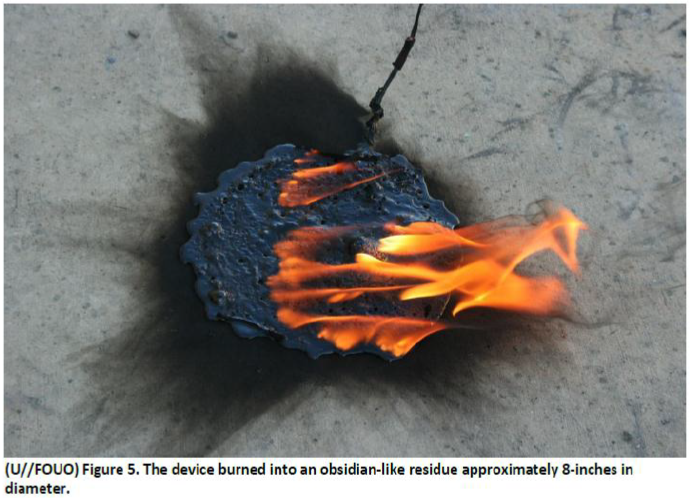
Using Cultural Intelligence Indicators

  • Marines noticed a change in daily traffic patterns at check points. Traffic patterns were an important indicator of cultural intelligence for this locality. (See CIIG, pp. 36–38)
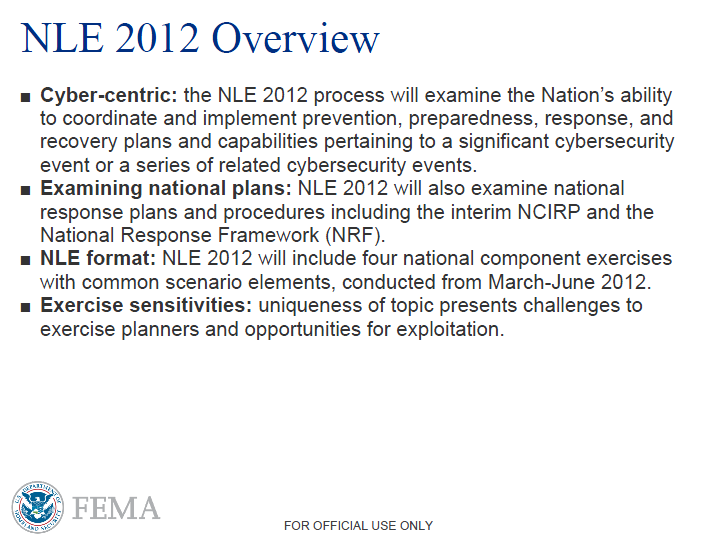
  • Marines went beyond directly observable indicators to find out why the traffic patterns changed. This led Marines to learn about dominant affiliations and backgrounds of the population in the AO. (See CIIG, p. 8)
  • Marines also found out about informal services and the wielding of power in that locality. (See CIIG, pp. 22–24, 60–62)
  • To learn more about interactions among tribes in the AO, Marines could also investigate which tribes did and did not take advantage of ‘taxi’ service.